
Japan, US Move Ahead in Co-Developing Hypersonic Weapons Interceptor as Regional Threats Grow
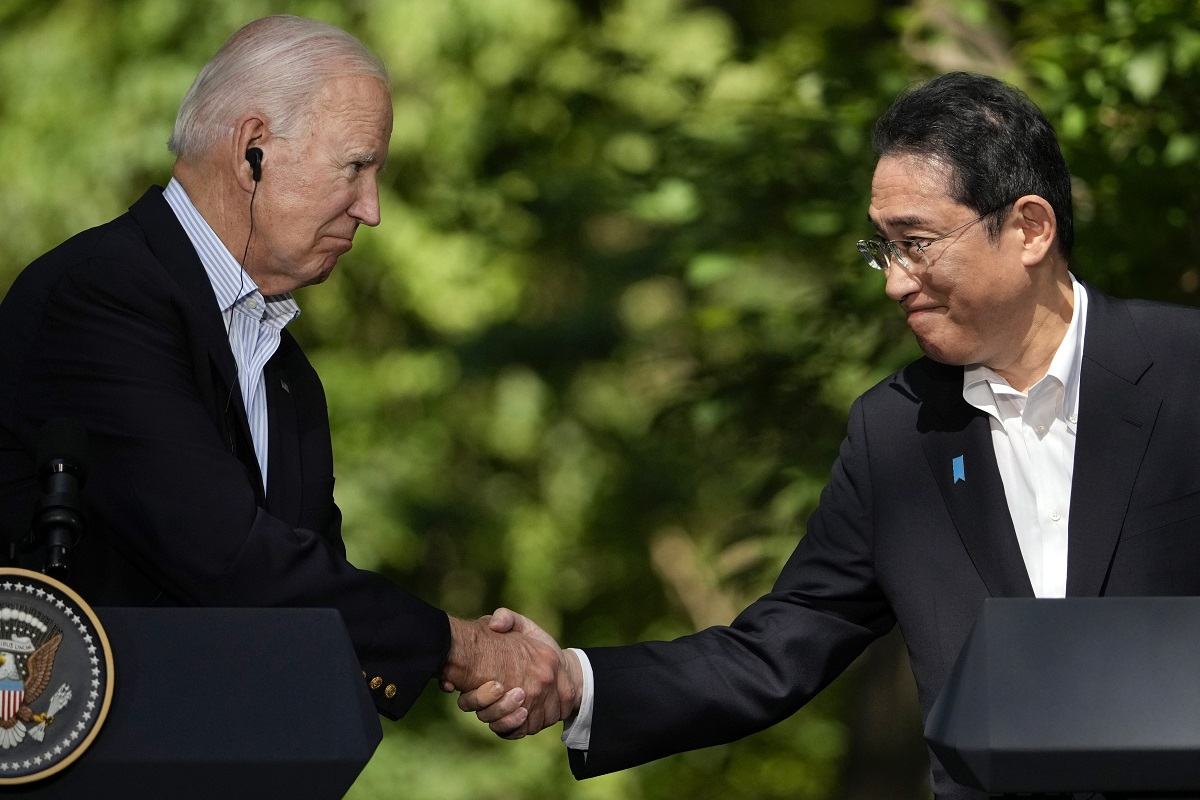
U.S. President Joe Biden, left, shakes hands with Japan’s Prime Minister Fumio Kishida during a joint news conference with South Korean President Yoon Suk Yeol, not visible, on Aug.
13:45 JST, May 16, 2024
TOKYO (AP) — Japan and the United States on Wednesday signed an arrangement to jointly develop a new type of missile defense system as the allies seek to defend against the growing threat of hypersonic weapons, which are possessed by China and Russia and being tested by North Korea.
The project was initially agreed between Japan’s Prime Minister Fumio Kishida and U.S. President Joe Biden at their summit last August and reaffirmed between the leaders during Kishida’s April visit to Washington. The Glide Sphere Interceptor is planned for deployment by the mid-2030s.
Wednesday’s agreement determines the allocation of responsibility and decision-making process, a first major step in the project, Japanese defense ministry officials said. They hope to decide on Japanese contractors and start the development process by March 2025.
Hypersonic weapons are designed to exceed Mach 5, or five times the speed of sound, posing a threat to regional missile-defense systems with their speed and maneuverability. Developing interceptors of them is a challenge.
Japan’s defense ministry called it a “pressing issue” and noted that hypersonic weapons in the region have dramatically improved in recent years.
Under the arrangement, Japan is responsible for developing a part at the interceptor’s tip that separates in space to destroy the incoming warhead, as well as its rocket motors, officials said.
Japan has earmarked 75.7 billion yen ($490 million) for initial development and testing of the interceptor, according to the defense ministry.
The cost includes making components for the two companies, Raytheon Technologies and Northrop Grumman, that are developing the weapon in a competition led by the U.S. Missile Defense Agency. One will be chosen for the project.
The MDA has estimated the cost to develop the hypersonic missile interceptor will exceed $3 billion, including Japan’s share of $1 billion.
The interceptors will be deployed on Aegis-class destroyers, like the ship-to-air Standard Missile-3 that Japan previously co-developed with the United States.
Japan has been accelerating its miliary buildup as it stresses the need to fortify its deterrence against growing threats. Japan has also significantly eased its weapons export policy to allow co-developed lethal weapons to third countries.






Most Read
Popular articles in the past 24 hours
-

Man Accused of Making Woman Drink 32 Shots of Tequila, Resulting ...
-

U.S. Launches Attacks on Iran: Avoid Escalation of Conflict by An...
-

Record Snowfall in Japan Causes Serious Agricultural Damage in To...
-
Japan Police Told to Boost Security, Vigilance Around U.S., Israe...
-

Japan Shares and Yen Fall, Jgbs Rise as Iran Strikes Continue
-
Japan Traditional Puppet Performance Held at Onsen Resort in Shiz...
-

U.S. Urges Citizens to Immediately Depart over A Dozen Middle Eas...
-

Mt. Fuji's Shizuoka-Side Subashiri Trail Mulls July 1 Opening to ...
Popular articles in the past week
-
Milano Cortina 2026: Japanese Gold Medalist Figure Skater Miura S...
-
Tokyo Spends Big on Children, Wins Over Parents
-
Japan’s Miura, Kihara Announce Withdrawal from Figure Skating Wor...
-

Exhibition Featuring Yoshiharu Tsuge’s Manga World Underway in Ch...
-
Yokohama to Test Out Renewable-Powered Offshore Floating Data Cen...
-

BOJ Keeping Eye on Economy and Takaichi's ‘Proactive Fiscal Polic...
-
20 Trapped in Tokyo Skytree Lift, Rescued 5½ Hours Later
-
Tokyo Measles Patient Traveled to Fukuoka Aboard JAL Planes; Susp...
Popular articles in the past month
-

Producer Behind Pop Group XG Arrested for Cocaine Possession
-

Japan PM Takaichi’s Cabinet Resigns en Masse
-

Man Infected with Measles Reportedly Dined at Restaurant in Tokyo...
-

Israeli Ambassador to Japan Speaks about Japan’s Role in the Reco...
-

Videos Plagiarized, Reposted with False Subtitles Claiming ‘Ryuky...
-

Man Infected with Measles May Have Come in Contact with Many Peop...
-

Prudential Life Insurance Plans to Fully Compensate for Damages C...
-

Woman with Measles Visited Hospital in Tokyo Multiple Times Befor...
Top Articles in News Services
-
Survey Shows False Election Info Perceived as True
-
Hong Kong Ex-Publisher Jimmy Lai’s Sentence Raises International Outcry as China Defends It
-
Japan’s Nikkei Stock Average Falls as US-Iran Tensions Unsettle Investors (UPDATE 1)
-
Japan’s Nikkei Stock Average Touches 58,000 as Yen, Jgbs Rally on Election Fallout (UPDATE 1)
-
Japan’s Nikkei Stock Average Rises on Tech Rally and Takaichi’s Spending Hopes (UPDATE 1)
JN ACCESS RANKING
-
Producer Behind Pop Group XG Arrested for Cocaine Possession
-
Japan PM Takaichi’s Cabinet Resigns en Masse
-
Man Infected with Measles Reportedly Dined at Restaurant in Tokyo Station
-
Israeli Ambassador to Japan Speaks about Japan’s Role in the Reconstruction of Gaza
-
Videos Plagiarized, Reposted with False Subtitles Claiming ‘Ryukyu Belongs to China’; Anti-China False Information Also Posted in Japan