

Divers install an artificial reef made of bamboo on the seafloor in waters off Shirahama, Wakayama Prefecture.
12:10 JST, June 4, 2022
SHIRAHAMA, Wakayama — Bamboo left uneaten by giant pandas is being used to create spawning reefs for squid in a bid to help counter declining catches in Wakayama Prefecture.
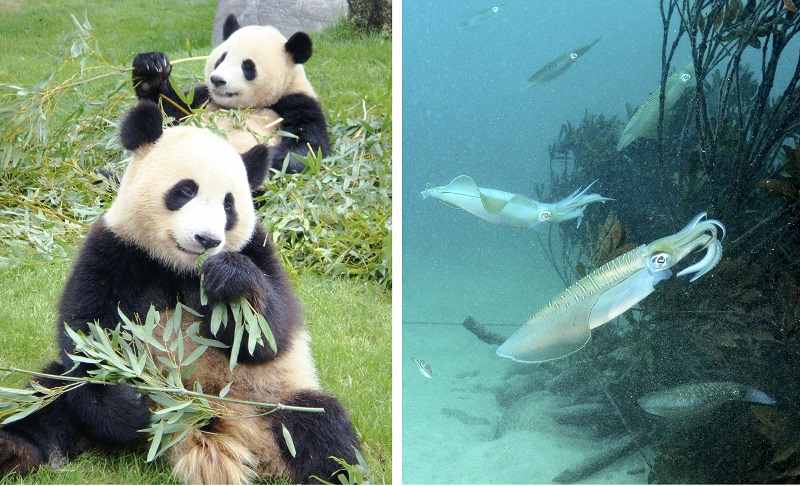
Pandas at the Adventure World theme park, left, and aoriika squid
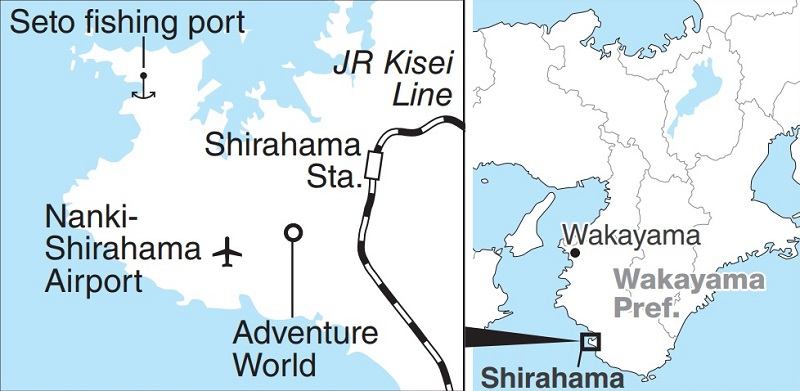
The bamboo is provided by a zoo in the Adventure World theme park in Shirahama, in the prefecture. On May 17, staff at the zoo used discarded bamboo to fashion 30 sections of artificial reef for aoriika squid, before installing their creations on the seafloor in waters off three fishing ports in Shirahama.
Bamboo is the staple food of pandas. The zoo, which has seven pandas, procures the evergreen plant from a bamboo grove in Kishiwada, Osaka Prefecture, where residents were concerned about damage to the environment due to overgrowth.
Pandas eat around 20 to 30 kilograms of bamboo each day. However, since they mainly prefer leaves, many parts of the plant go uneaten.
To avoid wasting the leftovers, staff at the zoo had previously used it to create lanterns and tumblers. While searching for other ways to recycle the leftover branches and leaves, they heard about dwindling squid catches due a recent change in direction of the Kuroshio current — which brings warm seawater to Japan’s southern coast — and hit upon the idea of making artificial reefs.
The reefs are created by inserting about 20 bamboo branches into holes in concrete blocks. They are then placed on the seafloor about 200 meters from the shore. Divers use sandbags to secure the roughly 50-kilogram reefs at a depth of about 7 meters.
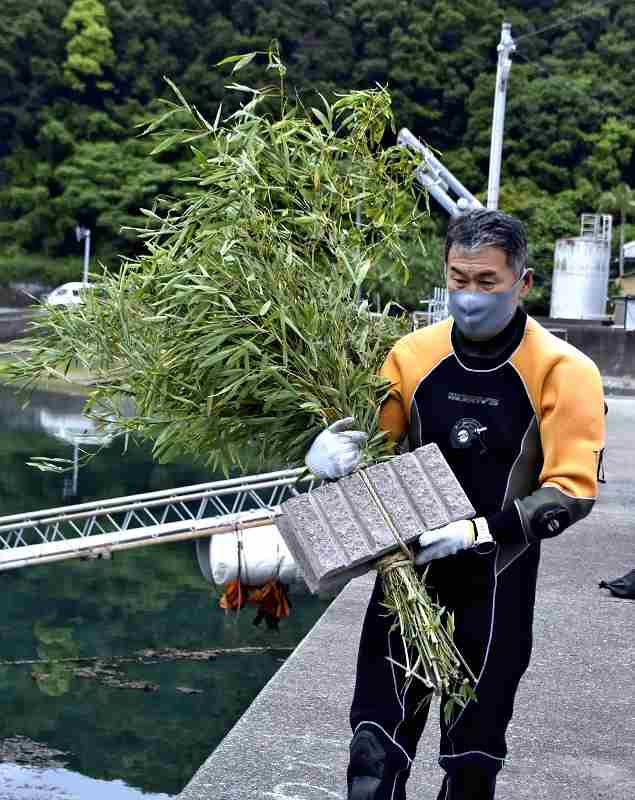
A man carries an artificial reef made from bamboo at the Seto fishing port in Shirahama, Wakayama Prefecture.
The reefs’ effectiveness will be periodically monitored until the end of the hatching season, then removed to maintain the marine environment.
“Squid were quick to lay eggs on a trial reef we set up,” said a zoo staffer. “I think they’ll do the same again. We hope the bamboo reefs will help restore the sea’s richness.”
The project will be rerun next year if squid numbers improve. The zoo now plans to build bamboo reefs for other marine species.


Related Tags






Most Read
Popular articles in the past 24 hours
-

Japan Figure Skating Legend Yuzuru Hanyu Is Proud Disaster Surviv...
-

Hawaii Museum on Tsunami Including Japan's 2011 Disaster at Risk ...
-

Japan Train Company to Increase Fares, Including in Tokyo Metropo...
-

Japan’s Mitsui O.S.K. Lines Container Ship Anchored in Persian Gu...
-

Struggling Onosato Pulls out of Spring Tourney
-

Japan’s Mitsui O.S.K. Lines Container Ship Anchored in Persian Gu...
-

Tail of ANA Plane Struck Runway During Landing in Houston; No Inj...
-

Iran Targets Busiest International Airport as Top UN Body Demands...
Popular articles in the past week
-
Japan Figure Skating Legend Yuzuru Hanyu Is Proud Disaster Surviv...
-

Ibaraki Pref.'s 1st Foreign Bus Driver Hired in Tsukuba
-

Nippon Life Insurance's U.S. Arm Sues OpenAI Over Legal Assistanc...
-

Govt to Utilize ODA for Ensuring Economic Security; Securing Ener...
-

Massive Sewer Pipe Found Jutting Out of Highway in Osaka
-

Amid Strait of Hormuz Blockade, Shipping Companies Scramble to Ge...
-

Beckoning Cats Get Makeover to Fit Modern Lifestyles with Sleek D...
-
Japan Govt Survey Finds Just 10% of Workers Want Working Hours to...
Popular articles in the past month
-

Producer Behind Pop Group XG Arrested for Cocaine Possession
-

Japan PM Takaichi’s Cabinet Resigns en Masse
-

Man Infected with Measles Reportedly Dined at Restaurant in Tokyo...
-

Videos Plagiarized, Reposted with False Subtitles Claiming ‘Ryuky...
-

iPS Treatments Pass Key Milestone, but Broader Applications Far f...
-

Sanae Takaichi Elected Prime Minister of Japan; Keeps All Cabinet...
-

Nepal Bus Crash Kills 19 People, Injures 25 Including One Japanes...
-

South Korea Tightens Rules on Foreigners Buying Homes in Seoul Me...
Top Articles in Features
-

Tokyo’s New Record-Breaking Fountain Named ‘Tokyo Aqua Symphony’
-

High-Hydration Bread on the Rise, Seeing Increase in Specialty Shops, Recipe Searches
-
Japanese Students Use Traditional Pickle to Create Novel Wagashi Confectionery
-
Heirs to Kyoto Talent: Craftsman Works to Keep Tradition of ‘Kinran’ Brocade Alive Through Initiatives, New Creations
-

My Spendthrift Mother Constantly Asks Me for Money
JN ACCESS RANKING
-
Producer Behind Pop Group XG Arrested for Cocaine Possession
-
Japan PM Takaichi’s Cabinet Resigns en Masse
-
Man Infected with Measles Reportedly Dined at Restaurant in Tokyo Station
-
Videos Plagiarized, Reposted with False Subtitles Claiming ‘Ryukyu Belongs to China’; Anti-China False Information Also Posted in Japan
-
iPS Treatments Pass Key Milestone, but Broader Applications Far from Guaranteed