
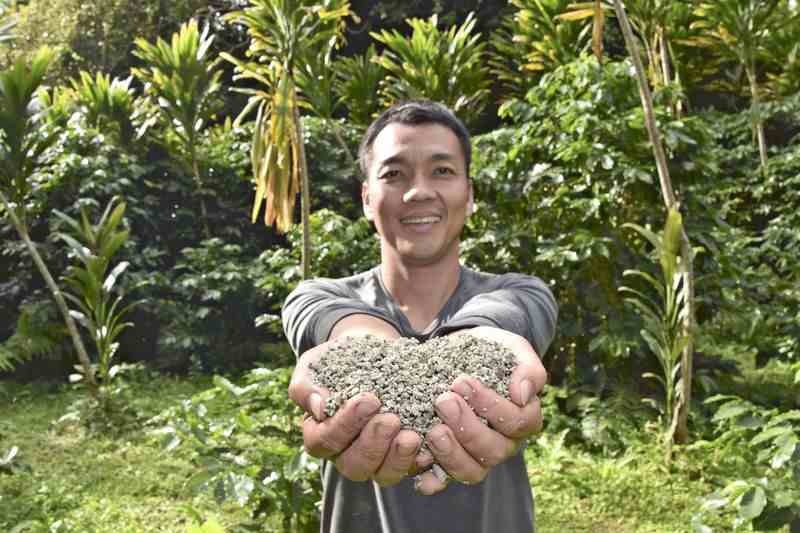
Hiroshi Miyade shows pumice he will mix with the soil for the coffee trees seen behind him.
18:50 JST, January 28, 2022
ISEN, Kagoshima — Pumice ejected from the undersea volcano Fukutoku-Okanoba near the Ogasawara Islands has been washing up on Okinawa Island and remote islands in Kagoshima Prefecture since late last year, greatly affecting the fishing and tourism industries.
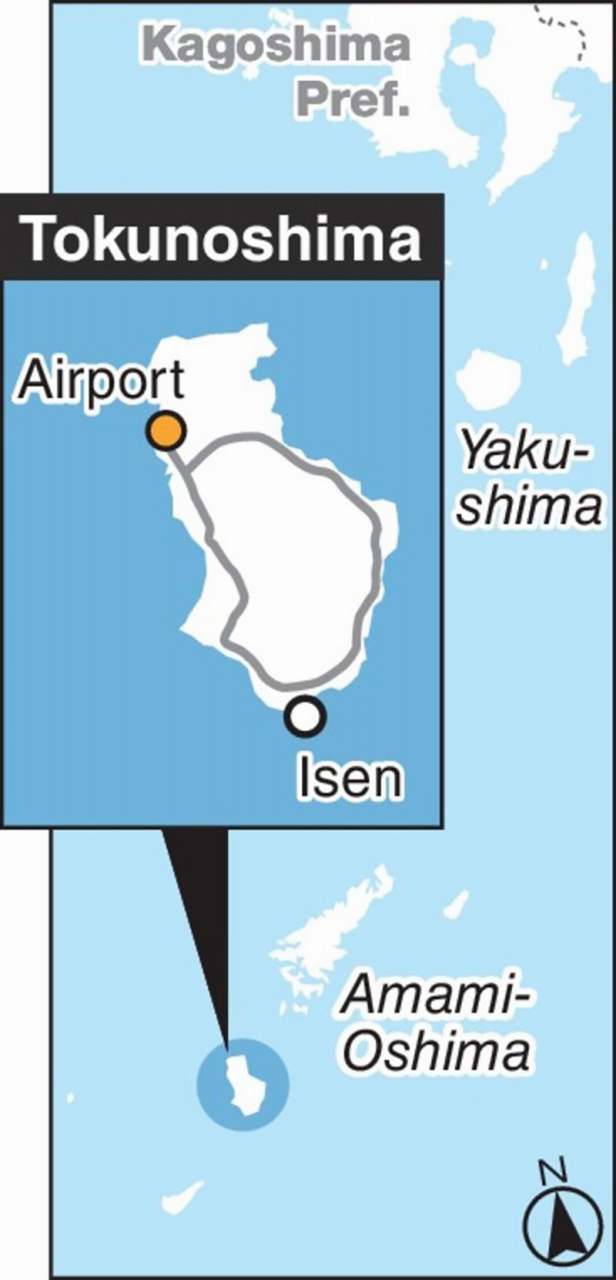
However, what is a nuisance to some looked like an opportunity for the owner of three coffee groves on Tokunoshima island in Kagoshima Prefecture.
“Pumice is the savior of coffee farms,” said Hiroshi Miyade, a 45-year-old representative of the company Tokunoshima Coffee Farmers.
Tokunoshima sees a lot of rainfall in February and March, when the coffee beans are harvested, and the quality of the beans tends to decline due to too much moisture in the soil. Most of the soil on the island is red clay soil, which makes it difficult for coffee trees to take root, and growth tends to be slow.
Coffee farmers there have been trying to improve the soil on their farms by mixing in volcanic-derived soil, such as Kanuma soil and Hyuga soil.
When Miyade heard that pumice had drifted ashore, he thought the pumice could make for a nice addition to the soil as it is also created by volcanoes. He has been working since October to improve drainage and the breathability of his farms’ soil by mixing in the pumice found along the shores.
He soaks the pumice in water for a certain period of time to remove salt, dries it in the sun, and then mixes it with the soil. Miyade has already used the pumice for 200 of the 2,000 coffee trees in his groves on the island.
Coffee bean production on Tokunoshima began 30 to 40 years ago, and there are currently about 30 coffee farmers, according to the local municipality of Isen.
Generally, it takes about 5 years — from sowing to harvesting — to produce coffee beans. It will be a few years, at least, to see if the quality of the beans has improved. However, whether the trees’ growth rates have improved should be known within a few months, Miyade said.
“I want to use it for the soil for 1,000 new trees that I plan to plant this spring,” Miyade added.


Related Tags





Most Read
Popular articles in the past 24 hours
-

Japan Figure Skating Legend Yuzuru Hanyu Is Proud Disaster Surviv...
-
Hawaii Museum on Tsunami Including Japan's 2011 Disaster at Risk ...
-

Japan Train Company to Increase Fares, Including in Tokyo Metropo...
-
Japan Holds Memorial Events to Mark 15th Anniversary of 2011 Eart...
-

Japan’s Mitsui O.S.K. Lines Container Ship Anchored in Persian Gu...
-

Struggling Onosato Pulls out of Spring Tourney
-

Japan’s Mitsui O.S.K. Lines Container Ship Anchored in Persian Gu...
-

Tail of ANA Plane Struck Runway During Landing in Houston; No Inj...
Popular articles in the past week
-
Japan Figure Skating Legend Yuzuru Hanyu Is Proud Disaster Surviv...
-

Ibaraki Pref.'s 1st Foreign Bus Driver Hired in Tsukuba
-

Nippon Life Insurance's U.S. Arm Sues OpenAI Over Legal Assistanc...
-
Govt to Utilize ODA for Ensuring Economic Security; Securing Ener...
-

Massive Sewer Pipe Found Jutting Out of Highway in Osaka
-

Amid Strait of Hormuz Blockade, Shipping Companies Scramble to Ge...
-

Beckoning Cats Get Makeover to Fit Modern Lifestyles with Sleek D...
-
Japan Govt Survey Finds Just 10% of Workers Want Working Hours to...
Popular articles in the past month
-

Producer Behind Pop Group XG Arrested for Cocaine Possession
-

Japan PM Takaichi’s Cabinet Resigns en Masse
-

Man Infected with Measles Reportedly Dined at Restaurant in Tokyo...
-

Videos Plagiarized, Reposted with False Subtitles Claiming ‘Ryuky...
-

iPS Treatments Pass Key Milestone, but Broader Applications Far f...
-

Sanae Takaichi Elected Prime Minister of Japan; Keeps All Cabinet...
-

Nepal Bus Crash Kills 19 People, Injures 25 Including One Japanes...
-

South Korea Tightens Rules on Foreigners Buying Homes in Seoul Me...
Top Articles in Features
-

Tokyo’s New Record-Breaking Fountain Named ‘Tokyo Aqua Symphony’
-

High-Hydration Bread on the Rise, Seeing Increase in Specialty Shops, Recipe Searches
-
Japanese Students Use Traditional Pickle to Create Novel Wagashi Confectionery
-
Heirs to Kyoto Talent: Craftsman Works to Keep Tradition of ‘Kinran’ Brocade Alive Through Initiatives, New Creations
-

My Spendthrift Mother Constantly Asks Me for Money
JN ACCESS RANKING
-
Producer Behind Pop Group XG Arrested for Cocaine Possession
-
Japan PM Takaichi’s Cabinet Resigns en Masse
-
Man Infected with Measles Reportedly Dined at Restaurant in Tokyo Station
-
Videos Plagiarized, Reposted with False Subtitles Claiming ‘Ryukyu Belongs to China’; Anti-China False Information Also Posted in Japan
-
iPS Treatments Pass Key Milestone, but Broader Applications Far from Guaranteed