
Japan’s Ties to Pacific Island Nations Have New Significance 80 Years after World War II, as U.S.-China Rivalry in Region Grows
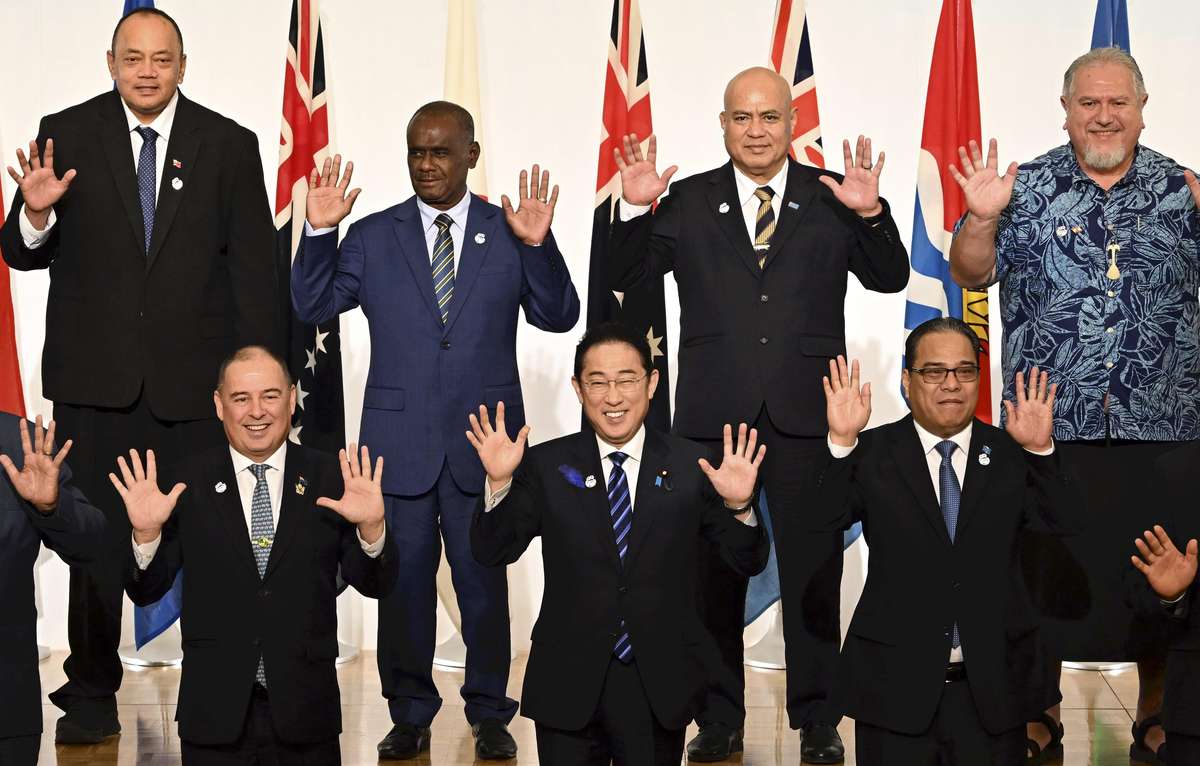
Then Japanese Prime Minister Fumio Kishida, front center, welcomes Pacific leaders in Tokyo at the 10th Pacific Islands Leaders Meeting (PALM10) in 2024.
8:00 JST, August 23, 2025
Eighty years ago, Japan lost its war against the United States. The battlefield was the vast Pacific Ocean and the islands dotted across it. Those islands, now independent nations as well as territories, have become the front line of U.S.-China rivalry. Japan, Taiwan and former European colonial powers are all entangled in this complex and rapidly evolving international political arena.
On Aug. 6, Prime Minister Jeremiah Manele of the Solomon Islands, who will chair the Pacific Islands Forum (PIF) summit in September, announced that he would not invite non-regional partners, such as the United States, Japan, China, Taiwan and European countries, to the summit.
The PIF was founded in 1971 and comprises 18 members: Australia, the Cook Islands, the Federated States of Micronesia, Fiji, French Polynesia, Kiribati, Nauru, New Caledonia, New Zealand, Niue, Palau, Papua New Guinea, the Republic of the Marshall Islands, Samoa, the Solomon Islands, Tonga, Tuvalu, and Vanuatu. The unusual decision to exclude other countries that have been invited in the past reflects the changing and complex international political situation.
The Solomon Islands, located in the South Pacific near Australia, includes Guadalcanal Island, where the Imperial Japanese military started to build an airfield during World War II to thwart cooperation between the United States and Australia. The island is symbolic as the site of the battle that turned the tide of the war, as the Japanese forces, which had been gaining the upper hand, were defeated by the U.S. military. Its location makes it a focus of geopolitical attention even today.
China is now attempting to bring these islands under its firm control. After gaining independence from the United Kingdom in 1978, the Solomon Islands in 1983 established diplomatic relations with Taiwan, which provided a great amount of support. However, in 2019, the Solomon Islands severed ties with Taiwan for reasons of “national interests,” and established diplomatic relations with China instead. Prime Minister Manele’s decision not to invite external partners was seen as a move to exclude Taiwan in line with China’s desire to restrict Taiwan’s diplomacy, but this might spark backlash from countries like Palau, which maintains diplomatic ties with Taiwan — so Manele apparently decided to also not invite other countries.
This decision shows that China is an increasingly salient factor in the Solomon Islands’ policymaking process. Of particular concern is China’s involvement in its security policy. In 2022, the Solomon Islands signed a security agreement with China, which allows Chinese naval vessels to refuel and Chinese police to operate in the Solomon Islands. Its neighboring country, Kiribati, also severed diplomatic ties with Taiwan in 2019 and established diplomatic relations with China. In 2024, Nauru followed.
Why is China moving eastward in the Pacific Ocean? It is to expand its sphere of influence and ultimately drive the United States out, even though Chinese President Xi Jinping told U.S. President Donald Trump in 2017 that “there is sufficient space in the Pacific for both China and the United States.”
China has famously established its own defense lines in the Pacific. These lines are the “first island chain,” stretching from the coast of Kyushu, Japan, to the Philippines; the “second island chain,” connecting the Ogasawara Islands of Japan to the U.S. territory of Guam; and the “third island chain,” which runs almost through the center of the Pacific Ocean, connecting the U.S. state of Hawaii to the U.S. territory of Samoa. China is strengthening its influence over Pacific islands by leveraging a combination of economic, police and military power to create a larger sphere of influence, aiming to “win without fighting” against the United States.
China is not only encroaching on independent nations but also on U.S. territories. The Northern Mariana Islands, a U.S. commonwealth, is currently the only U.S. territory that Chinese citizens can enter without a visa, and Chinese “illegal birth tourism,” an organized business to help pregnant Chinese women travel to the United States to deliver babies who automatically become American citizens, is also on the rise.
On July 23, Northern Mariana Islands Gov. Arnold Palacios, who had sought to confront China, suddenly passed away. This event drew attention to the islands’ relationship with China and how this U.S. front line is vulnerable to China’s ambitions.
But what can prevent China from exerting influence in this region? It is crucial to establish the autonomy and resilience of these countries and territories so that they are not overly reliant on foreign aid.
Australia, which is geographically close, plays a large role in supporting the region. However, Japan is a longtime contributor to this region as well. The Japanese government has been hosting the Pacific Islands Leaders Meeting (PALM) since 1997.
Riho Aizawa of the National Institute for Defense Studies in Tokyo explained, “Japan has been contributing to the enhancement of capabilities necessary to protect their own sovereignty and right to self-determination, so that they can decide their own future without becoming dependent on or coerced by any major power.”
Aizawa further distinguished Japan from China as follows: “For Japan, the measure of ‘success’ in engagement and relationship-building with the Pacific island countries is not how much influence it can exert over those countries, but whether it can support the preservation of sovereignty essential for sustainable peace, stability and prosperity, as well as the development of the capabilities to achieve that.”
Japan’s long-standing contributions are internationally recognized. Cleo Paskal, a non-resident senior fellow at the Washington-based think tank Foundation for Defense of Democracies and a leading expert on the Pacific islands, stated, “Japan’s aid projects tend to be practical, appropriately designed, and widely respected — and Japanese engagement is seen as less political and more culturally sensitive than, for example, Australian engagement.”
Japan’s sensitivity toward this region is, of course, due to the scars of war. Therefore, Japan has traditionally focused its support on areas such as climate change, education and health, while refraining from touching on security issues. However, in 2021, Japan established a defense dialogue with the region called the Japan Pacific Islands Defense Dialogue (JPIDD). This reflects Japan’s growing concerns about China.
It goes without saying that this region is important to the United States as a Pacific nation. In 2019, President Donald Trump hosted a historic meeting in the White House with the leaders of the Marshall Islands, Federated States of Micronesia and Palau. President Joe Biden followed by hosting the first U.S. Pacific Island Country Summit in 2022.
After the second Trump administration started in January this year, Defense Secretary Pete Hegseth visited the first, second and third island chains, but the administration has not shown a particular interest in the region beyond security issues.
Paskal remarked: “The Trump administration places a lot of emphasis on burden sharing. In some Pacific islands, Japan could benefit its own, as well as American, security by working with other partners such as Philippines and Taiwan.”
Eighty years after the tragic battles that claimed many lives, Japan, now a treaty ally of the United States, should engage more creatively and actively in this region.
Political Pulse appears every Saturday.

Yuko Mukai
Yuko Mukai is a Washington correspondent of The Yomiuri Shimbun.




Most Read
Popular articles in the past 24 hours
-

TEPCO's Rebuilding Still Far from Complete; Effects of 2011 Fukus...
-

78% Interested in Reconstruction from 2011 Disaster; Concern High...
-
2 Mt. Fuji Hikers Identified as Police Warn People Not to Climb i...
-

Japan’s Nikkei Stock Average Rise Lifted by AI Stocks, Easing Con...
-

Samurai Japan Routs Perky Czech Republic Team After Shuto, Muraka...
-

Italy Shocks U.S. in World Baseball Classic Pool Game
-

15 Years since Great East Japan Earthquake: How Can Affected Area...
-
Tokyo Conference 2026 Opens, Discusses Rebuilding Multilateralism...
Popular articles in the past week
-

Ibaraki Pref.'s 1st Foreign Bus Driver Hired in Tsukuba
-
Govt to Utilize ODA for Ensuring Economic Security; Securing Ener...
-

Nippon Life Insurance's U.S. Arm Sues OpenAI Over Legal Assistanc...
-
Amid Strait of Hormuz Blockade, Shipping Companies Scramble to Ge...
-
Japan Govt Survey Finds Just 10% of Workers Want Working Hours to...
-
Japan's 2nd Round of U.S. Investments May Be Worth Over $100 Bill...
-

Imperial Family Watches World Baseball Classic Game Against Austr...
-

Beckoning Cats Get Makeover to Fit Modern Lifestyles with Sleek D...
Popular articles in the past month
-

Producer Behind Pop Group XG Arrested for Cocaine Possession
-

Japan PM Takaichi’s Cabinet Resigns en Masse
-

Man Infected with Measles Reportedly Dined at Restaurant in Tokyo...
-

Videos Plagiarized, Reposted with False Subtitles Claiming ‘Ryuky...
-

iPS Treatments Pass Key Milestone, but Broader Applications Far f...
-

Sanae Takaichi Elected Prime Minister of Japan; Keeps All Cabinet...
-

Nepal Bus Crash Kills 19 People, Injures 25 Including One Japanes...
-

South Korea Tightens Rules on Foreigners Buying Homes in Seoul Me...
Top Articles in Editorial & Columns
-

Riku-Ryu Pair Wins Gold Medal: Their Strong Bond Leads to Major Comeback Victory
-
Reciprocal Tariffs Ruled Illegal: Judiciary Would Not Tolerate President’s High-Handed Approach
-
Flu Cases Surging Again: Infection Can Also Be Prevented by Humidifying Indoor Spaces
-
Japan’s Plan for Investment in U.S.: Aim for Mutual Development by Ensuring Profitability
-
Chronic Issues Erode Thailand’s Economy as Political Confusion Persists, Threatening Terminal Decline in Its Economy
JN ACCESS RANKING
-
Producer Behind Pop Group XG Arrested for Cocaine Possession
-
Japan PM Takaichi’s Cabinet Resigns en Masse
-
Man Infected with Measles Reportedly Dined at Restaurant in Tokyo Station
-
Videos Plagiarized, Reposted with False Subtitles Claiming ‘Ryukyu Belongs to China’; Anti-China False Information Also Posted in Japan
-
iPS Treatments Pass Key Milestone, but Broader Applications Far from Guaranteed