
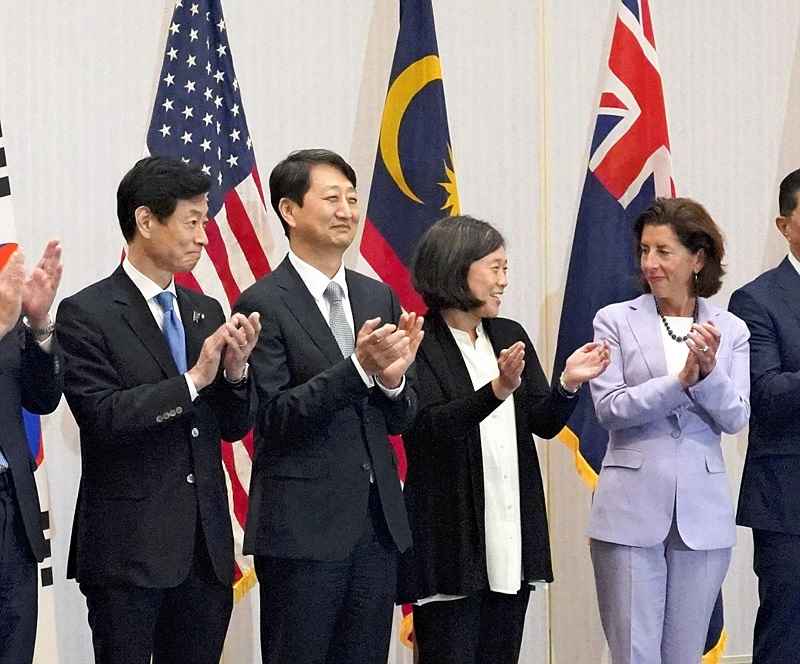
Economy, Trade and Industry Minister Yasutoshi Nishimura, left, joins a commemorative photo session in Los Angeles on Thursday.
17:04 JST, September 10, 2022
LOS ANGELES — Ministers from 14 countries agreed Friday to enter into formal negotiations on the Indo-Pacific Economic Framework (IPEF), a new economic zone initiative led by the United States, following two days of talks in Los Angeles.
With China’s growing influence in the Indo-Pacific region in mind, the IPEF member countries intend to strengthen cooperation under four key pillars: trade, supply chains, a clean economy and a fair economy.
Ministerial meetings for the initiative were held in a face-to-face format for the first time on Thursday and Friday, with a ministerial statement outlining future negotiation items for the four key pillars.
India decided not to participate in the trade pillar portion of the negotiations, but the 13 other countries will participate in negotiations for all of the key pillars.
U.S. Commerce Secretary Gina Raimondo said at a press conference that a series of meetings would be held for the initiative before the end of this year, and that the next ministerial meeting would probably take place in early 2023.
The statement produced by the ministers included specific details of what the countries should work on.
For the trade pillar, the statement said the countries will address the protection of laborers and the environment, the digitization of customs procedures and the advancement of trusted and secure cross-border data flows.
For the supply chains pillar, the statement calls for the member countries to collaborate to create a mechanism for information sharing and crisis response in order to mitigate and prevent future supply chain disruptions for critical commodities, such as semiconductors and pharmaceuticals.
For the clean energy pillar, the member countries agreed to promote infrastructure investment support for decarbonization and technological cooperation for developing countries. And for the fair economy pillar, they listed anti-corruption measures, such as for bribery, and curbing tax evasion.
“The IPEF embodies how we intend to move forward to bring equitable growth to our region,” U.S. Trade Representative Katherine Tai said.
Economy, Trade and Industry Minister Yasutoshi Nishimura, who represented Japan at the meeting, stated at the press conference: “The IPEF can serve as a model for new economic partnerships. Japan will actively contribute to the IPEF.”






Most Read
Popular articles in the past 24 hours
-
Business Hotels Expanding into Regional Areas in Japan, Aiming to...
-
6 Injured at Naked Festival in Japan’s Okayama Prefecture; Police...
-

Fiji Defense Minister Hopes Japan Will Support Stabilization of P...
-

Space One Delays Launch of No. 3 Kairos Rocket; Company to Announ...
-

Milano Cortina 2026: Malinin Highlights Dangers of Social Media i...
-

Reciprocal Tariffs Ruled Illegal: Judiciary Would Not Tolerate Pr...
-
3rd Japan Pacific Islands Defense Dialogue to Begin in Tokyo on S...
-

Japanese Film, Anymart, Wins Critics’ Award at International Film...
Popular articles in the past week
-

Japan PM Takaichi’s Cabinet Resigns en Masse
-

Man Infected with Measles Reportedly Dined at Restaurant in Tokyo...
-

Sanae Takaichi Elected Prime Minister of Japan; Keeps All Cabinet...
-

Japan's Govt to Submit Road Map for Growth Strategy in March, PM ...
-

Bus Carrying 40 Passengers Catches Fire on Chuo Expressway; All E...
-

Milano Cortina 2026: Figure Skaters Riku Miura, Ryuichi Kihara Pa...
-

Japan, U.S. Name 3 Inaugural Investment Projects; Reached Agreeme...
-
U.S. Firm to Build Training Hub in Fukushima N-plant for Debris R...
Popular articles in the past month
-
Japan PM Takaichi’s Cabinet Resigns en Masse
-

Japan Institute to Use Domestic Commercial Optical Lattice Clock ...
-

Israeli Ambassador to Japan Speaks about Japan’s Role in the Reco...
-
Man Infected with Measles Reportedly Dined at Restaurant in Tokyo...
-

Videos Plagiarized, Reposted with False Subtitles Claiming ‘Ryuky...
-

Man Infected with Measles May Have Come in Contact with Many Peop...
-

Prudential Life Insurance Plans to Fully Compensate for Damages C...
-

Woman with Measles Visited Hospital in Tokyo Multiple Times Befor...
Top Articles in Business
-
Prudential Life Insurance Plans to Fully Compensate for Damages Caused by Fraudulent Actions Without Waiting for Third-Party Committee Review
-
Narita Airport, Startup in Japan Demonstrate Machine to Compress Clothes for Tourists to Prevent People from Abandoning Suitcases
-
Japan, U.S. Name 3 Inaugural Investment Projects; Reached Agreement After Considerable Difficulty
-

Toyota Motor Group Firm to Sell Clean Energy Greenhouses for Strawberries
-

SoftBank Launches AI Service for Call Centers That Converts Harsh Customer Voices into Softer Voices
JN ACCESS RANKING
-
Japan PM Takaichi’s Cabinet Resigns en Masse
-
Japan Institute to Use Domestic Commercial Optical Lattice Clock to Set Japan Standard Time
-
Israeli Ambassador to Japan Speaks about Japan’s Role in the Reconstruction of Gaza
-
Man Infected with Measles Reportedly Dined at Restaurant in Tokyo Station
-
Videos Plagiarized, Reposted with False Subtitles Claiming ‘Ryukyu Belongs to China’; Anti-China False Information Also Posted in Japan