
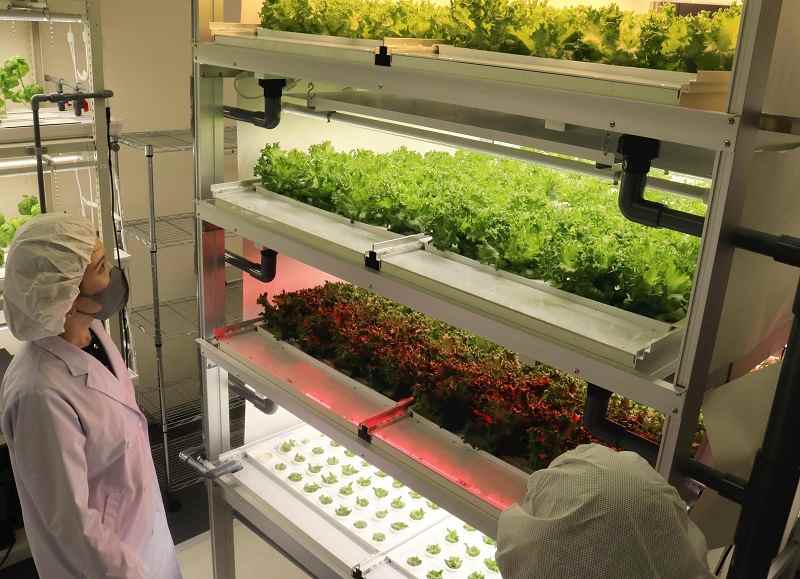
A worker checks lettuce being grown in an indoor farming facility run by Otsuka Tekko Co. in Ota Ward, Tokyo.
12:07 JST, May 2, 2022
With the automotive industry rapidly shifting toward electric vehicles, which require fewer parts than gasoline-powered automobiles, a Tokyo-based manufacturer of truck components has entered the field of urban farming.
Otsuka Tekko Co. in Ota Ward started producing vegetables indoors with artificial light in an effort to diversify its business, as the outlook for the manufacturing side of the firm is becoming increasingly uncertain.
The company has been growing lettuce and basil on multi-tiered shelves lit by LED lighting in an experimental cultivation space. By changing room temperature, humidity, and light intensity, the firm is trying to find the ideal method to cultivate the best-tasting vegetables.
“Vegetable cultivation has a lot in common with manufacturing,” said Otsuka Tekko President Akihiro Otsuka. Founded in 1939, the company manufactures iron parts and components used in trucks and construction machines.
Truck parts, mainly engine-related components such as transmissions, account for 70% of the company’s sales. But with major automakers ramping up production of EVs amid a push for decarbonization, the company is concerned that parts orders could eventually evaporate.
Otsuka, 39, began exploring opportunities in other industries about two years ago. “There’s no way of knowing when a major shift will occur in an industry. You could be wiped out suddenly if you just go with the flow.”
His concerns were heightened when the COVID-19 pandemic caused a decline in orders from major firms, and delivery suspensions bumped up the costs of raw materials and energy.
The company’s indoor cultivation space uses sensors to control nearly 20 parameters, including temperature, humidity, and nutrient concentration. The manufacturer also uses sensors to monitor the status of equipment in the main side of the business, and Otsuka thought such experience could be utilized in urban farming.
The company saw potential in indoor farming because it is not affected by weather conditions, and vegetables can be grown without pesticides. Being located in a major consumption area was also viewed as an advantage.
Last autumn, the company set up an experimental cultivation space, with technical guidance from Tamagawa University’s College of Agriculture in Machida, Tokyo. The firm has also secured a four-story building in Ota Ward that it plans to establish as the main site of its urban farming operations.
In March, Otsuka established the subsidiary Farm Haneda, which will operate the facility, with full-scale cultivation planned by around spring 2023. The company will open a retail space on the first floor of the building and hopes to establish sales links with supermarkets and other retailers in Tokyo.
“We’re hoping the urban farm becomes a pillar of the firm that can make up for possible declines in the manufacturing side of the business,” Otsuka said.






Most Read
Popular articles in the past 24 hours
-

National Intelligence Council: Proposed Body Must Be Utilized To ...
-
Japan's Defense Ministry: North Korea Appears to Have Fired Balli...
-

Aichi Fisheries Cooperatives Use Smart Tech to Farm Triploid Oyst...
-

CARTOON OF THE DAY (March 14)
-

Japan's Lower House Passes Budget Proposal; Could Be Delayed in U...
-

Fukuoka: American Beavers at Japan's Zoo Create Sculptures; Visit...
-
Hyogo: Family in Japan Produces Traditional Charcoal to Help Pres...
-

Election Fraud in Tokyo’s Ota Ward: Use Incident As Catalyst for ...
Popular articles in the past week
-

Japan Figure Skating Legend Yuzuru Hanyu Is Proud Disaster Surviv...
-
Govt to Utilize ODA for Ensuring Economic Security; Securing Ener...
-
15 Measles Patients Confirmed in Tokyo in Past 6 Days; 1 May Have...
-
Massive Sewer Pipe Found Jutting Out of Highway in Osaka
-

Japan Govt to Tighten Requirements to Receive Permanent Residency...
-
JR Tokai Breaks Ground on Yamanashi Maglev Station; Will Be Part ...
-
Power Outage Forces About 980 Passengers in Yokohama to Walk to T...
-

Beckoning Cats Get Makeover to Fit Modern Lifestyles with Sleek D...
Popular articles in the past month
-

Producer Behind Pop Group XG Arrested for Cocaine Possession
-

Japan PM Takaichi’s Cabinet Resigns en Masse
-

Man Infected with Measles Reportedly Dined at Restaurant in Tokyo...
-
Japan Figure Skating Legend Yuzuru Hanyu Is Proud Disaster Surviv...
-

iPS Treatments Pass Key Milestone, but Broader Applications Far f...
-

Sanae Takaichi Elected Prime Minister of Japan; Keeps All Cabinet...
-

South Korea Tightens Rules on Foreigners Buying Homes in Seoul Me...
-

Nepal Bus Crash Kills 19 People, Injures 25 Including One Japanes...
Top Articles in Business
-

Nippon Life Insurance’s U.S. Arm Sues OpenAI Over Legal Assistance Provided by ChatGPT
-

Japan, U.S. Name 3 Inaugural Investment Projects; Reached Agreement After Considerable Difficulty
-

Japan’s Major Real Estate Firms Expanding Overseas Businesses to Secure Future Growth, Focusing on Europe, U.S., Asia
-
JR Tokai Breaks Ground on Yamanashi Maglev Station; Will Be Part of Linear Chuo Shinkansen Line from Tokyo to Nagoya
-

Transport Companies See Opportunity in Narita Expansion; Airlines, Railways Prepare to Meet Expected Growth in Demand
JN ACCESS RANKING
-
Producer Behind Pop Group XG Arrested for Cocaine Possession
-
Japan PM Takaichi’s Cabinet Resigns en Masse
-
Man Infected with Measles Reportedly Dined at Restaurant in Tokyo Station
-
Japan Figure Skating Legend Yuzuru Hanyu Is Proud Disaster Survivor and Gold Medalist, Vows to Continue Support Efforts
-
iPS Treatments Pass Key Milestone, but Broader Applications Far from Guaranteed