
14:34 JST, February 16, 2021
There were no large tsunami as a result of the quake that struck off Fukushima Prefecture late Saturday night due to the quake’s relatively deep seismic center, a government panel has announced.
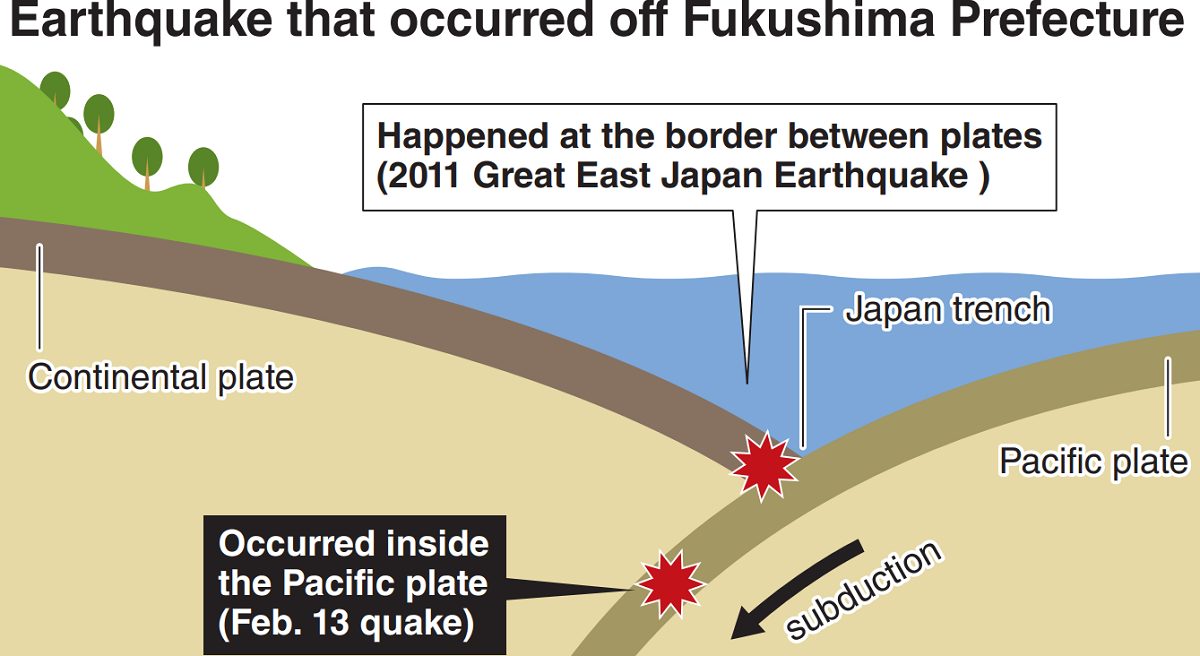
The Earthquake Research Committee said at an extraordinary meeting on Sunday that the quake occurred inside the Pacific plate, and its seismic center was estimated at a depth of about 55 kilometers. As a result, the seabed was not drastically deformed and no large tsunami occurred.
The quake recorded a maximum of upper 6 on the Japanese earthquake intensity scale of 7. According to the committee, it took place where an oceanic plate slipped under the continental plate.
The epicenter of the quake was located about 110 kilometers southwest of the epicenter of the Great East Japan Earthquake, within the aftershock area of the 2011 disaster.
The committee said a tsunami about 20 centimeters high was recorded at Ishinomaki Port in Miyagi Prefecture, and tsunami of 10 centimeters at Sendai Port, in Soma, Fukushima Prefecture, and elsewhere. There were 54 aftershocks after the Saturday quake, three of which measured at least 3 on the Japanese seismic scale, as of 10 a.m. Monday.
The Meteorological Agency has issued a warning of earthquakes with a maximum seismic intensity of upper 6 for about a week. Naoshi Hirata, a professor emeritus at the University of Tokyo and a member of the panel, said: “A large tsunami might have occurred if the quake was larger in scale with a slightly shallower epicenter. It was barely avoided.”
“Even a 30-centimeter inundation from a tsunami can sweep an adult off their feet. People living in coastal areas should take precautions against tsunami,” Hirata said.
Strong tremors were observed over a wide area in the latest quake. According to Tohoku University Prof. Ryota Hino, a seismology expert, earthquakes of this type are less likely to cause tsunami because of deep epicenters, but they tend to be felt over a wider area than earthquakes with shallow epicenters.
Hino said such quakes also tend to cause quick “rattling” tremors that people easily can feel.
“The seismic intensity of the latest earthquake was strong partly because the epicenter was close to land,” he said.







Most Read
Most read in the last 24 hours
-

Milano Cortina 2026: Miura, Kihara Among Participants at Tokyo Pa...
-
Japan to Release Additional Oil Reserves from May 1
-

Former Staff Members at Japan's Osaka-Kansai Expo Use Skills from...
-
Iwate Pref. Forest Fires Continue into 4th Day, with 30% of Town'...
-

Mazda to End Domestic Production of Mazda2 Compact Car
-
India’s Arms Indigenization Quest for Self-Reliance / Big Firms, ...
-

Japan Moves Closer to Blocking Illegal Online Casinos as Governme...
-
Profitability of Hokkaido Shinkansen Project Profitability
Most read in the last 7 days
-
Earthquake Hits Japan's Tohoku Region; 3-meter Tsunami Warning Is...
-

China, South Korea Object to Japanese PM Takaichi's Ritual Offeri...
-

Trump Extends the Ceasefire with Iran but Keeps the Blockade
-

India's Arms Indigenization Quest for Self-Reliance / New Delhi S...
-

¥1,000 Coins to Be Issued to Mark Anniversary of Beginning of Jap...
-

Most Serious Cyberattacks against the UK Now from Russia, Iran an...
-

Trump Opposes United–American Merger, Signals Support for Spirit
-
System Malfunction in Haneda Airport Causes 83 Flight Cancelation...
Most read in the last 30 days
-
Earthquake Hits Japan's Tohoku Region; 3-meter Tsunami Warning Is...
-
Police Find Child's Shoe During Search for Missing Boy in Nantan,...
-
Body Found in Nantan, Kyoto Prefecture, During Search for 11-Year...
-
Cherry Blossoms, Rapeseed Flowers Perform Colorful ‘Duet’ in Niig...
-
China, South Korea Object to Japanese PM Takaichi's Ritual Offeri...
-
Trump Extends the Ceasefire with Iran but Keeps the Blockade
-

Olympic Gold Medal-Winning Figure Skaters Riku-Ryu Announce Retir...
-

Japanese Prime Minister Takaichi Speaks to Pakistani Prime Minist...
Top Articles in Society
-
Earthquake Hits Japan’s Tohoku Region; 3-meter Tsunami Warning Issued (Update 1)
-
Police Find Child’s Shoe During Search for Missing Boy in Nantan, Kyoto Prefecture
-
Body Found in Nantan, Kyoto Prefecture, During Search for 11-Year-Old Boy in Area (Update 1)
-
Cherry Blossoms, Rapeseed Flowers Perform Colorful ‘Duet’ in Niigata
-
Japan to Ban Use of Portable Chargers on Airplanes from April 24, Number of Regular Chargers To Be Limited to 2
JN ACCESS RANKING
-
Earthquake Hits Japan’s Tohoku Region; 3-meter Tsunami Warning Issued (Update 1)
-
Police Find Child’s Shoe During Search for Missing Boy in Nantan, Kyoto Prefecture
-
Body Found in Nantan, Kyoto Prefecture, During Search for 11-Year-Old Boy in Area (Update 1)
-
Cherry Blossoms, Rapeseed Flowers Perform Colorful ‘Duet’ in Niigata
-
China, South Korea Object to Japanese PM Takaichi’s Ritual Offering to Yasukuni Shrine
Most read in the last 24 hours
-
Milano Cortina 2026: Miura, Kihara Among Participants at Tokyo Pa...
-
Japan to Release Additional Oil Reserves from May 1
-
Former Staff Members at Japan's Osaka-Kansai Expo Use Skills from...
-
Iwate Pref. Forest Fires Continue into 4th Day, with 30% of Town'...
-
Mazda to End Domestic Production of Mazda2 Compact Car
Most read in the last 7 days
-
Earthquake Hits Japan's Tohoku Region; 3-meter Tsunami Warning Is...
-
China, South Korea Object to Japanese PM Takaichi's Ritual Offeri...
-
Trump Extends the Ceasefire with Iran but Keeps the Blockade
-
India's Arms Indigenization Quest for Self-Reliance / New Delhi S...
-
¥1,000 Coins to Be Issued to Mark Anniversary of Beginning of Jap...
Most read in the last 30 days
-
Earthquake Hits Japan's Tohoku Region; 3-meter Tsunami Warning Is...
-
Police Find Child's Shoe During Search for Missing Boy in Nantan,...
-
Body Found in Nantan, Kyoto Prefecture, During Search for 11-Year...
-
Cherry Blossoms, Rapeseed Flowers Perform Colorful ‘Duet’ in Niig...
-
China, South Korea Object to Japanese PM Takaichi's Ritual Offeri...