
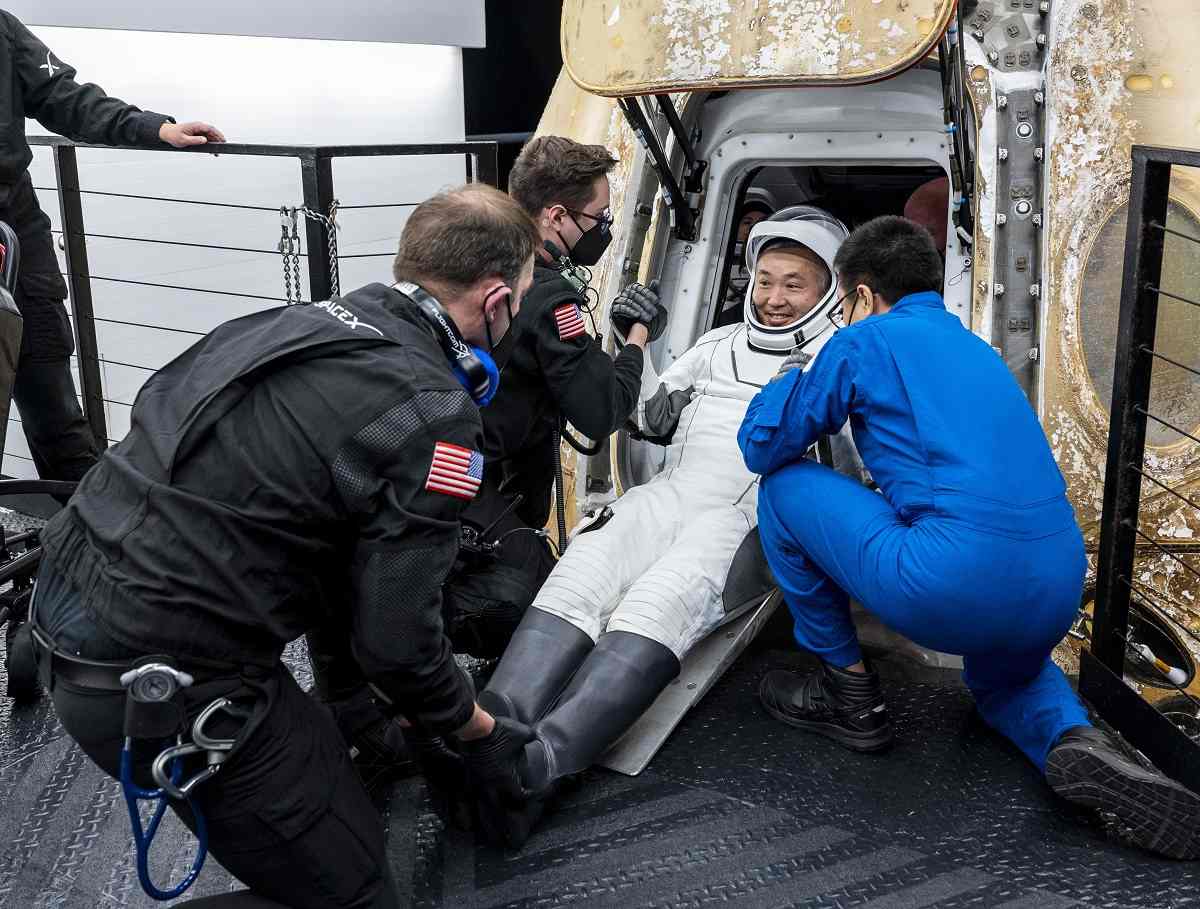
Japan Aerospace Exploration Agency (JAXA) astronaut Koichi Wakata is helped out of the SpaceX Dragon Endurance spacecraft onboard a recovery ship shortly after he, along with NASA astronaut Nicole Mann, Josh Cassada, and Roscosmos cosmonaut Anna Kikina, landed in the Gulf of Mexico off the coast of Tampa, Fla., Saturday, March 11, 2023, following a five-month mission on the International Space Station.
15:11 JST, March 12, 2023
Tokyo, March 12 (Jiji Press)—Japanese astronaut Koichi Wakata safely returned to Earth on Sunday Japan time after a five-month mission aboard the International Space Station.
The Crew Dragon capsule carrying Wakata and three other astronauts landed in waters off the U.S, state of Florida around 11 a.m. Japan time (2 a.m. GMT).
The capsule was pulled up by a ship, and the hatch was opened around 11:40 a.m. Wakata was the third to get off, smiling and looking healthy.
Wakata, 59, does not seem to have any particular health problems, according to the Japan Aerospace Exploration Agency, or JAXA.
Crew Dragon, developed by Space Exploration Technologies Corp., or SpaceX, was separated from the ISS at 4:20 p.m. Saturday.
After the final injection to leave the orbit around 10:10 a.m. Sunday, the capsule re-entered the atmosphere, opened the parachute and splashed down onto the sea.
Wakata, who traveled to space for the fifth time, arrived at the ISS in October last year. The latest mission has boosted the total number of days he spent in space to 504 days, the longest for a Japanese astronaut.
During his stay in the ISS, he carried out a number of experiments mainly in the Japanese experiment module Kibo.
He also engaged in activities considered useful for the international lunar exploration project Artemis, in which Japan is set to participate. These include the collection of basic technical data for a manned lunar vehicle under development and a demonstration test of a next-generation water recovery system.
In January and February, he conducted extravehicular activities, including the installation of a mounting platform for a new solar cell of the ISS. The first round marked his debut in extravehicular activities.
Wakata had boarded a U.S. space shuttle and a Russian Soyuz spacecraft before his flights aboard Crew Dragon. He has made round trips to space using all three types, just as his predecessors Soichi Noguchi, 57, and Akihiko Hoshide, 54, did.






Most Read
Popular articles in the past 24 hours
-

Japan's Snow-Clad Beauty: Camellia Flowers Seen in Winter Bloom a...
-

Monkey Strikes Junior High School Girl from Behind in Japan's Yam...
-

Foreign and Security Policy: Political Parties Must Discuss How T...
-
Genichiro Inokuma's Mural in Ueno Station That Gave Hope in Postw...
-

Senior Japanese Citizens Return to University to Gain Knowledge, ...
-
Heavy Snow Linked to 30 Deaths across Japan since Late Jan.; JMA ...
-

Tokyo Police Arrest Head of Resignation Assistance Firm
-

Japan’s Nikkei Stock Average Jumps near 4%, Closes at Record High...
Popular articles in the past week
-

Japan Institute to Use Domestic Commercial Optical Lattice Clock ...
-
Australian Woman Dies After Mishap on Ski Lift in Nagano Prefectu...
-
Foreign Snowboarder in Serious Condition After Hanging in Midair ...
-

Chinese Embassy in Japan Reiterates Call for Chinese People to Re...
-
Narita Airport, Startup in Japan Demonstrate Machine to Compress ...
-

Toyota Motor Group Firm to Sell Clean Energy Greenhouses for Stra...
-

Sakie Yokota, Last Surviving Parent of a North Korea Abductee, Ur...
-

Beer Yeast Helps Save Labor, Water Use in Growing Rice; Govt Hope...
Popular articles in the past month
-
Univ. in Japan, Tokyo-Based Startup to Develop Satellite for Disa...
-
JAL, ANA Cancel Flights During 3-day Holiday Weekend due to Blizz...
-
China Confirmed to Be Operating Drilling Vessel Near Japan-China ...
-

China Eyes Rare Earth Foothold in Malaysia to Maintain Dominance,...
-
Japan Institute to Use Domestic Commercial Optical Lattice Clock ...
-
M6.2 Earthquake Hits Japan's Tottori, Shimane Prefectures; No Tsu...
-
Japan, Qatar Ministers Agree on Need for Stable Energy Supplies; ...
-

Japan, Italy to Boost LNG Cooperation; Aimed at Diversifying Japa...
Top Articles in Society
-
JAL, ANA Cancel Flights During 3-day Holiday Weekend due to Blizzard
-
Record-Breaking Snow Cripples Public Transport in Hokkaido; 7,000 People Stay Overnight at New Chitose Airport
-
Australian Woman Dies After Mishap on Ski Lift in Nagano Prefecture
-
Foreign Snowboarder in Serious Condition After Hanging in Midair from Chairlift in Nagano Prefecture
-
Train Services in Tokyo Resume Following Power Outage That Suspended Yamanote, Keihin-Tohoku Lines (Update 4)
JN ACCESS RANKING
-
Univ. in Japan, Tokyo-Based Startup to Develop Satellite for Disaster Prevention Measures, Bears
-
JAL, ANA Cancel Flights During 3-day Holiday Weekend due to Blizzard
-
China Confirmed to Be Operating Drilling Vessel Near Japan-China Median Line
-
China Eyes Rare Earth Foothold in Malaysia to Maintain Dominance, Counter Japan, U.S.
-
Japan Institute to Use Domestic Commercial Optical Lattice Clock to Set Japan Standard Time