
3 years after start of Henoko reclamation work, 30% of coastal area converted into land
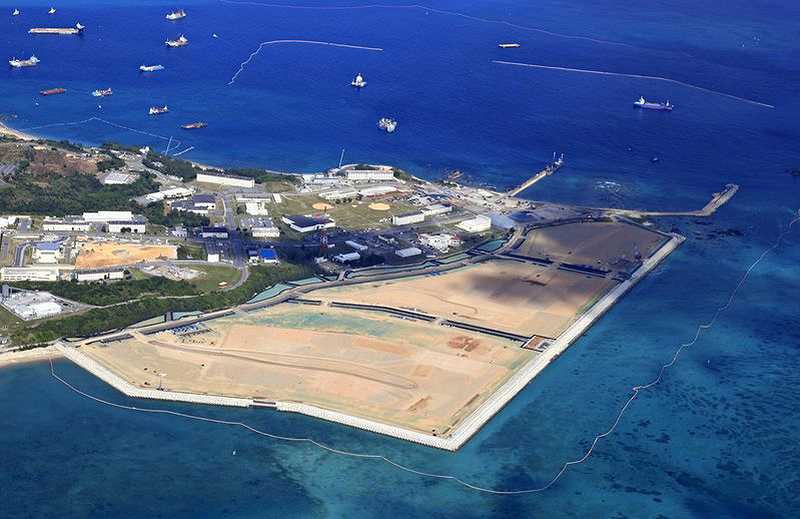
The Henoko district of Nago, Okinawa Prefecture, is seen on Dec. 10.
December 14, 2021
Three years have passed since the Defense Ministry started landfill work in the coastal area of the Henoko district of Nago, Okinawa Prefecture, for the planned relocation of the U.S. Marine Corps’ Futenma Air Station in the city of Ginowan.
About 30% of the planned area has been reclaimed so far, but the Okinawa prefectural government’s opposition to work to reinforce the soft seabed has cast uncertainty over the relocation plan.
On Monday, a boat was docked at a new seawall on the northern side of the Henoko coastal area. An excavator scooped earth and sand from the ship to fill trucks that carried their loads to the reclamation area.
Construction of the 250-meter-long seawall began in August after all coral in the area had been moved. The construction was completed at the end of November, and since early December, the seawall has been used as one of three locations where earth and sand are unloaded.
“We’ll do everything we can to accelerate the reclamation work,” a senior defense ministry official said.
Since the start of land reclamation work in December 2018, 41 hectares of the planned 152-hectare area has been converted into land.
The reclaimed land reached a height of 4 meters above sea level in August this year, and work to raise it further is underway. The soil will eventually be raised to a height of about 10 meters at its highest point.
Chief Cabinet Secretary Hirokazu Matsuno told reporters on Monday, “Steady progress in the construction is what we need to complete the return of [the land hosting] the Futenma Air Station as soon as possible to eliminate dangers” posed by keeping the base in its existing location.
The government had planned to spend about four years reinforcing about 66 hectares of soft seabed, but in November the Okinawa prefectural government rejected the government’s request for design changes to its plan.
Earlier this month, the defense ministry filed an appeal with the Land, Infrastructure, Transport and Tourism Minister over the prefecture’s decision.
The moves are likely to lead to a new legal battle between the prefecture and the central government, which is considering issuing recommendations or instructions to the Okinawa government to get the plan approved.
In 2022, three elections will be held in Okinawa Prefecture that are likely to have an impact on the planned relocation: mayoral elections in Nago in January and Ginowan in autumn, and the Okinawa gubernatorial election, which is also slated for autumn.
The central government assumes work to reinforce the soft seabed will not start unless it wins its appeal, or a governor is elected who approves of the relocation plan.
Even if the central government wins the appeal, the targeted 2030 completion of the air station could be further delayed.




Most Read
Popular articles in the past 24 hours
-
Japanese High School Student Aims to Share Kaiten History Through...
-
PM Takaichi Spells out Plans to Advance Bold Policy Shifts in Spe...
-

Chronic Issues Erode Thailand’s Economy as Political Confusion Pe...
-

Japanese Version of Shohei Ohtani's Picture Book Published
-
Tottori: 95-Year-Old Japanese Descendent from Philippines Visits ...
-

Japan to Monitor Trump Administration's Response to U.S. Supreme ...
-

Milano Cortina 2026: Speed Skater Takagi Finishes 6th in the 1,50...
-

Osaka: 40 Ninjas Display Shuriken Throwing Skills at Japan Champi...
Popular articles in the past week
-

Japan PM Takaichi’s Cabinet Resigns en Masse
-

Man Infected with Measles Reportedly Dined at Restaurant in Tokyo...
-

Sanae Takaichi Elected Prime Minister of Japan; Keeps All Cabinet...
-

Japan's Govt to Submit Road Map for Growth Strategy in March, PM ...
-

Bus Carrying 40 Passengers Catches Fire on Chuo Expressway; All E...
-

Milano Cortina 2026: Figure Skaters Riku Miura, Ryuichi Kihara Pa...
-

Japan, U.S. Name 3 Inaugural Investment Projects; Reached Agreeme...
-
U.S. Firm to Build Training Hub in Fukushima N-plant for Debris R...
Popular articles in the past month
-
Japan PM Takaichi’s Cabinet Resigns en Masse
-

Japan Institute to Use Domestic Commercial Optical Lattice Clock ...
-

Israeli Ambassador to Japan Speaks about Japan’s Role in the Reco...
-
Man Infected with Measles Reportedly Dined at Restaurant in Tokyo...
-

Videos Plagiarized, Reposted with False Subtitles Claiming ‘Ryuky...
-

Man Infected with Measles May Have Come in Contact with Many Peop...
-

Prudential Life Insurance Plans to Fully Compensate for Damages C...
-

Woman with Measles Visited Hospital in Tokyo Multiple Times Befor...
Top Articles in Politics
-
Japan PM Takaichi’s Cabinet Resigns en Masse
-
Sanae Takaichi Elected Prime Minister of Japan; Keeps All Cabinet Appointees from Previous Term
-
Japan’s Govt to Submit Road Map for Growth Strategy in March, PM Takaichi to Announce in Upcoming Policy Speech
-

LDP Wins Historic Landslide Victory
-

LDP Wins Landslide Victory, Secures Single-party Majority; Ruling Coalition with JIP Poised to Secure Over 300 seats (UPDATE 1)
JN ACCESS RANKING
-
Japan PM Takaichi’s Cabinet Resigns en Masse
-
Japan Institute to Use Domestic Commercial Optical Lattice Clock to Set Japan Standard Time
-
Israeli Ambassador to Japan Speaks about Japan’s Role in the Reconstruction of Gaza
-
Man Infected with Measles Reportedly Dined at Restaurant in Tokyo Station
-
Videos Plagiarized, Reposted with False Subtitles Claiming ‘Ryukyu Belongs to China’; Anti-China False Information Also Posted in Japan