
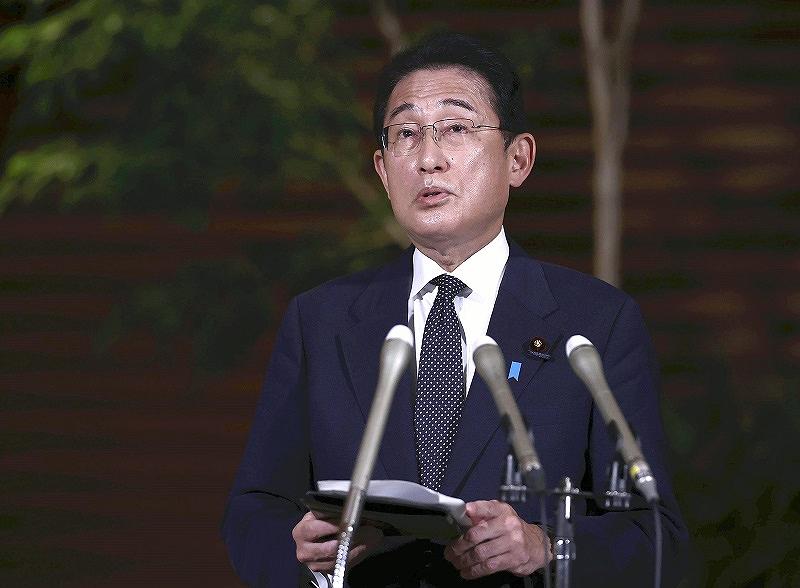
Prime Minister Fumio Kishida speaks to reporters on Friday following the resignation of Yasuhiro Hanashi as justice minister.
17:44 JST, November 12, 2022
Even within his own party, faith in Prime Minister Fumio Kishida’s leadership has been shaken following Friday’s replacement of a Cabinet minister over a gaffe on the death penalty, because Kishida initially failed to take such action even the day after the remarks.
Kishida replaced Yasuhiro Hanashi as justice minister for his controversial remarks appearing to make light of his duties related to executions of death-row inmates, in an effort to minimize the issue’s negative impact on Diet deliberations as much as possible, among other reasons.
“I took very seriously the impact of Minister Hanashi’s remarks and made the decision to accept his resignation,” Kishida said on Friday evening at the Prime Minister’s Office.
Hanashi, who served as a National Police Agency official before becoming a House of Representatives member in 2003, belongs to Kishida’s own faction of the Liberal Democratic Party. He took up his first Cabinet post when the prime minister reshuffled his Cabinet in August.
“It’s an unspectacular job that only makes the top news at noon if I stamp a seal on a document for the death penalty in the morning,” Hanashi said of his duties as justice minister, while attending on Wednesday a party hosted by an LDP member who also belongs to Kishida’s faction.
When Kishida heard reports on these remarks later that day, he reportedly found them concerning, saying the comments were “awful.” However, the prime minister was unable to make up his mind over whether to allow Hanashi to retain his post or replace him.
The following morning, Kishida tried to get past the issue by asserting that Hanashi would sincerely apologize and give thorough explanations, while also having Chief Cabinet Secretary Hirokazu Matsuno give a stern warning to the justice minister.
However, Hanashi’s remarks were publicly criticized for lacking the seriousness demanded of a justice minister by such figures as Toshiaki Endo, chairperson of the LDP’s General Council; and Land, Infrastructure, Transport and Tourism Minister Tetsuo Saito, who is a member of Komeito, the LDP’s junior partner. Diet members from opposition parties also demanded Hanashi’s resignation.
These backlashes prompted government officials to propose to Kishida that the justice minister be replaced.
Later on Thursday, Kishida delayed the start of a meeting of the council to realize a new form of capitalism — his signature policy — by 45 minutes to discuss the issue with his aides at the Prime Minister’s Office. The aides included Seiji Kihara and Yoshihiko Isozaki, two of his deputy chief cabinet secretaries.
Various options were discussed at that time, such as having Hanashi resign on Friday or on Nov. 21, two days after Kishida’s scheduled return from his trip to Southeast Asian nations. However, the prime minister eventually said, “[Hanashi] should fulfill his accountability to the public and the Diet,” which meant it was decided that Hanashi would not be replaced for the time being.
Not the first time
Kishida had been scheduled to leave for Cambodia at 3 p.m. on Friday. No changes had been made to the schedule as of Friday morning.
At a morning press conference, however, Hanashi admitted that he had made similar remarks in the past at other parties and gatherings in Ibaraki Prefecture, from which he was elected. This admission again heightened a sense of crisis within the government, with a fellow Cabinet member saying, “If new problems keep cropping up later, we won’t be able to protect him anymore.”
A plenary session of the House of Councillors was held just after the press conference, with deliberations starting over a bill to revise the Infectious Diseases Control Law, which has been a priority of Kishida’s administration.
“I’ll give my all to my duties [as justice minister],” Hanashi said during the session, to which opposition party members jeered, demanding his resignation.
Kishida became convinced that explanations by Hanashi would make it difficult for his Cabinet to handle the Diet session. His departure time for Cambodia was delayed to begin preparations for completing the process to appoint Hanashi’s successor by the end of Friday.
Even so, Kishida sought advice from several senior LDP officials on how to deal with the situation, and did not make the final decision to replace Hanashi until late in the morning. Hanashi, who himself had been discussing with the prime minister since Thursday evening whether he should quit, accepted the decision.
Kishida was also criticized for his slow response in regard to multiple revelations about former economic revitalization minister Daishiro Yamagiwa’s relationship with the Unification Church (officially known as the Family Federation for World Peace and Unification) before Yamagiwa resigned last month.
Kishida’s stance over Hanashi’s resignation has also been criticized even by some LDP members, who said that the prime minister has only cemented his image as an “indecisive politician incapable of making decisions.”
“The biggest problem was that [Kishida] changed his response so much over whether he would make [Hanashi] quit or not,” said one of the LDP’s top four executives.





Most Read
Popular articles in the past 24 hours
-

My Spendthrift Mother Constantly Asks Me for Money
-

Japanese Students Use Traditional Pickle to Create Novel Wagashi ...
-

‘Dry Bonsai’ Gives New Life to Withered Trees, Allows Free Artist...
-

A Packed Bus Plunges off a Nepal Highway, Killing 19 and Injuring...
-

Astellas Collaborates with Vir to Develop Its Experimental Prosta...
-

Nepal Bus Crash Kills 19 People, Injures 25 Including One Japanes...
-

Japan’s Nikkei Stock Average Rises as AI-Related Stocks Shine; Co...
-

Early-Blooming Kawazu Cherry Blossoms Create Sea of Pink at Park ...
Popular articles in the past week
-

Producer Behind Pop Group XG Arrested for Cocaine Possession
-

Japan PM Takaichi’s Cabinet Resigns en Masse
-

Sanae Takaichi Elected Prime Minister of Japan; Keeps All Cabinet...
-

Japan's Govt to Submit Road Map for Growth Strategy in March, PM ...
-

Bus Carrying 40 Passengers Catches Fire on Chuo Expressway; All E...
-
U.S. Firm to Build Training Hub in Fukushima N-plant for Debris R...
-

Japan, U.S. Name 3 Inaugural Investment Projects; Reached Agreeme...
-

Riku-Ryu Pair Wins Gold Medal: Their Strong Bond Leads to Major C...
Popular articles in the past month
-
Producer Behind Pop Group XG Arrested for Cocaine Possession
-
Japan PM Takaichi’s Cabinet Resigns en Masse
-

Japan Institute to Use Domestic Commercial Optical Lattice Clock ...
-

Man Infected with Measles Reportedly Dined at Restaurant in Tokyo...
-

Israeli Ambassador to Japan Speaks about Japan’s Role in the Reco...
-

Videos Plagiarized, Reposted with False Subtitles Claiming ‘Ryuky...
-

Man Infected with Measles May Have Come in Contact with Many Peop...
-

Prudential Life Insurance Plans to Fully Compensate for Damages C...
Top Articles in Politics
-
Japan PM Takaichi’s Cabinet Resigns en Masse
-
Sanae Takaichi Elected Prime Minister of Japan; Keeps All Cabinet Appointees from Previous Term
-
Japan’s Govt to Submit Road Map for Growth Strategy in March, PM Takaichi to Announce in Upcoming Policy Speech
-

LDP Wins Historic Landslide Victory
-

LDP Wins Landslide Victory, Secures Single-party Majority; Ruling Coalition with JIP Poised to Secure Over 300 seats (UPDATE 1)
JN ACCESS RANKING
-
Producer Behind Pop Group XG Arrested for Cocaine Possession
-
Japan PM Takaichi’s Cabinet Resigns en Masse
-
Japan Institute to Use Domestic Commercial Optical Lattice Clock to Set Japan Standard Time
-
Man Infected with Measles Reportedly Dined at Restaurant in Tokyo Station
-
Israeli Ambassador to Japan Speaks about Japan’s Role in the Reconstruction of Gaza