
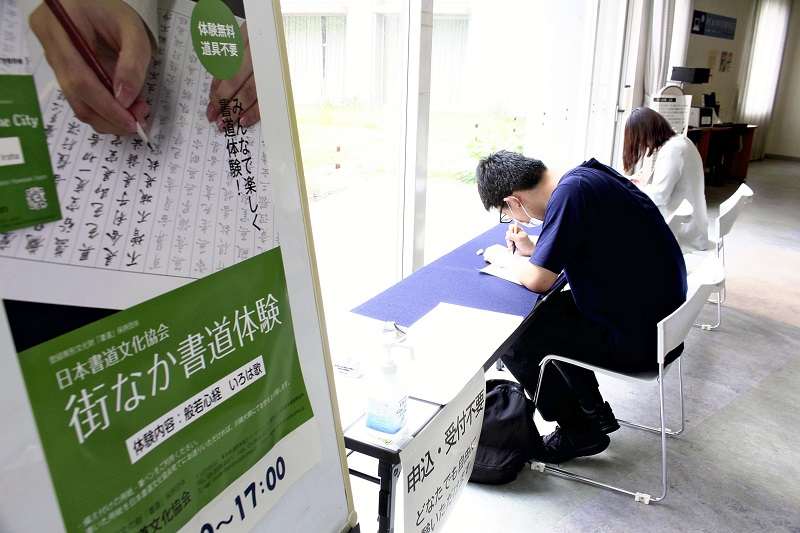
Participants in a calligraphy training course trace texts at the National Olympics Memorial Youth Center in Shibuya Ward, Tokyo.
11:03 JST, September 8, 2022
Annual summer exhibitions of Japanese calligraphy usually hold commentary sessions and exhibits open to the public nationwide, but this year has seen another wave of cancellations of events due to the coronavirus pandemic. However, new attempts are being made to promote the traditional art form.
Shodo, or calligraphy, was designated as an Intangible Cultural Property by the government in December.
The Japan Shodo Culture Association, an entity dedicated to preserving the art of calligraphy, has started a program called “Calligraphy Experience in the City.” In the program, people can trace calligraphic models of the “Heart Sutra” and “Japanese poem: Iroha” at places such as calligraphy supply stores that participate in the promotional campaign. Ink brushes and paper are provided to participants.
Keido Ishige, who is chairman of the association’s board of trustees and recognized as a “Person of Cultural Merit,” came up with the idea for the program. He was inspired by street piano performances in which pianos are placed at train stations and airports, and anyone can freely play them.
One place the program is being held at is the International Exchange Building in the National Olympics Memorial Youth Center, in Shibuya Ward, Tokyo. The event runs through Sept. 30.
Visitors to the center have taken up the brush, and 349 pieces of calligraphy were written from July 25 through the end of August.
Visitors can send these handwritten copies of the “Heart Sutra” texts to the association, which will then arrange them to be burned in a ceremonial bonfire at Kawasaki Daishi, a Buddhist temple in Kawasaki.
“We’d like to steadily increase opportunities for as many people as possible to experience calligraphy so they become familiar with it,” said Seiu Takaki, vice president of the association and a member of the Japan Art Academy.
Another attempt to promote the art form was an exhibition of calligraphy masterpieces titled “Can’t Read It, but I Like It” held at the Nezu Museum in Minami-Aoyama in Minato Ward, Tokyo, from July to August.
The exhibition tried to turn the tables on not being able to read the text or understand words, into an advantage to illustrate key points to appreciate the pieces, with explanations such as, “I can’t read it, but the sense of speed is pleasant.”
Young visitors enjoyed the exhibit.




Most Read
Popular articles in the past 24 hours
-

China’s National People’s Congress Opens: Military Expansion Cont...
-

Samurai Japan Beats Taiwan in its First World Baseball Classic Ga...
-

Japanese Nationals in 4 Gulf Countries to Be Evacuated with Chart...
-
Japan's DPFP to Join Natl Council Considering Tax Cut Measures
-

Japan, Canada to Launch Strategic Roadmap on Defense, Economic Se...
-

Excited Baseball Fans Gather at Tokyo Dome Ahead of Japan's Openi...
-
AI Can't Be Listed as Inventor on Patent Applications, Japan's To...
-

Hanamaruki to Sell Liquid 'Shio-Koji' Seasoning to U.S. Consumers
Popular articles in the past week
-
South Korea Tightens Rules on Foreigners Buying Homes in Seoul Me...
-
2 Unpublished Early Novellas by Japan's Kenzaburo Oe Discovered, ...
-

Ibaraki Pref.'s 1st Foreign Bus Driver Hired in Tsukuba
-

Strait of Hormuz Closure Shakes Markets; Prolonged Closure Could ...
-

Amid Strait of Hormuz Blockade, Shipping Companies Scramble to Ge...
-

Iran Situation: Japan Must Exert Diplomatic Efforts without Merel...
-
Measles Patient Visited Hospital in Bunkyo Ward, Tokyo, Metropoli...
-
Tokyo’s ‘Strawberry War’ Intensifies as Producers Vie to Become ‘...
Popular articles in the past month
-

Producer Behind Pop Group XG Arrested for Cocaine Possession
-

Japan PM Takaichi’s Cabinet Resigns en Masse
-

Man Infected with Measles Reportedly Dined at Restaurant in Tokyo...
-

Videos Plagiarized, Reposted with False Subtitles Claiming ‘Ryuky...
-

Prudential Life Insurance Plans to Fully Compensate for Damages C...
-

Woman with Measles Visited Hospital in Tokyo Multiple Times Befor...
-

iPS Treatments Pass Key Milestone, but Broader Applications Far f...
-

Sanae Takaichi Elected Prime Minister of Japan; Keeps All Cabinet...
Top Articles in Culture
-

Director Naomi Kawase’s New Film Explores Heart Transplants in Japan, Production Involved Real Patients, Families
-

Tokyo Exhibition Offers Inside Look at Impressionism; 70 of 100 Works on ‘Interiors’ by Monet, Others on Loan from Paris
-
Traditional Japanese Silk Hakama Tradition Preserved by Sole Weaver in Sendai
-
Exhibition Featuring Yoshiharu Tsuge’s Manga World Underway in Chofu, Tokyo; Unique, Surreal Works Draw Steady Crowds
-
2 Unpublished Early Novellas by Japan’s Kenzaburo Oe Discovered, Show Budding Promise of Future Nobel Prize-Winning Author
JN ACCESS RANKING
-
Producer Behind Pop Group XG Arrested for Cocaine Possession
-
Japan PM Takaichi’s Cabinet Resigns en Masse
-
Man Infected with Measles Reportedly Dined at Restaurant in Tokyo Station
-
Videos Plagiarized, Reposted with False Subtitles Claiming ‘Ryukyu Belongs to China’; Anti-China False Information Also Posted in Japan
-
Prudential Life Insurance Plans to Fully Compensate for Damages Caused by Fraudulent Actions Without Waiting for Third-Party Committee Review