
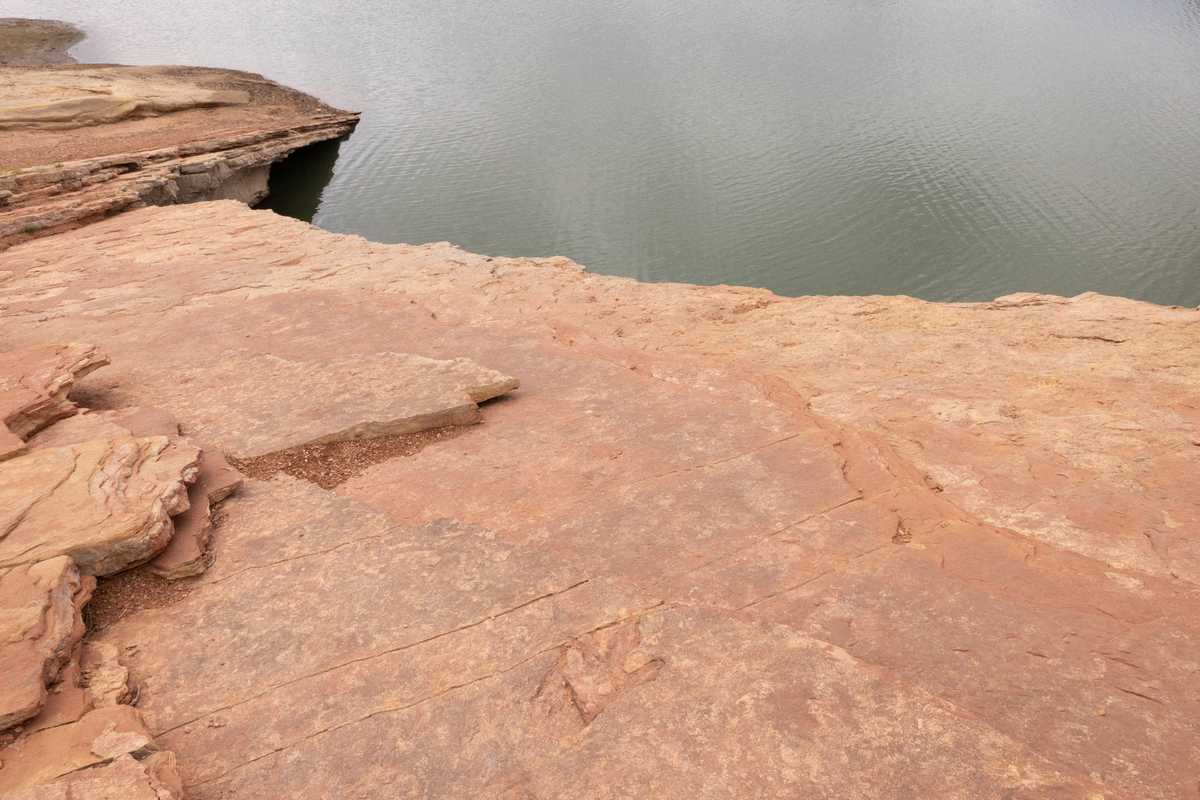
A dinosaur footprint at Red Fleet State Park in Utah.
14:25 JST, February 18, 2026
RED FLEET STATE PARK, Utah – A three-toed footprint appeared in the rock, slightly longer than my hiking boot.
The outlines weren’t crisp, but the impression was deep enough to collect sand grains and pebbles. This impression is estimated to be between 157 million years old and 206 million years old.
After a one-mile desert hike through scattered sagebrush, juniper trees and cactus, I found proof of dinosaurs.
More footprints – faint as bruises in the overcast light – emerged on the sandstone slope at the edge of a reservoir. These tracks were attributed to dilophosaurus – a carnivore from the Early Jurassic, and a star of “Jurassic Park” (1993).
Seeing dinosaur remains in the wild felt different than looking at fossils arranged behind glass in a museum. You can imagine a living, breathing reptile passing through, even if the timescale is incomprehensible.
Somehow, they are still here.
The improbability brought a sense of calm and relief. I felt small, inconsequential and so did the stresses of everyday life.
These tracks at Red Fleet State Park marked one of the more remarkable moments in a nine-day dinosaur hunt that led me from Salt Lake City to Denver.
At every stop, I was looking for answers. Why are we so fascinated with these ancient creatures? Why do they feel inseparable from this part of the country?
After traveling 1,139 miles and passing through 11 towns and cities, it became clear that this region isn’t just rich in fossil discoveries. Dinosaurs have become as woven into the identity of the West as the cowboy.
Part science, part fantasy
Because Utah and Colorado yield an abundance of dinosaur fossils, the states are full of regional museums. Many have laboratory spaces where paleontologists and volunteers let observers watch them prepare fossils. I got the sense of seeing science happening in front of my eyes, not backstage.
Unsurprisingly, I saw many families with children. Their eyes light up when they saw a giant supersaurus vertebra the size of their own body.
“I get schooled all the time by kids that are 4 or 5 years old that already have pronunciations and go beyond my knowledge of dinosauria,” said Daniel Read, visitor experience guide at Rocky Mountain Dinosaur Resource Center. “If it starts young, that’s a good thing, because that’s going to foster maybe a scientist, you know?”
For so many kids, dinosaurs are their first gateway into the wider world of science and history.
“It’s the all-encompassing thing for the hungry mind – no matter how much you learn about dinosaurs, there’s more to learn,” said Mary Ann Bonnell, education coordinator at the Morrison Natural History Museum.
Learning about dinosaurs feels like science mixed with fantasy. Some attractions tap into that mixture, offering entertainment alongside education.
The Royal Gorge Dinosaur Experience near Cañon City, Colorado, and George S. Eccles Dinosaur Park in Ogden, Utah, both blend traditional museum experience with a more playful theme-park approach.
Most of the science lives inside with the fossils and exhibits. Outdoors, replica dinosaurs and kid-friendly play areas take over.
“Talking about something that lived 145 million years ago is really difficult to grasp, and personally it fills me with a sense of wonder,” said Amy Lewis, a staff member at the George S. Eccles Dinosaur Park.
“I think that happens to a lot of people especially as adults, we kind of yearn for that sense of wonder that we felt as a child,’’ she said.
Attractions from another time
West of Cañon City, a stegosaurus sculpture quietly observes the traffic along U.S. Highway 50.
Cañon City was long known as “Prison Valley” for its high concentration of state and federal prisons. The sculpture was built in 1995 by inmates using steel and sheet metal as a vocational project.
This is part of the scenic loop known as the Dinosaur Diamond Prehistoric Highway.
Dinah the Dinosaur, a 40-foot-tall pink creature with long eyelashes, holds a sign that proclaims Vernal as “Utah’s Dinosaur Land.” On the opposite side of Main Street there’s a green T. rex with pointy teeth.
In Fruita, Colorado, there’s Grrrreta the T. rex, named by the local schoolchildren and sculpted as a caricature rather than a lifelike predator.
From the car window, they read like Americana, an attempt to catch the eyes of travelers. Up close you can see the cracks on the surface, streak marks and spots of rust that bleed through in small patches.
If you are into the charm of roadside oddities, you might find your luck at a Best Western in Lakewood, Colorado. On the outside, this Denver-area location looks fairly ordinary, minus the dinosaur statue at the entrance and murals on the side.
Inside, it leans all the way in. A replica of a stegosaurus fossil commands the wall behind the front desk. More dinosaur bones, figurines and paleontological touches share space with antique hardwood furniture in the lobby area, along with the usual hotel signage and amenities.
Lakewood sits next door to a prominent outcrop of the Morrison Formation, a famous rock layer across the western U.S. renowned for its abundance of iconic dinosaur fossils. The hotel is less than 10 miles away from Dinosaur Ridge and the Morrison Natural History Museum.
In late 2012, former co-owners Greg and Meredith Tally started renovating the hotel, incorporating a dinosaur theme as a unique edge to attract more visitors. The theme extends down the hallways with paleo drawings on the wall, overhead in the breakfast lounge where fossil replicas span the ceiling and into individual guest rooms with dinosaur silhouettes on the pillows.
“Most hotels tasted like chicken. I wanted mine to taste like pterodactyl,” Greg Tally said.
Dinosaurs as Western identity
Dinosaur, Colorado, appears along U.S. Route 40 – and disappears just as fast. But if you take the exit, this town of roughly 300 lives up to its name.
I remember flipping through the illustrated “Dinotopia” books as a kid, immersed in its drawings of a hidden world where people and dinosaurs coexisted. The town of Dinosaur feels like it belongs in that world. It was renamed in 1962 from Artesia to capitalize on its proximity to the Dinosaur National Monument.
There are no museums or theme parks; the connection is expressed through street names, public works and the architecture of daily life. Driving down Stegosaurus Freeway, I saw wooden dinosaur sculptures in a community park and cartoon dinosaur murals on the side of a liquor store.
At the town hall entrance, a clear box of miniature dinosaur figures was installed for visitors to take. A yellow, smiling sauropod sculpture covered in colorful handprints was the first thing to greet you outside the police department.
At Bedrock Depot, a local gift shop and restaurant, you can find items like chaiceratops and allosaurus delight, a chicken sausage sandwich served on focaccia.
It may be the only place in the world where you can buy ice cream and dinosaur poop (allegedly). Even the town’s marshal and fire crews have comic-book-style dinosaur drawings on their patches.
Three hours away, across the Utah line, there is an open-air dinosaur park and museum. Moab Giants features over 100 life-size dinosaur sculptures placed along an outdoor trail that stretches over half a mile.
First opened in 2015, the museum was founded by a Polish group that has opened similar dinosaur museums in Europe.
A crisp Friday morning didn’t bring much of a crowd. Most attendees were families pulling their children down the trail in dinosaur-shaped kiddie carts provided by the museum.
Among the replicas on display, the gojirasaurus, named after Japan’s movie monster Godzilla, was hard to miss with its bold color choice of a bright, almost neon yellow on its underside. Avaceratops, a small horned dinosaur, appeared frozen in a sprint.
Two T. rexes, reserved for the end of the trail, were rendered with a fuzz-like covering on their bodies. Several other theropods were rendered with feathers.
Framed by the unmistakable red rock formations and high desert of southeastern Utah, the dinosaurs felt right at home.
Collapsing our sense of time
Stretching across the Utah-Colorado border, the Dinosaur National Monument is a vast protected area of high-desert canyons, layered cliffs and river country.
It is best known for its rich dinosaur fossil beds, particularly the Quarry Exhibit Hall. There, visitors can touch fossils on the Wall of Bones, a steep rock face with approximately 1,500 dinosaur bones still embedded in the cliff exactly where they were buried.
“People say touch grass and I’d say touch bone, touch fossil, because fossil to me is even more powerful than grass as far as getting yourself back in touch with Earth,” said Mary Ann Bonnell, who works at Morrison Natural History Museum.
With the exhibit hall temporarily closed due to construction, I turned to the Fossil Discovery Trail, a 1.2-mile desert path featuring exposed fossils along the route.
As I climbed to the top of a viewing platform, a sauropod thigh bone came into focus. Naturally eroding out of the Morrison Formation, it was broken and cracked, yet its surface felt smooth – presumably polished by countless hands.
The cliff was not being worked on by paleontologists, yet it revealed eight vertebrae about 10 feet above the platform, along with smaller bones.
Back on the Colorado side of the Morrison Formation, Diane Shumway, a tour guide at Dinosaur Ridge, calmly pulled out a stegosaurus figure as she delivered dinosaur facts, all without missing a beat at the wheel of a tour bus – fittingly labeled the “StegoBus.”
Dinosaur ridge, an outdoor fossil site 20 minutes west of Denver, is known as the top dinosaur track site in North America. Hundreds of dinosaur footprints and fossils dating to the Jurassic and Cretaceous, two distinct geologic periods, are located along a paved crestline road.
Shumway explains that the T. rex, being a Cretaceous species, is actually closer in time to humans than to Jurassic dinosaurs like the stegosaurus.
Through the bus window, I saw dog-walkers and cyclists casually moving along the ridge, with a rock layer stamped with dozens of dinosaur footprints as the backdrop.
In fossil country, it was just another Monday stroll.









Most Read
Popular articles in the past 24 hours
-

AI Agents Should Consult Humans, Say New Rules from Japanese Govt
-
U.S. Firm to Build Training Hub in Fukushima N-plant for Debris R...
-

Japan PM Takaichi’s Cabinet Resigns en Masse
-
TEPCO's Niigata Pref. Nuclear Power Plant Begins Transmitting Pow...
-

Milano Cortina 2026: Japan Gains Bronze in Speed Skating Women's ...
-

Bus Carrying 40 Passengers Catches Fire on Chuo Expressway; All E...
-

Milano Cortina 2026: Japan’s Ami Nakai Leads Women’s ...
-

Sanae Takaichi Elected Japan's 105th Prime Minister (UPDATE 1)
Popular articles in the past week
-

Videos Plagiarized, Reposted with False Subtitles Claiming ‘Ryuky...
-

Man Infected with Measles Reportedly Dined at Restaurant in Tokyo...
-
Tokyo’s New Record-Breaking Fountain Named ‘Tokyo Aqua Symphony’
-

Milano Cortina 2026: Figure Skaters Riku Miura, Ryuichi Kihara Pa...
-

Milano Cortina 2026: Kokomo Murase Comes Out on Top After Overcom...
-

CRA Leadership Election Will Center on Party Rebuilding; Lower Ho...
-
Crime in Japan Ticks Up for 4th Straight Year
-

Japanese Constitutional Revision Debate Expected to be Revived Af...
Popular articles in the past month
-

Japan Institute to Use Domestic Commercial Optical Lattice Clock ...
-

Israeli Ambassador to Japan Speaks about Japan’s Role in the Reco...
-

Man Infected with Measles May Have Come in Contact with Many Peop...
-
China Eyes Rare Earth Foothold in Malaysia to Maintain Dominance,...
-

Prudential Life Insurance Plans to Fully Compensate for Damages C...
-

Woman with Measles Visited Hospital in Tokyo Multiple Times Befor...
-
Australian Woman Dies After Mishap on Ski Lift in Nagano Prefectu...
-
Foreign Snowboarder in Serious Condition After Hanging in Midair ...
Top Articles in News Services
-

Prudential Life Expected to Face Inspection over Fraud
-

Hong Kong Ex-Publisher Jimmy Lai’s Sentence Raises International Outcry as China Defends It
-

Japan’s Nikkei Stock Average Touches 58,000 as Yen, Jgbs Rally on Election Fallout (UPDATE 1)
-

Trump Names Former Federal Reserve Governor Warsh as the Next Fed Chair, Replacing Powell
-

Suzuki Overtakes Nissan as Japan’s Third‑Largest Automaker in 2025
JN ACCESS RANKING
-
Japan Institute to Use Domestic Commercial Optical Lattice Clock to Set Japan Standard Time
-
Israeli Ambassador to Japan Speaks about Japan’s Role in the Reconstruction of Gaza
-
Man Infected with Measles May Have Come in Contact with Many People in Tokyo, Went to Store, Restaurant Around When Symptoms Emerged
-
Prudential Life Insurance Plans to Fully Compensate for Damages Caused by Fraudulent Actions Without Waiting for Third-Party Committee Review
-
Woman with Measles Visited Hospital in Tokyo Multiple Times Before Being Diagnosed with Disease