
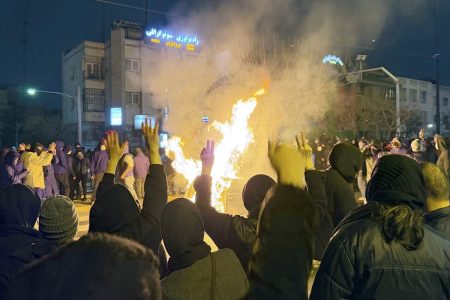
Iranians attend an anti-government protest in Tehran on Jan. 9.
8:00 JST, February 14, 2026
“HAPPY NEW YEAR. Wishing you and your dear family a 2026 full of happiness, health and heartwarming moments.”
In early January, I received this New Year greeting from an overseas friend via social media. I replied to the message, but days passed without my reply being marked as read.
My friend lives in Tehran, the capital of Iran.
Several days later, news reports appeared to explain the problem. Protests against rising prices had spread, and clashes with security forces attempting to suppress them had escalated. Authorities cut off the internet to prevent foreign interference, making social media difficult to access. The death toll was said to be in the thousands, but the information trickling through was fragmentary, and the true situation remained unclear.
Around that time, Supreme Leader Ayatollah Ali Khamenei’s X account produced a steady stream of posts. On Jan. 13, it posted, “These great rallies, overflowing with your firm determination, have completely shattered the foreign enemies’ plots that were supposed to be carried out by internal hirelings.” The post included an aerial photo of a rally of regime supporters filling a square.
X users viewing those posts added “background information,” such as, “Khamenei writes this tweet while Iran’s internet and phone lines are completely shut down!”
The economic crisis is worsening in Iran. When I was stationed there as a Yomiuri Shimbun correspondent in 2015, the actual market rate for the Iranian rial was 34,200 rials to the U.S. dollar. I learned from a Yomiuri article that on Dec. 28 last year it hit a record of 1,432,000 rials to the dollar. This means the rial’s value has plummeted to about 2.4% of its former worth. Imagine if the yen were to weaken from its recent level around ¥153 to the dollar to around ¥6,400 — this conveys the sheer magnitude of the currency’s collapse.
Despite the widespread protests, there appear to have been no defections within security forces such as the Revolutionary Guards, and the regime’s foundation showed no signs of weakening. The protests were suppressed and eventually subsided.
This is not the first time antigovernment protests have erupted in Iran. Among the largest were the Green Movement protests of 2009, objecting to election fraud by the regime. In 2022, protests erupted after a 22-year-old woman died in custody for wearing her hijab — a headscarf that covers women’s hair — “inappropriately.” Both times, the protests were suppressed.
This year’s demonstrations differ in character, as they stem from economic hardship, unlike the Green Movement, which was related to Iran’s form of democracy. Nor are they a fundamental challenge to the Iranian regime’s governance based on Islamic principles, like the anti-hijab movement.
The Green Movement was defused by the election of a moderate president. The hijab protests were contained through a certain degree of de facto toleration of women going hijabless. But the root causes of the latest large-scale protests may be more difficult to address. Economic hardship has not been alleviated; it has only worsened. Past demonstrations lasted about five days in 2017 and about 10 days in 2019. This time, they lasted around 20 days.
The administration of U.S. President Donald Trump, which had signaled it could intervene in the crackdown on the protests, dispatched U.S. Navy vessels to waters near Iran. Iran then contacted the United States, leading to talks about its nuclear program in Oman on Feb. 6. It is ironic that nuclear talks that had stalled due to the “12-day war” last June have now resumed, triggered by the crackdown on protests.
Iran’s apparent aim is to use the downsizing of its nuclear activities as a bargaining chip to extract a breakthrough in lifting U.S. sanctions, which have become a major cause of economic hardship. The United States is continuing to talk with Iran while maintaining military pressure.
According to reports, what Iran is offering is a reduction in the enrichment level of its highly enriched uranium. But it has once again rejected the U.S. demand to abandon its uranium enrichment activities. The U.S. side is also demanding curbs on ballistic missile development and an end to support for pro-Iranian forces in the Middle East, but Iran has refused to discuss these matters. For Iran, these activities are strategic pillars of its security, vital for deterring threats, including from Israel.
Will the United States take military action, depending on the course of negotiations? Shintaro Yoshimura, a Hiroshima University professor emeritus who’s an expert on Iran, sees it as “fifty-fifty.” With the November midterm elections in sight, the Trump administration could gain some advantages from military action, but there is also a risk of expanding conflict in the Middle East. Analyzing the situation, Yoshimura said: “There is a possibility of limited military operations. However, even if they strike Revolutionary Guard bases or attack nuclear facilities, it is unlikely to lead to greater public support for those seeking to overthrow the Iranian regime, nor would it likely reignite the momentum of anti-government protests. If, by any chance, Iranian civilians become casualties of a U.S. attack, it would give the Iranian regime a pretext to stoke anti-American sentiment, potentially backfiring on the United States.”
Not even two months have passed since the start of this year, and already protests have been suppressed, U.S. military and economic pressure has intensified further and the situation in Iran has plunged into utter uncertainty. The cost falls hardest on the people who took to the streets demanding better lives. Yoshimura expressed concern: “A certain number of middle-class Iranians diligently buy and save gold coins. If this situation continues, even those who still have some ability to endure hardship may eventually reach a breaking point. They might flee the country or go to the streets to join protests. But without leaders or organizations capable of broadly sharing a vision of the future with the people that could replace the current system, anti-establishment actions will inevitably face limitations. What lies ahead is a future that offers no grounds for optimism.”
As for my friend in Tehran, I received a short message four weeks later saying some internet access had returned but people needed to use a VPN for social media. “Sorry, I saw your message late because we had a VPN problem. Thank you very much,” it read. I hope that the rest of the year for my friend is “full of happiness, health and heartwarming moments.”
Political Pulse appears every Saturday.
Kenji Nakanishi
Kenji Nakanishi is a deputy editor in the City News Department of The Yomiuri Shimbun Osaka.







Most Read
Popular articles in the past 24 hours
-
Japan's Ruling Bloc Aims to Reclaim Key Committee Posts in Lower ...
-

Milano Cortina 2026: Japan’s Mitsuki Ono, Ikuma Horishima Add 2 B...
-
Japan, U.S. Fail to Make Final Decision on $550 Bil. Investment P...
-

Milano Cortina 2026: Bronze Validates Mogul Runner Ikuma Horishim...
-

Taiwan Chipmaker’s New Factory: Utilize Advanced Products to Boos...
-
Japan's Former Justice Minister Mori Expected to Be Elected as Sp...
-

Berlin Film Festival Kicks off with a Nod to New Voices from Mich...
-

Council Submits Proposals for Revising Retrial System; Some Legal...
Popular articles in the past week
-

Woman with Measles Visited Hospital in Tokyo Multiple Times Befor...
-

Prudential Life Insurance Plans to Fully Compensate for Damages C...
-

Woman with No Overseas Travel History Infected with Measles in Na...
-

LDP Wins Historic Landslide Victory
-

LDP Wins Landslide Victory, Secures Single-party Majority; Ruling...
-
Measles Patient Flew Between Tokyo, Hokkaido in Late January; Lik...
-

Milano Cortina 2026: Kokomo Murase Comes Out on Top After Overcom...
-

Tokyo, Many Regions across Japan Hit with Heavy Snow
Popular articles in the past month
-

Japan Institute to Use Domestic Commercial Optical Lattice Clock ...
-

Israeli Ambassador to Japan Speaks about Japan’s Role in the Reco...
-

Man Infected with Measles May Have Come in Contact with Many Peop...
-
China Eyes Rare Earth Foothold in Malaysia to Maintain Dominance,...
-
Australian Woman Dies After Mishap on Ski Lift in Nagano Prefectu...
-
Japan, Qatar Ministers Agree on Need for Stable Energy Supplies; ...
-
Woman with Measles Visited Hospital in Tokyo Multiple Times Befor...
-
Foreign Snowboarder in Serious Condition After Hanging in Midair ...
Top Articles in Editorial & Columns
-
40 Million Foreign Visitors to Japan: Urgent Measures Should Be Implemented to Tackle Overtourism
-

University of Tokyo Professor Arrested: Serious Lack of Ethical Sense, Failure of Institutional Governance
-
Policy Measures on Foreign Nationals: How Should Stricter Regulations and Coexistence Be Balanced?
-
Greenland: U.S. Territorial Ambitions Are Anachronistic
-
China Provoked Takaichi into Risky Move of Dissolving House of Representatives, But It’s a Gamble She Just Might Win
JN ACCESS RANKING
-
Japan Institute to Use Domestic Commercial Optical Lattice Clock to Set Japan Standard Time
-
Israeli Ambassador to Japan Speaks about Japan’s Role in the Reconstruction of Gaza
-
Man Infected with Measles May Have Come in Contact with Many People in Tokyo, Went to Store, Restaurant Around When Symptoms Emerged
-
China Eyes Rare Earth Foothold in Malaysia to Maintain Dominance, Counter Japan, U.S.
-
Australian Woman Dies After Mishap on Ski Lift in Nagano Prefecture