
LDP Rides Wave of Takaichi’s Popularity to Landslide Win; PM’s Political Gambit Pays off
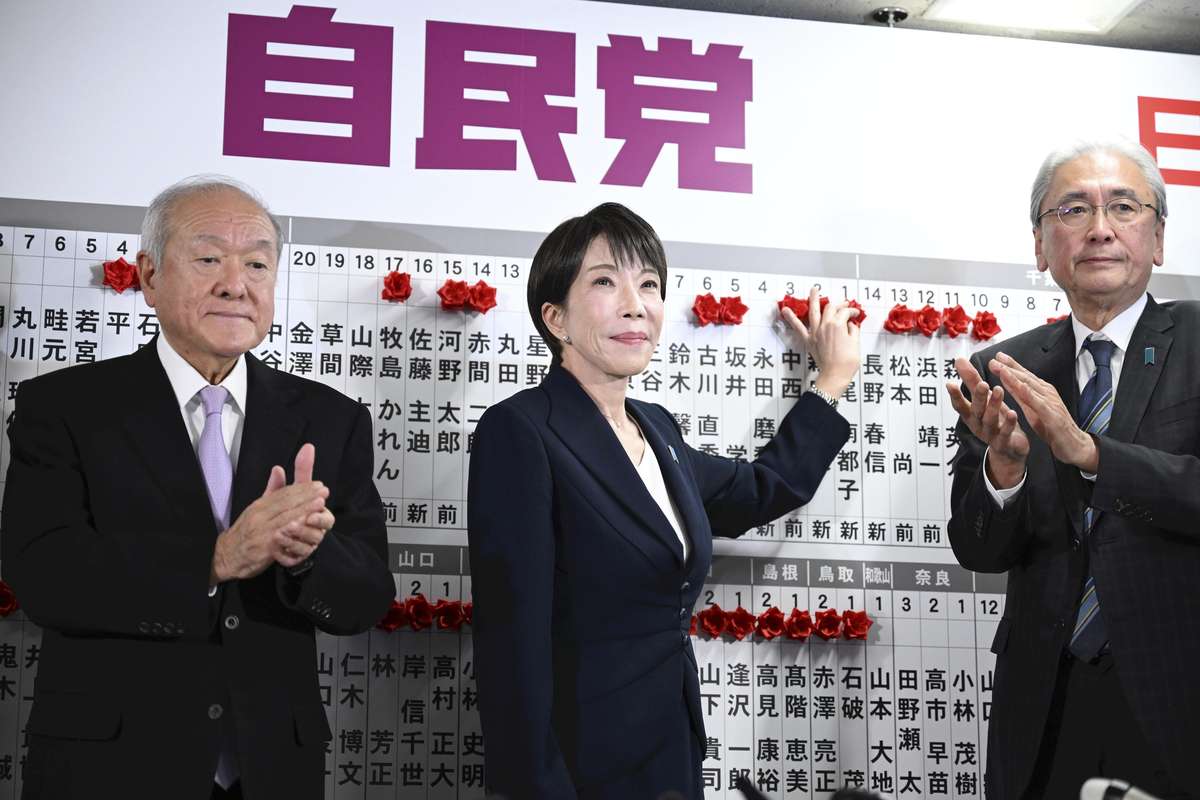
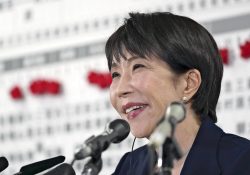
Prime Minister Sanae Takaichi puts a flower on a board for a candidate who secured victory in the general election at the Liberal Democratic Party’s headquarters in Tokyo on Sunday night.
13:53 JST, February 9, 2026
With the Liberal Democratic Party having pulled off a historic landslide victory in the House of Representatives election, Prime Minister Sanae Takaichi has strengthened the government’s foundation and gained significant momentum to advance key policies, such as her “responsible and proactive public finances.”
Takaichi, who is also LDP president, intends to continue the coalition government with the Japan Innovation Party while her putting her full effort into addressing domestic and foreign policy challenges. A consumption tax reduction on food items will be another key focus.
During the election campaign, Takaichi said she was “seeking a mandate for policy change,” asking for trust in the LDP-JIP coalition government. She also said she would “implement bold policies and reforms that could divide national opinion and shift things into a higher gear.”
With her prominent pledge to spur economic growth through “responsible and proactive public finances,” Takaichi increased the public’s expectation that the current economic stagnation would be overcome. The move won support from conservative and young voters who, in recent elections, are said to have shifted to parties like the Democratic Party for the People and Sanseito. She also captured the nonpartisan vote.
The primary driving force behind the historic victory was strong support for the prime minister herself. Cabinet approval ratings remained high even after the lower house was dissolved. The prime minister declared, “Let the people decide whether it’s acceptable for Sanae Takaichi to remain as prime minister,” strongly conveying to voters that the election would be a vote of confidence in her and thereby spreading her popularity to LDP candidates.
Massive crowds formed at campaign rallies that Takaichi attended, with higher-than-usual numbers of people actively taking LDP pamphlets featuring her photo. Many campaign teams said that this lower house election was completely different from the last one.
Takaichi’s repeated, explicit statement that she would resign if the ruling coalition failed to secure a majority also proved effective. She framed the race as a contest between “the faces of the parties,” referring to herself and Yoshihiko Noda, coleader of the Centrist Reform Alliance. As a result, she won votes from those who support her and her Cabinet.
The 16-day period from lower house dissolution to election day, the shortest since the end of World War II, also proved advantageous, allowing the momentum to be maintained throughout the campaign period.
Within the LDP, more and more party members believe that the prime minister, who won such a decisive battle, “has increased the strength of her unifying force,” an LDP source said. “She will take the lead in governing the administration and the party and be able to more easily assert her own style.”
The prime minister will first focus all her efforts on quickly passing a fiscal 2026 budget bill. Based on a coalition agreement with the JIP, she also intends to advance key policies such as promptly revising three security documents — including the National Security Strategy — and establishing a National Intelligence Bureau.
The LDP became a minority ruling party after the 2024 lower house election, which forced it to navigate a precarious parliamentary situation. Now, with the ruling bloc having secured over 310 seats — a two-thirds majority — parliamentary discussions will proceed at the ruling party’s pace.
The LDP is also expected to regain control of the lower house’s Budget Committee chair, a position held by the Constitutional Democratic Party of Japan before the election.
In the House of Councillors, which has 248 seats with one vacancy, the ruling coalition bloc holds only 120 seats, falling short of a majority. However, if a bill that has been passed by the lower house is rejected or not voted on within 60 days in the upper house, it can still be passed in the lower house with a second vote supported by at least two-thirds of representatives.
Therefore, the ruling coalition is likely to strengthen its negotiating power against opposition parties in the upper house as well.
To further stabilize the government’s foundation, Takaichi is also considering expanding the coalition framework. Appearing on a Nippon TV program on Sunday evening, she said, “If there are parties willing to work with us, I’d like to work with them.”


Related Tags




Most Read
Popular articles in the past 24 hours
-

LDP Wins Historic Landslide Victory
-

LDP Wins Landslide Victory, Secures Single-party Majority; Ruling...
-
Japan’s LDP Set for Landslide Victory, Securing Sole Majority; Ex...
-

Ruling Coalition of LDP, JIP Secures Two-Thirds Majority, Enablin...
-

Milano Cortina 2026: Japan Finishes 2nd in Figure Skating Team Co...
-

Diver from Taiwan Dies In Survey Work at Undersea Coal Mine Site ...
-
LDP Secures ‘Absolute Majority,’ Enabling It to Dominate All Comm...
-
Japan's Opposition CRA Set to Lose Seats
Popular articles in the past week
-

Man Infected with Measles May Have Come in Contact with Many Peop...
-

Israeli Ambassador to Japan Speaks about Japan’s Role in the Reco...
-

BTS to Hold Comeback Concert in Seoul on March 21; Popular Boy Ba...
-
LDP Wins Historic Landslide Victory
-

Sapporo Snow Festival Opens with 210 Snow and Ice Sculptures at 3...
-

Green Tea Exports Hit Record High in 2025 Amid Growing Demand, Li...
-

U.N. Plans to Set Safety Regulation Standards on Automated Drivin...
-

Tokyo Had 65,000 More People Move In Than Out In 2025; Osaka Area...
Popular articles in the past month
-

Univ. in Japan, Tokyo-Based Startup to Develop Satellite for Disa...
-

Japan Institute to Use Domestic Commercial Optical Lattice Clock ...
-

JAL, ANA Cancel Flights During 3-day Holiday Weekend due to Blizz...
-

China Eyes Rare Earth Foothold in Malaysia to Maintain Dominance,...
-
Man Infected with Measles May Have Come in Contact with Many Peop...
-

Japan, Qatar Ministers Agree on Need for Stable Energy Supplies; ...
-

Australian Woman Dies After Mishap on Ski Lift in Nagano Prefectu...
-

Japan, Italy to Boost LNG Cooperation; Aimed at Diversifying Japa...
Top Articles in Politics
-
LDP Wins Historic Landslide Victory
-

Japan Tourism Agency Calls for Strengthening Measures Against Overtourism
-
LDP Wins Landslide Victory, Secures Single-party Majority; Ruling Coalition with JIP Poised to Secure Over 300 seats (UPDATE 1)
-

Japan’s Prime Minister: 2-Year Tax Cut on Food Possible Without Issuing Bonds
-

Voters Using AI to Choose Candidates in Japan’s Upcoming General Election; ChatGPT, Other AI Services Found Providing Incorrect Information
JN ACCESS RANKING
-
Japan Institute to Use Domestic Commercial Optical Lattice Clock to Set Japan Standard Time
-
China Eyes Rare Earth Foothold in Malaysia to Maintain Dominance, Counter Japan, U.S.
-
Man Infected with Measles May Have Come in Contact with Many People in Tokyo, Went to Store, Restaurant Around When Symptoms Emerged
-
Japan, Qatar Ministers Agree on Need for Stable Energy Supplies; Motegi, Qatari Prime Minister Al-Thani Affirm Commitment to Cooperation
-
Australian Woman Dies After Mishap on Ski Lift in Nagano Prefecture