
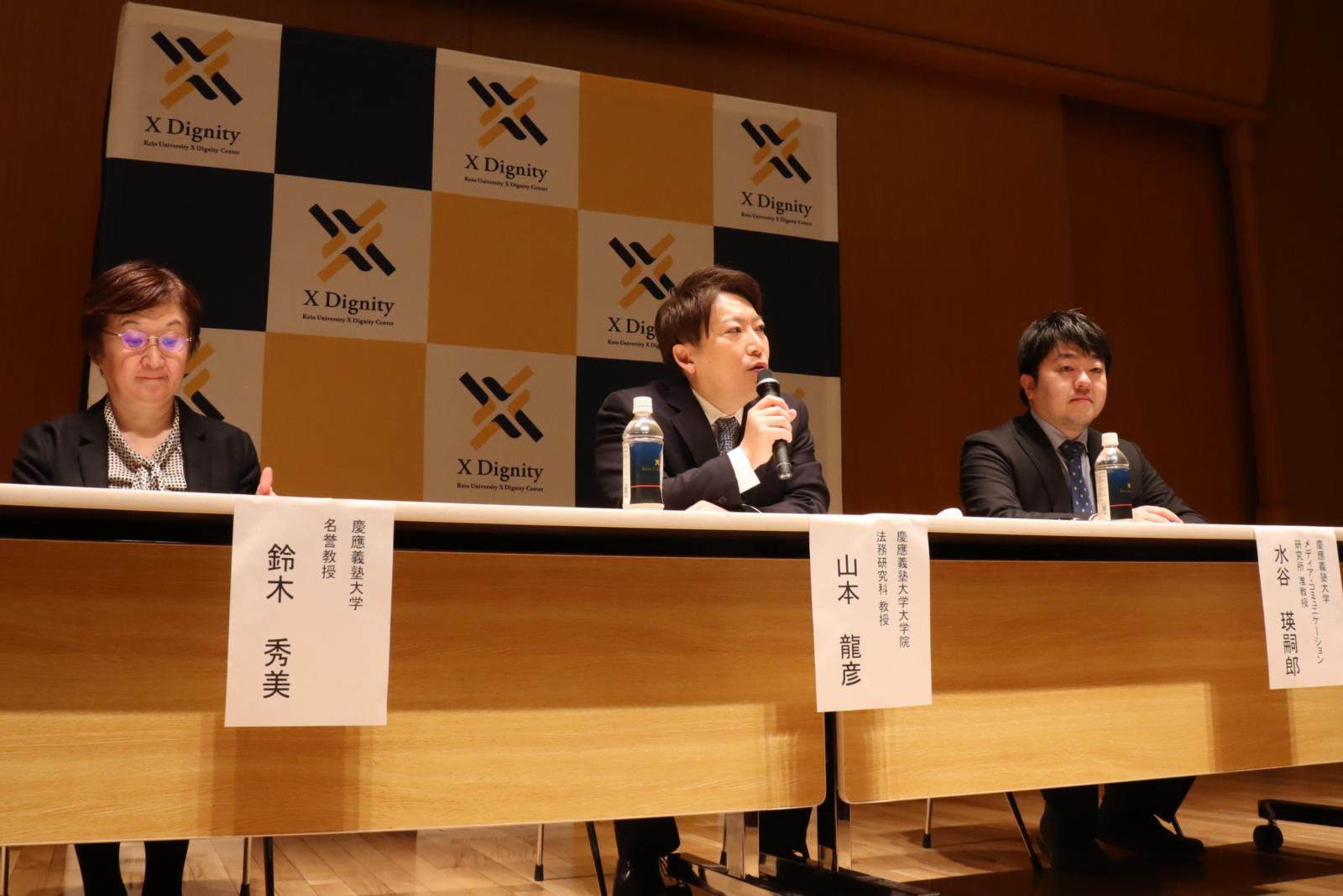
Keio University Prof. Tatsuhiko Yamamoto speaks at the university’s Mita Campus in Minato Ward, Tokyo, on Monday.
6:45 JST, January 27, 2026
The following is the full text of “Proposal on the Role of News Organizations in the AI Era” released by the X Dignity Center of the Keio University Global Research Institute on Jan. 26, 2026.
***
Preamble
Artificial intelligence (AI) is permeating our daily lives, delivering significant benefits to society. However, when considering the information space or the sphere of discourse, the evolution, development, and proliferation of AI cannot be welcomed unreservedly. Social media AI and algorithms, designed to capture our attention and maximize engagement, tend to spread and amplify provocative false information, misinformation, and defamatory content that reflexively draws human attention. The proliferation of generative AI has enabled anyone to create and distribute information and videos that appear plausible. This transformation of the information space jeopardizes democracy, which relies on fact-based, rational communication.
To avert this crisis, the role of news organizations becomes critically important. They should operate under a governance framework, providing information based on reporting and verification, guided by professional ethical standards. However, news organizations themselves, as actors within the information space, cannot remain entirely independent from the influence of AI’s evolution, development, and proliferation. For news organizations to remain guardians of democracy, they need to reaffirm their raison d’être, develop awareness and mechanisms to avoid being swallowed by the “attention economy,” formulate and implement policies for appropriate AI use, and undertake new tasks including the oversight of AI and other technologies.
The X Dignity Center strongly advocates for the realization of a democratic society where human dignity is upheld and hereby proposes the following direction for news organizations in the AI era.
X Dignity Center, Keio University Global Research Institute
I. Confirming the Functions and Roles of News Organizations
1. In today’s world, where anyone can become a publisher due to the development of the internet, the spread of the attention economy has also increased information dissemination driven by economic motives. Under the attention economy, where provocative discourse is easily amplified, discourse that merely asserts one’s own political stance while criticizing or attacking differing opinions, or discourse aimed solely at exposing others’ private matters, is also proliferating. Amidst this flood of discourse serving diverse purposes, the influence of discourse that contributes to democracy and other public goals — facilitating the understanding and judgment of public affairs — is being relativized. Addressing this situation is an urgent challenge in today’s information environment.
The Supreme Court has already stated regarding media reporting: “In a democratic society, it provides important materials for judgment when citizens engage in national affairs and serves the public’s ‘right to know.’”[1] Having recognized the structural changes in the information space, news organizations should reaffirm this social responsibility and public functions, and continuously explore their proper role.
2. As the influence of the attention economy grows, attracting attention becomes the primary goal of information dissemination, leading to the widespread circulation of information lacking consideration for the reliability of sources or the accuracy of content. Furthermore, the development and proliferation of AI have made it easy for anyone to generate information. However, AI-generated content is sometimes created based on biased training data (information sources) and logic that humans cannot sufficiently verify. It can also lead to the spread and amplification of “information that appears to be true.” In such a chaotic information environment where truth and falsehood coexist, information produced through responsible editing based on reliable sources and explainable rationales becomes scarce. Therefore, maintaining the production and distribution of such credible information is essential.
The Supreme Court has already positioned the “freedom of reporting” enjoyed by news organizations as “worthy of full respect in light of the spirit of Article 21 of the Constitution,”[2] specifically for the purpose of “ensuring the accuracy of reporting.” This distinguishes it from the information gathering activities of ordinary citizens, which are merely “to be respected in light of the spirit of Article 21, Paragraph 1 of the Constitution.”[3] News organizations should deeply recognize the special significance accorded to this freedom of reporting and reaffirm the importance of disseminating information through careful processes — reporting, verification, and confirmation from multiple sources — and of serving as the “mechanism for delivering information that has been verified from multiple angles.” Furthermore, news organizations should recognize that such processes differentiate them from AI-generated content and form the very foundation supporting their social trust and operational base.
II. Maintaining Appropriate Distance from the “Attention Economy” and Ensuring Governance Structures
In an information space dominated by the attention economy, even news organizations may prioritize view counts and short-term advertising revenue in practice, despite understanding their social responsibility and pursuit of the public interest as ideals. This risks undermining their very raison d’être. To fulfill their mission of satisfying the public’s “right to know” —as highlighted in the aforementioned Hakata Railway Station Case ruling—, news organizations should consciously maintain an appropriate distance from the attention economy. Furthermore, news organizations should share this awareness across all levels of their organizations.
To this end, news organizations should implement institutional measures, including formulating reporting ethics tailored to the digital environment and establishing third-party organizations to ensure their effectiveness. Furthermore, by ensuring the transparency of the existence and operation of these systems, they should actively build trust in news organizations within society at large.
III. Further Ensuring Transparency and Accountability
In today’s era of “information gluttony,” where information is overwhelmingly abundant, news organizations’ information has become just one part of a vast sea of data. Under the attention economy, stimulating information floods the landscape, perpetuating a zero-sum game where entities compete to capture people’s attention. To help people understand the importance of information and choose to accept it from this vast sea of data, the processes of journalism, including the reporting and editing, should be made more transparent than ever before, with explanations provided to society as necessary. Such transparency and accountability are essential not only to enhance the credibility of news organizations themselves but also to differentiate their information from that originating from sources that have not undergone the unique processes of journalism, thereby solidifying the public foundation of news organizations.
IV. Journalism Ethics and Operational Guidelines in the AI Era
The appropriate use of AI within news organizations can reduce the burden of certain tasks suited to quantification, enabling journalists to focus on core activities, such as reporting. Therefore, utilizing AI in appropriate contexts can strengthen the functions and roles of news organizations. However, excessive reliance on AI can lead not only to a decline in the capabilities of journalists and others, but also to the spread of unverified information and the blurring of editorial responsibility. This risks undermining the credibility of news organizations and their information. Taking these risks into account, news organizations should formulate and publish AI utilization policies and build systems to ensure their reliable implementation, in order to guarantee appropriate AI use — through human review and verification — and to ensure transparency regarding AI deployment.
V. Reexamining the Scope of Media Oversight in the AI Era
1. News organizations, often referred to as the “fourth estate,” should remain conscious of their own power even in the AI era. They should persistently maintain a stance of mutual oversight among themselves, respecting each other’s independence, particularly regarding their distance from the attention economy and their use of AI. Especially in the current climate of widespread distrust toward media, organizations should recognize their own power, demonstrate a more responsive attitude toward the public, and thereby secure the trust necessary to fulfill their role of monitoring power.
2. Information technologies like AI can significantly impact our freedoms, human rights, and democracy, depending on how they are designed and utilized. Furthermore, certain digital platforms possess the power to significantly influence public decision-making through the design and implementation of AI and similar technologies, bypassing democratic procedures. Therefore, news organizations should develop specialized technical expertise themselves or work in collaboration with experts who possess such knowledge, in order to analyze the design and behavior of AI and other technologies with broad societal impact, reporting on their content as necessary. Furthermore, certain digital platforms, as “new powers” potentially rivaling state authority, should be subject to scrutiny alongside state power.
3. In the modern information space, narratives that incite public sympathy to shape public opinion and political decision-making can be amplified by algorithms, gaining excessive influence. News organizations should be mindful of the influence of such narratives and provide information enabling people to critically evaluate them rationally.
VI. Enhanced Functionality During Specific Periods Requiring Particular Public Interest, Such as Elections and Natural Disasters
During specific periods requiring heightened public attention, such as elections and natural disasters, news organizations should conduct necessary verification of information that is questionable in terms of factual accuracy yet possesses significant influence, and should actively correct or supplement such information.
[During Elections]
1. News organizations should strive to present voters with the essential issues at stake in the election, carefully conveying the background of these issues, the conflicting values involved, and the context of the debate, to prevent “information gaps.”
2. News organizations should strive for fair reporting and ensure qualitative fairness. If differences in treatment of information about candidates are applied, they should provide reasonable explanations to justify such differences to prevent recipients from feeling unfairly treated.
[During Natural Disasters]
1. News organizations should prioritize the provision of accurate and timely information to protect lives. Through verified, calm reporting, they should deliver the necessary information to victims and residents.
2. To prevent confusion at disaster sites caused by false or misleading information, they should perform fact-checking functions as necessary.
VII. Proactive Engagement in Awareness Activities
Trust in information dissemination by news organizations is continuously cultivated through dialogue with various societal actors. News organizations should build a cross-industry framework for literacy improvement and actively engage in communication across generations through collaboration with other stakeholders, including educational institutions and technology companies. In doing so, they should strive to carefully explain their reporting and editorial processes and standards, ensuring that the distinction between news organization reporting and information not subject to journalism’s inherent processes — such as reporting and editing — is understood and shared across generations.
[1] HAKATA RAILWAY STATION CASE and a Court Order to produce films collected for news report, Supreme Court Plenary Session Decision, November 26, 1969, Supreme Court Criminal Cases Reports Compilation, Vol. 23, No. 11, p. 1490
[2] HAKATA RAILWAY STATION CASE and a Court Order to produce films collected for news report
[3] Judgment on the constitutionality of the measure taken by the Presiding Judge to prohibit spectators from taking notes in the courtroom, Supreme Court Plenary Session Decision, March 8, 1989, Supreme Court Civil Cases Reports Compilation, Vol. 23, No. 11, p. 1490
Supplementary Note
This proposal is the outcome of deliberations conducted by the Expert Panel on the Soundness of the Information Space, established at the X Dignity Center.
Members of the Expert Panel on the Sound Development of the Information Space (in alphabetical order)
Eijiro Mizutani Associate Professor, Institute of Journalism, Media and Communication Studies, Keio University / Affiliated Researcher, X Dignity Center
Yuya Shibuya Associate Professor, Interfaculty Initiative in Information Studies, The University of Tokyo
Hidemi Suzuki Specially Appointed Professor, Faculty of Law, Kokushikan University / Trustee, Shizuoka University / Professor Emeritus, Osaka University / Professor Emeritus, Keio University
Fujio Toriumi Professor, Department of Systems Innovation, Faculty of Engineering, The University of Tokyo
Shuzo Yamakoshi Professor, Department of Political Science, Faculty of Law, Keio University
Tatsuhiko Yamamoto Professor, Law School, Keio University / Co-Director, X Dignity Center
Advisors (in alphabetical order)
George Shishido Professor, Graduate Schools for Law and Politics, Faculty of Law, The University of Tokyo
Masahiro Sogabe Professor, Graduate School of Law, Kyoto University






Most Read
Popular articles in the past 24 hours
-

Voters Using AI to Choose Candidates in Japan's Upcoming General ...
-

Japan's Snow-Clad Beauty: Camellia Flowers Seen in Winter Bloom a...
-
Monkey Strikes Junior High School Girl from Behind in Japan's Yam...
-

Genichiro Inokuma's Mural in Ueno Station That Gave Hope in Postw...
-
Senior Japanese Citizens Return to University to Gain Knowledge, ...
-

Foreign and Security Policy: Political Parties Must Discuss How T...
-

Heavy Snow Linked to 30 Deaths across Japan since Late Jan.; JMA ...
-

Tokyo Police Arrest Head of Resignation Assistance Firm
Popular articles in the past week
-

Japan Institute to Use Domestic Commercial Optical Lattice Clock ...
-

Australian Woman Dies After Mishap on Ski Lift in Nagano Prefectu...
-

Foreign Snowboarder in Serious Condition After Hanging in Midair ...
-
Chinese Embassy in Japan Reiterates Call for Chinese People to Re...
-
Narita Airport, Startup in Japan Demonstrate Machine to Compress ...
-

Toyota Motor Group Firm to Sell Clean Energy Greenhouses for Stra...
-

Sakie Yokota, Last Surviving Parent of a North Korea Abductee, Ur...
-
Beer Yeast Helps Save Labor, Water Use in Growing Rice; Govt Hope...
Popular articles in the past month
-
Univ. in Japan, Tokyo-Based Startup to Develop Satellite for Disa...
-

JAL, ANA Cancel Flights During 3-day Holiday Weekend due to Blizz...
-
China Confirmed to Be Operating Drilling Vessel Near Japan-China ...
-

China Eyes Rare Earth Foothold in Malaysia to Maintain Dominance,...
-
M6.2 Earthquake Hits Japan's Tottori, Shimane Prefectures; No Tsu...
-
Japan Institute to Use Domestic Commercial Optical Lattice Clock ...
-

Japan, Qatar Ministers Agree on Need for Stable Energy Supplies; ...
-

Japan, Italy to Boost LNG Cooperation; Aimed at Diversifying Japa...
Top Articles in Society
-
JAL, ANA Cancel Flights During 3-day Holiday Weekend due to Blizzard
-
Record-Breaking Snow Cripples Public Transport in Hokkaido; 7,000 People Stay Overnight at New Chitose Airport
-
Australian Woman Dies After Mishap on Ski Lift in Nagano Prefecture
-
Foreign Snowboarder in Serious Condition After Hanging in Midair from Chairlift in Nagano Prefecture
-
Train Services in Tokyo Resume Following Power Outage That Suspended Yamanote, Keihin-Tohoku Lines (Update 4)
JN ACCESS RANKING
-
Univ. in Japan, Tokyo-Based Startup to Develop Satellite for Disaster Prevention Measures, Bears
-
JAL, ANA Cancel Flights During 3-day Holiday Weekend due to Blizzard
-
China Confirmed to Be Operating Drilling Vessel Near Japan-China Median Line
-
China Eyes Rare Earth Foothold in Malaysia to Maintain Dominance, Counter Japan, U.S.
-
Japan Institute to Use Domestic Commercial Optical Lattice Clock to Set Japan Standard Time