
Disaster Preparedness / Apartment Management Associations: Instructions on What to Do in the Event of Power Outage
12:42 JST, January 3, 2026
Compared to those in houses, apartment and condominium residents face greater inconvenience when disasters such as earthquakes trigger power outages. It is important for condominium management associations to be ready for disasters, for example, by preparing “Action Sheets” that contain simple and concise instructions on what actions to take in the event of a disaster.
***
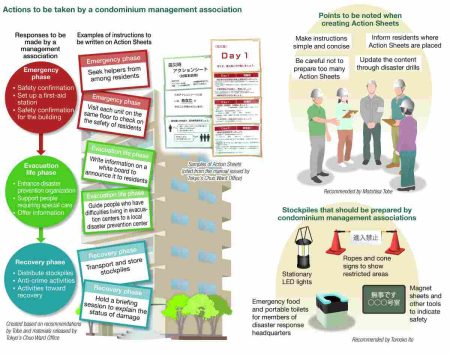
In many condominiums, a management association has established a disaster prevention committee and compiled a disaster response manual. However, some have no members in charge. “Condominium residents tend to feel as if someone else will take charge. So, it is necessary to be prepared so that any residents are equipped to respond to the early stage of a disaster,” said Motohisa Tobe, a licensed condominium manager familiar with condominium disaster prevention.
You may also like to read
Kawasaki Releases Guide to Sheltering at Home During Disasters, with Essential Tips for Apartment Residents Japanese Student Gamifies Tsunami Evacuation Drill with Nighttime Quake ScenarioAction Sheets
One example is an Action Sheet. This is a card that includes instructions such as, “Seek helpers from among residents,” and “Visit each unit to check on the safety of residents and compile information.” With Action Sheets, even residents unfamiliar with what to do can get involved.
Action Sheet templates can be found online and should be prepared by the management association of each condominium. “The number of members should increase as time passes after a disaster occurs, so the content can be limited to initial safety confirmation and relief efforts, which require special attention,” Tobe added.
Once created, Action Sheets are displayed in the superintendent’s office as well as on each floor, with their locations made known to residents.
“Action Sheets are not the end of the process. It is also important to learn how to respond through disaster drills and to reduce or revise the content of Action Sheets,” he said.
Stationary LED lights
Tomoko Ito, president of Kanagawa 311 Network, a nonprofit organization that promotes disaster prevention in condominiums, said, “The convenience of condominium living is based on the assumption of having electricity readily available, so preparation is crucial.”
When the power goes out, residents are left to use the stairs to move between floors while hallways and stairways may be completely dark. Upper floors could be more affected by tremors than lower floors.
Condominium management associations should prepare ropes, cone signs and other tools to alert residences of restricted areas. Walkie-talkies are also needed to communicate with residents on upper floors without relying on smartphones.
Each household should stockpile emergency food and water. However, management associations are recommended to stockpile emergency food and water for their disaster response teams due to the difficulty of returning to units once elevators are not functioning. Portable toilet facilities should also be prepared.
Several stationary LED lights should be installed on each floor in anticipation of power outages at multiple locations, such as hallways and stairway landings.
Other items to prepare include those for safety confirmation, such as magnet sheets and contact slips to be attached to unit doors in the event that residents cannot be confirmed as safe.
“In principle, condominium residents should shelter in their own homes and, if prepared, can feel safer there than in evacuation centers. Condominium management associations are responsible for disaster prevention and need to be well prepared,” Ito stressed.


Most Read
Popular articles in the past 24 hours
-

Japan PM Takaichi’s Cabinet Resigns en Masse
-

Japan's Govt to Submit Road Map for Growth Strategy in March, PM ...
-

Bus Carrying 40 Passengers Catches Fire on Chuo Expressway; All E...
-

Riku-Ryu Pair Wins Gold Medal: Their Strong Bond Leads to Major C...
-
Survey Shows False Election Info Perceived as True
-

Milano Cortina 2026: Japan’s Ami Nakai Leads Women’s ...
-

Japan’s Plan for Investment in U.S.: Aim for Mutual Development b...
-
Sanae Takaichi Elected Japan's 105th Prime Minister (UPDATE 1)
Popular articles in the past week
-
Japan PM Takaichi’s Cabinet Resigns en Masse
-

Man Infected with Measles Reportedly Dined at Restaurant in Tokyo...
-

Videos Plagiarized, Reposted with False Subtitles Claiming ‘Ryuky...
-

Milano Cortina 2026: Figure Skaters Riku Miura, Ryuichi Kihara Pa...
-

Tokyo’s New Record-Breaking Fountain Named ‘Tokyo Aqua Symphony’
-
CRA Leadership Election Will Center on Party Rebuilding; Lower Ho...
-
Japan's Govt to Submit Road Map for Growth Strategy in March, PM ...
-
Crime in Japan Ticks Up for 4th Straight Year
Popular articles in the past month
-
Japan PM Takaichi’s Cabinet Resigns en Masse
-

Japan Institute to Use Domestic Commercial Optical Lattice Clock ...
-

Israeli Ambassador to Japan Speaks about Japan’s Role in the Reco...
-

Man Infected with Measles May Have Come in Contact with Many Peop...
-

China Eyes Rare Earth Foothold in Malaysia to Maintain Dominance,...
-

Prudential Life Insurance Plans to Fully Compensate for Damages C...
-

Woman with Measles Visited Hospital in Tokyo Multiple Times Befor...
-
Man Infected with Measles Reportedly Dined at Restaurant in Tokyo...
Top Articles in JN Specialities
-

Tokyo University of the Arts Now Offering Free Guided Tour of New Storage Building, Completed in 2024
-
Exhibition Shows Keene’s Interactions with Showa-Era Writers in Tokyo, Features Newspaper Columns, Related Materials
-

The Japan News / Weekly Edition (1/30-2/5)
-

Step Back in Time at Historical Estate Renovated into a Commercial Complex in Tokyo
-
Prevent Accidents When Removing Snow from Roofs; Always Use Proper Gear and Follow Safety Precautions
JN ACCESS RANKING
-
Japan PM Takaichi’s Cabinet Resigns en Masse
-
Japan Institute to Use Domestic Commercial Optical Lattice Clock to Set Japan Standard Time
-
Israeli Ambassador to Japan Speaks about Japan’s Role in the Reconstruction of Gaza
-
Man Infected with Measles May Have Come in Contact with Many People in Tokyo, Went to Store, Restaurant Around When Symptoms Emerged
-
Prudential Life Insurance Plans to Fully Compensate for Damages Caused by Fraudulent Actions Without Waiting for Third-Party Committee Review