
Japan Firms to Get Financial Help for AI Data Prep; Government Seeks to Boost Performance of Domestic AI
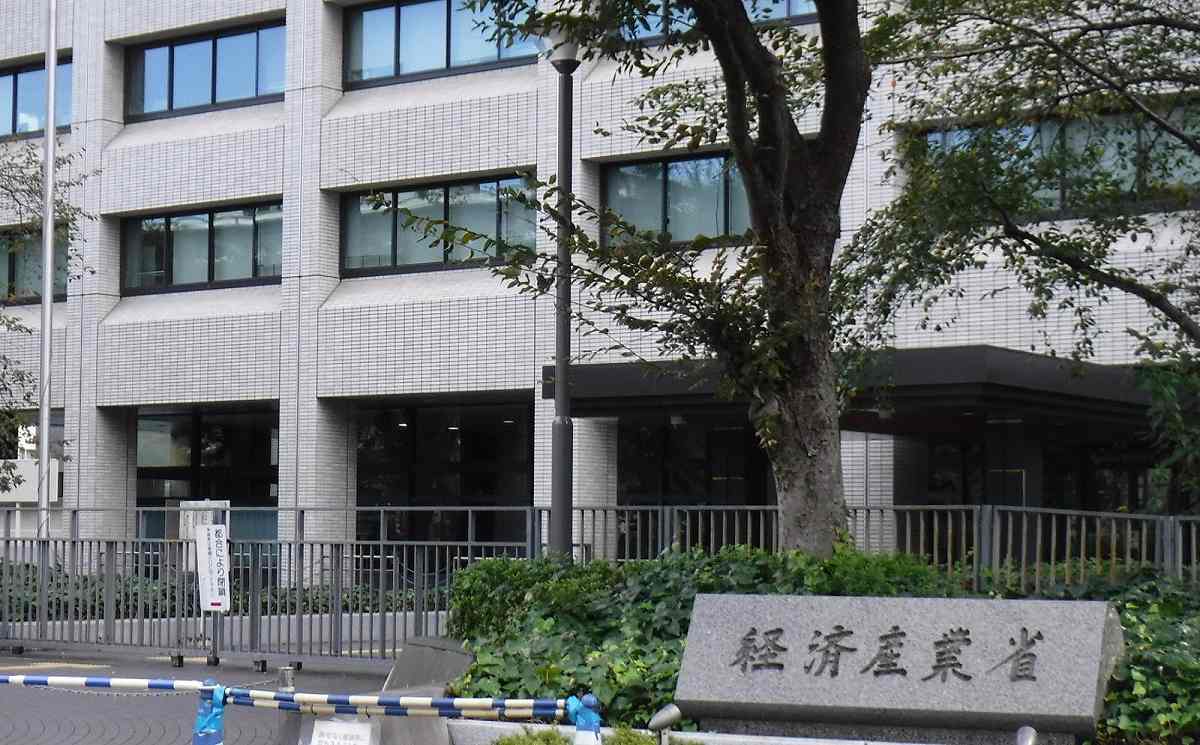
The Economy, Trade and Industry Ministry building in Chiyoda Ward, Tokyo
16:32 JST, December 29, 2025
The economy ministry will provide financial support for domestic companies’ efforts to process their vast amount of data for machine learning.
Massive amounts of training data need to be pre-processed to improve the accuracy of artificial intelligence. The Economy, Trade and Industry Ministry has focused particularly on the data possessed by Japan’s strong manufacturing sector, believing that enhancing the performance of domestically developed AI will strengthen the nation’s product competitiveness and productivity.
The processed data is expected to be used to train domestically developed AI, in which the ministry plans to invest ¥1 trillion over five years from fiscal 2026.
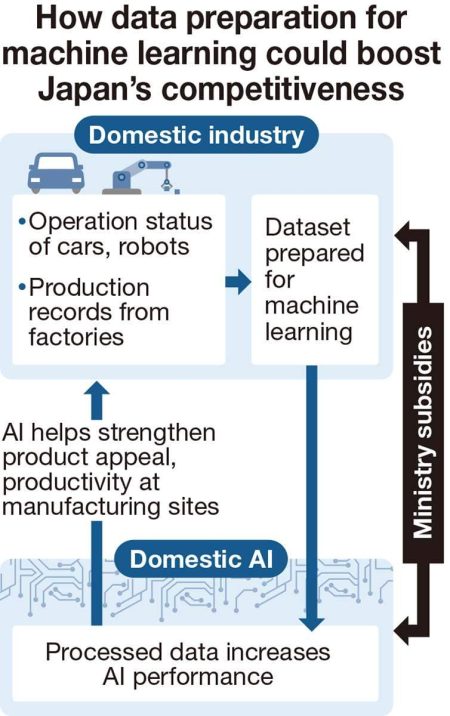
Manufacturers possess vast amounts of information, including data generated during production processes and records of the operating conditions of automobiles and equipment. This is considered “Japan’s most critical resource for AI development and implementation,” a ministry official said.
Such raw data need to be pre-processed into data with fewer errors and inconsistencies to make it easier for AI to learn from it. The government will subsidize the costs of this preparation work — specifically, it will use a portion of the about ¥150 billion allocated in the fiscal 2025 supplementary budget for projects to strengthen AI development capabilities.
AI developers have traditionally used publicly available internet data for training. This approach is advancing rapidly, with predictions suggesting that online data sources could be depleted as early as 2026. Meanwhile, an estimated 60% of the world’s data is held internally by companies, with the majority still unused for training.
Consequently, AI developers have begun negotiating with businesses to request the provision of data. Major Japanese manufacturers are being approached by overseas AI firms, and in China, advanced factories that utilize data and AI have been developed.
The ministry has decided that Japan is at risk of falling behind in the global data race unless it takes action.
AI is expected to play a pivotal role across various fields, including autonomous driving for vehicles and robots, and improving efficiency on factory production lines. It is believed that Japan can create a virtuous cycle by leveraging corporate data to enhance AI performance and strengthen industrial competitiveness.








Most Read
Most read in the last 24 hours
-

India's Arms Indigenization Quest for Self-Reliance / New Delhi S...
-

Most Serious Cyberattacks against the UK Now from Russia, Iran an...
-

Iran Fires on 3 Ships in the Strait of Hormuz as US Maintains Blo...
-

Trump Envoy Seeks to Replace Iran with Italy in Upcoming World Cu...
-

EU Close to Approving a $106B Loan for Ukraine after Months of De...
-

U.S. Extends Ceasefire: Lifting Blockades on Strait is Urgent for...
-

White Sox Rookie Munetaka Murakami Ties MLB Rookie Record with HR...
-

Navy Secretary John Phelan Is Leaving in Latest Departure of a To...
Most read in the last 7 days
-
Earthquake Hits Japan's Tohoku Region; 3-meter Tsunami Warning Is...
-

Trump Extends the Ceasefire with Iran but Keeps the Blockade
-

Olympic Gold Medal-Winning Figure Skaters Riku-Ryu Announce Retir...
-

China, South Korea Object to Japanese PM Takaichi's Ritual Offeri...
-
India's Arms Indigenization Quest for Self-Reliance / New Delhi S...
-
Japan to Ban Use of Portable Chargers on Airplanes from April 24,...
-

¥1,000 Coins to Be Issued to Mark Anniversary of Beginning of Jap...
-
Most Serious Cyberattacks against the UK Now from Russia, Iran an...
Most read in the last 30 days
-
Earthquake Hits Japan's Tohoku Region; 3-meter Tsunami Warning Is...
-
Police Find Child's Shoe During Search for Missing Boy in Nantan,...
-
Body Found in Nantan, Kyoto Prefecture, During Search for 11-Year...
-

Cherry Blossoms, Rapeseed Flowers Perform Colorful ‘Duet’ in Niig...
-
Trump Extends the Ceasefire with Iran but Keeps the Blockade
-
Olympic Gold Medal-Winning Figure Skaters Riku-Ryu Announce Retir...
-

Nori Prices Surge in Japan Due to Poor Seaweed Production Amid Ri...
-
Japanese Prime Minister Takaichi Speaks to Pakistani Prime Minist...
Top Articles in Business
-
Foreign Tourists Set New Record in March; 30% Drop in Visitors from Middle East
-

Japan’s ANA to Introduce Fuel Surcharges to Domestic Flights from Fy27, Driven by Rising Fuel Costs, Declining Profits
-
Middle Powers Should Create Alternative to WTO, Says Research Group
-

Airborne Cellular Stations to Be Tested in Ishikawa, Miyagi; Aim to Ensure Communication During Disasters
-
Toyota Motor to Begin Full-Scale Hydrogen Production in May; Mass Production and Sales of Equipment Planned to Start in 2029
JN ACCESS RANKING
-
Earthquake Hits Japan’s Tohoku Region; 3-meter Tsunami Warning Issued (Update 1)
-
Police Find Child’s Shoe During Search for Missing Boy in Nantan, Kyoto Prefecture
-
Body Found in Nantan, Kyoto Prefecture, During Search for 11-Year-Old Boy in Area (Update 1)
-
Cherry Blossoms, Rapeseed Flowers Perform Colorful ‘Duet’ in Niigata
-
Trump Extends the Ceasefire with Iran but Keeps the Blockade
Most read in the last 24 hours
-
India's Arms Indigenization Quest for Self-Reliance / New Delhi S...
-
Most Serious Cyberattacks against the UK Now from Russia, Iran an...
-
Iran Fires on 3 Ships in the Strait of Hormuz as US Maintains Blo...
-
Trump Envoy Seeks to Replace Iran with Italy in Upcoming World Cu...
-
EU Close to Approving a $106B Loan for Ukraine after Months of De...
Most read in the last 7 days
-
Earthquake Hits Japan's Tohoku Region; 3-meter Tsunami Warning Is...
-
Trump Extends the Ceasefire with Iran but Keeps the Blockade
-
Olympic Gold Medal-Winning Figure Skaters Riku-Ryu Announce Retir...
-
China, South Korea Object to Japanese PM Takaichi's Ritual Offeri...
-
India's Arms Indigenization Quest for Self-Reliance / New Delhi S...
Most read in the last 30 days
-
Earthquake Hits Japan's Tohoku Region; 3-meter Tsunami Warning Is...
-
Police Find Child's Shoe During Search for Missing Boy in Nantan,...
-
Body Found in Nantan, Kyoto Prefecture, During Search for 11-Year...
-
Cherry Blossoms, Rapeseed Flowers Perform Colorful ‘Duet’ in Niig...
-
Trump Extends the Ceasefire with Iran but Keeps the Blockade