
15:12 JST, December 5, 2025
Rising construction costs due to inflation have caused delays and cost spikes in urban redevelopment projects nationwide.
A Yomiuri Shimbun survey found 60% of such projects approved in the last five years experienced construction delays or cost overruns. Some projects have been forced to scale back plans or have been withdrawn before they were approved, raising concerns about the overall impact on city development.
Redevelopment projects consolidate fragmented urban land to develop condominiums, office buildings and other structures and eliminate areas of densely packed wooden housing or establish new public facilities. They are based on the Urban Redevelopment Law that took effect in 1969.
The projects are approved by prefectures or government-designated cities and carried out by associations formed by landowners and real estate companies. The central and local governments provide subsidies.
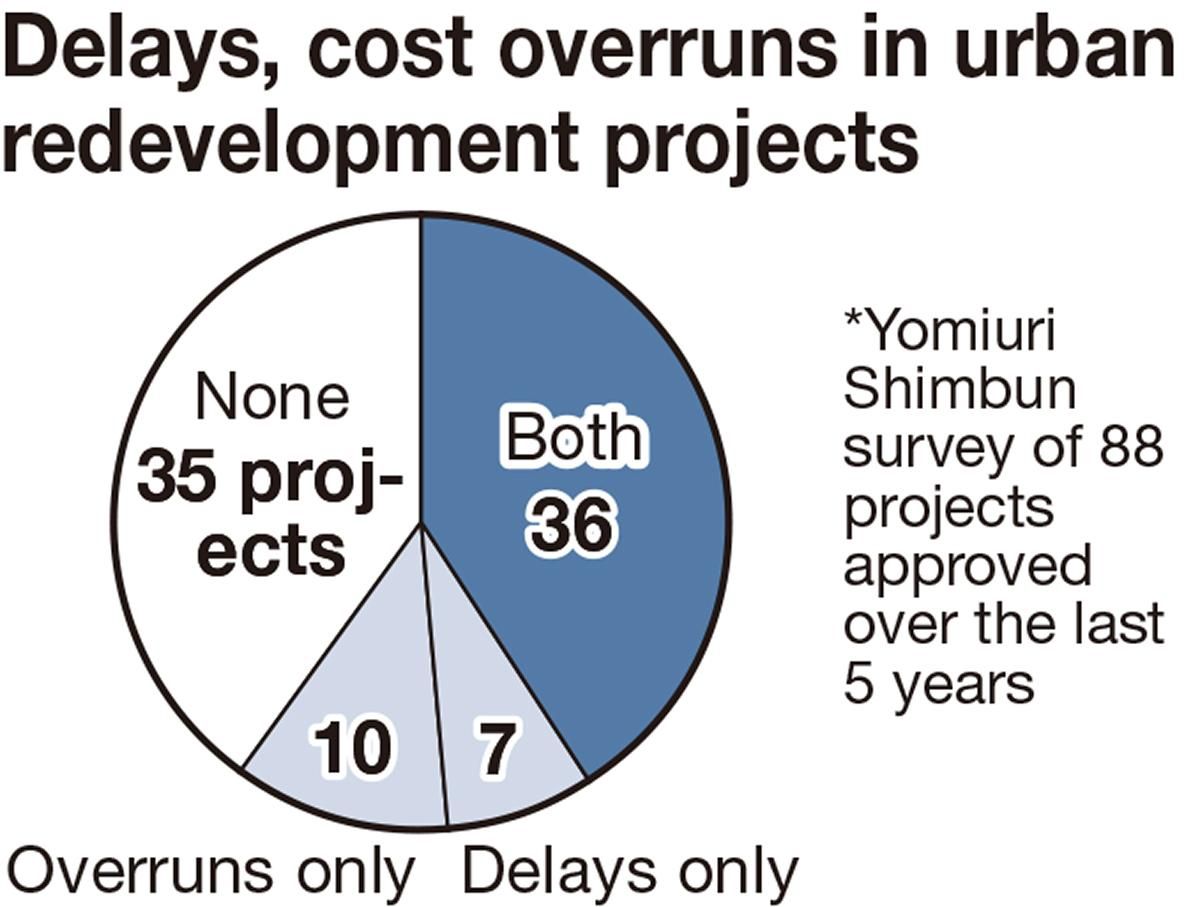
The Yomiuri Shimbun sent questionnaires in October to developers, such as redevelopment associations, and to municipalities about 141 projects underway in 27 prefectures as of the end of September, asking about construction times and costs. It received responses for 126 projects, or 89% of the total. Among these, the Yomiuri analyzed 88 projects approved between October 2020 and this September, a period marked by a significant rise in construction costs.
According to the survey, construction times for 43 projects, or 49% of the total, were extended for about 1½ years on average from when they were approved. Notable delays include a redevelopment for offices and apartments at the Tokyo’s Nihombashi district that was 46 months behind schedule; Itabashi Station’s west exit, Fukushima Station’s east exit and Minami-dori street in front of Fukui Station, with each delayed by three years; and the Suehiromachi 1-chome district in Oita, which was two years behind schedule.
Cost overruns triggered by rising construction expenses were the primary cause of the delays, with respondents saying, “Construction costs increased significantly due to high prices” or “We revised funding plans due to soaring labor costs.” This applied to at least 17 projects, including the Nihombashi, Itabashi and Fukushima projects.
According to the Land, Infrastructure, Transport and Tourism Ministry, city redevelopment projects since the 2000s have taken around five years from approval to completion on average, but in the survey, projects averaged seven years and two months for completion.
The survey also found that 46 projects, or 52%, faced a cost increase from when they were approved, with the increase averaging ¥11.4 billion. The Nihombashi project ballooned by ¥63.5 billion to ¥158.5 billion. Fifty-three projects, or 60%, faced at least a delay or a cost hike, while 36 projects, or 41%, experienced both.
Rising costs have also caused projects to be abandoned before they were even started. Tokyo’s Nakano Ward terminated a basic agreement for a redevelopment plan around the Nakano Sunplaza complex.
“Many projects are being forced to scale back plans due to the sharp rise in construction costs, which could impact urban planning as a whole,” said Hiroo Ichikawa, a professor emeritus at Meiji University. “Local governments need to be more proactive in engaging with and supporting these plans, rather than leaving everything to the developers.”







Most Read
Popular articles in the past 24 hours
-

Milano Cortina 2026: Japan’s Kaori Sakamoto Wins Silver; Ami Naka...
-

Japan's PM Takaichi Looks to Establish Dominance as She Follows i...
-

Milano Cortina 2026: Kaori Sakamoto Wins Silver, Ami Nakai Takes ...
-
Approval of Takaichi Cabinet Stands at 73%; Yomiuri Survey Finds ...
-

Anonymous Individual Donates Gold Bars Worth ¥566 Mil. to Osaka M...
-

New Japanese Animated Film ‘A New Dawn’ Applauded at Berlin Inter...
-

Ex-ROK President Yoon Gets Life Sentence: Declaration of Martial ...
-
Early-Blooming Cherry Blossoms Adorn Former Samurai Residences in...
Popular articles in the past week
-

Japan PM Takaichi’s Cabinet Resigns en Masse
-

Man Infected with Measles Reportedly Dined at Restaurant in Tokyo...
-

Videos Plagiarized, Reposted with False Subtitles Claiming ‘Ryuky...
-

Sanae Takaichi Elected 105th Prime Minister of Japan; Keeps All C...
-

Japan's Govt to Submit Road Map for Growth Strategy in March, PM ...
-

Milano Cortina 2026: Figure Skaters Riku Miura, Ryuichi Kihara Pa...
-

Bus Carrying 40 Passengers Catches Fire on Chuo Expressway; All E...
-

Tokyo’s New Record-Breaking Fountain Named ‘Tokyo Aqua Symphony’
Popular articles in the past month
-
Japan PM Takaichi’s Cabinet Resigns en Masse
-

Japan Institute to Use Domestic Commercial Optical Lattice Clock ...
-

Israeli Ambassador to Japan Speaks about Japan’s Role in the Reco...
-
Man Infected with Measles Reportedly Dined at Restaurant in Tokyo...
-

Man Infected with Measles May Have Come in Contact with Many Peop...
-
Videos Plagiarized, Reposted with False Subtitles Claiming ‘Ryuky...
-

Prudential Life Insurance Plans to Fully Compensate for Damages C...
-

Woman with Measles Visited Hospital in Tokyo Multiple Times Befor...
Top Articles in Society
-
Man Infected with Measles Reportedly Dined at Restaurant in Tokyo Station
-
Man Infected with Measles May Have Come in Contact with Many People in Tokyo, Went to Store, Restaurant Around When Symptoms Emerged
-
Woman with Measles Visited Hospital in Tokyo Multiple Times Before Being Diagnosed with Disease
-
Australian Woman Dies After Mishap on Ski Lift in Nagano Prefecture
-
Foreign Snowboarder in Serious Condition After Hanging in Midair from Chairlift in Nagano Prefecture
JN ACCESS RANKING
-
Japan PM Takaichi’s Cabinet Resigns en Masse
-
Japan Institute to Use Domestic Commercial Optical Lattice Clock to Set Japan Standard Time
-
Israeli Ambassador to Japan Speaks about Japan’s Role in the Reconstruction of Gaza
-
Man Infected with Measles Reportedly Dined at Restaurant in Tokyo Station
-
Man Infected with Measles May Have Come in Contact with Many People in Tokyo, Went to Store, Restaurant Around When Symptoms Emerged