
Fermented Foods Become Tourist Attractions, Local Revitalization Amid Health-Conscious Trends
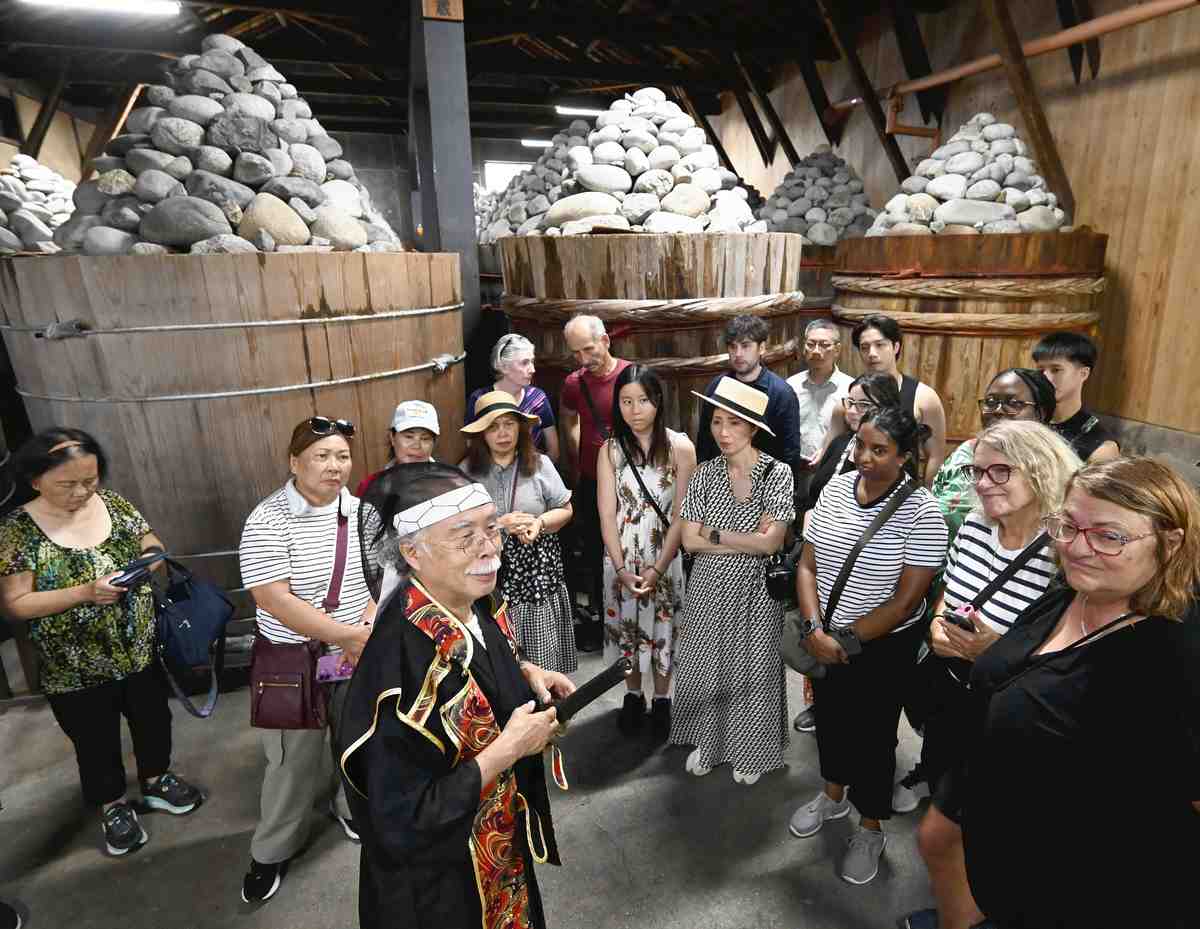
Nobutaro Asai, president of Maruya Hatcho Miso Co., explains his company’s miso production process to tourists from overseas in Okazaki, Aichi Prefecture.
15:18 JST, November 16, 2025
NAGOYA — Localities are capitalizing on a growing taste for fermentation tourism — where fermented foods like miso, soy sauce and sake help lure tourists in.
Aichi Prefecture, home to many manufacturers of fermented foods, is running a campaign to raise awareness of its food culture. Aichi promotes itself as “the prefecture of umami,” referring to the flavor produced during the fermentation process when microorganisms break down proteins.
“Our hatcho miso tastes like cheese,” said Nobutaro Asai, 76, president of Maruya Hatcho Miso Co. in Okazaki, Aichi Prefecture, during a factory tour in September. “It takes more than two years to make.”
Founded in 1337, the long-established miso maker does business with more than 20 countries.
Asai explained the manufacturing process during the tour to a group of about 30 foreign tourists, who admired the miso soup they were served, saying it had a great flavor.
A 73-year-old man from the United States seemed to like the taste of the soup. “I’ve never ate it before,” he said. “I’m going to check back at the States.”
Fermented foods have come into focus amid a growing trend toward health consciousness. In recent years, even chefs from overseas have visited the miso company.
“People are even interested in the wooden barrels we’ve been using for over 160 years,” Asai said. “We also want to convey the Japanese culture of treasuring tools.”
Last year, the Aichi prefectural government launched a promotion council with 41 municipalities and industry groups within the prefecture with the aim of turning fermented foods into a tourist attraction. In September, the council exhibited miso and soy sauce at Tourism Expo Japan, one of the world’s largest travel trade fairs.
The council has set up a registration system for restaurants that serve dishes using fermented foods. As Aichi is set to host the Asian Games and Asian Para Games next autumn, with 45 countries and regions participating, the prefectural government has local fermented foods in its sights as one of the main pillars for promoting tourism.
One of the council’s aims is to promote fermented food manufacturers, many of which are small and midsize enterprises. Sawada Shuzo Co., a sake brewery in Tokoname, Aichi Prefecture, has received support to provide multilingual guidance to tourists. The brewery has seen a rise in tourists from Hong Kong, Taiwan and Singapore, who fly into Chubu Airport. The company said visitors seem to find it exciting to learn about traditional sake brewing methods at its historic buildings.
Chiba Prefecture, the top producer of soy sauce and mirin in Japan, is also promoting the appeal of its products.
Fermentation culture was developed there during the Edo period (1603-1867) by taking advantage of local rivers that were used to transport products to Edo (now Tokyo). In August, the prefectural government exhibited some of its locally produced fermented products at the 2025 Osaka-Kansai Expo. About 78,000 people visited the exhibition over five days, with queues forming for original products, such as shaved ice with strawberry and shiro (white) mirin, a specialty of the prefecture.
Fukushima Prefecture, meanwhile, has a thriving brewing industry. In September, the prefectural government published a booklet in collaboration with the travel guide “co-Trip” to introduce the prefecture’s fermentation-related facilities.
In June, the prefectural government organized a train tour on a trial basis that took participants to soy sauce- and wine-producing places. Although the tour had been targeted at women, many men took part, prompting the prefectural government to consider encouraging travel agencies to organize similar tours.
“We felt there was demand [for such tours], regardless of gender or age,” said an official.
“Fermented food culture can be found in various regions in Japan, and each region has the potential to attract visitors,” said Masayuki Kondo, an expert on fermentation tourism at the Japan Institute of Tourism Research. He said it is important for such regions not only to give tourists the chance to interact with locals by having them experience some of the production processes of fermented foods and taste the products, but also to train people who can talk about the history of their food culture.
“If these regions as whole can promote the appeal of their fermented foods, more visitors will be attracted and their communities will be vitalized,” he added.








Most Read
Popular articles in the past 24 hours
-
Business Hotels Expanding into Regional Areas in Japan, Aiming to...
-
Milano Cortina 2026: Japan Sees Leap in Olympic Performance Throu...
-

Milano Cortina 2026: Japan's Satoshi Furuno Places 4th in Men's S...
-

Fiji Defense Minister Hopes Japan Will Support Stabilization of P...
-
6 Injured at Naked Festival in Japan’s Okayama Prefecture; Police...
-

Milano Cortina 2026: Speed Skater Takagi Finishes 6th in the 1,50...
-

Milano Cortina 2026: Malinin Highlights Dangers of Social Media i...
-

3rd Japan Pacific Islands Defense Dialogue to Begin in Tokyo on S...
Popular articles in the past week
-

Japan PM Takaichi’s Cabinet Resigns en Masse
-

Man Infected with Measles Reportedly Dined at Restaurant in Tokyo...
-

Sanae Takaichi Elected Prime Minister of Japan; Keeps All Cabinet...
-

Japan's Govt to Submit Road Map for Growth Strategy in March, PM ...
-

Bus Carrying 40 Passengers Catches Fire on Chuo Expressway; All E...
-

Milano Cortina 2026: Figure Skaters Riku Miura, Ryuichi Kihara Pa...
-

Japan, U.S. Name 3 Inaugural Investment Projects; Reached Agreeme...
-
U.S. Firm to Build Training Hub in Fukushima N-plant for Debris R...
Popular articles in the past month
-
Japan PM Takaichi’s Cabinet Resigns en Masse
-

Japan Institute to Use Domestic Commercial Optical Lattice Clock ...
-

Israeli Ambassador to Japan Speaks about Japan’s Role in the Reco...
-
Man Infected with Measles Reportedly Dined at Restaurant in Tokyo...
-

Videos Plagiarized, Reposted with False Subtitles Claiming ‘Ryuky...
-

Man Infected with Measles May Have Come in Contact with Many Peop...
-

Prudential Life Insurance Plans to Fully Compensate for Damages C...
-
Woman with Measles Visited Hospital in Tokyo Multiple Times Befor...
Top Articles in Society
-
Man Infected with Measles Reportedly Dined at Restaurant in Tokyo Station
-
Man Infected with Measles May Have Come in Contact with Many People in Tokyo, Went to Store, Restaurant Around When Symptoms Emerged
-
Woman with Measles Visited Hospital in Tokyo Multiple Times Before Being Diagnosed with Disease
-
Australian Woman Dies After Mishap on Ski Lift in Nagano Prefecture
-
Foreign Snowboarder in Serious Condition After Hanging in Midair from Chairlift in Nagano Prefecture
JN ACCESS RANKING
-
Japan PM Takaichi’s Cabinet Resigns en Masse
-
Japan Institute to Use Domestic Commercial Optical Lattice Clock to Set Japan Standard Time
-
Israeli Ambassador to Japan Speaks about Japan’s Role in the Reconstruction of Gaza
-
Man Infected with Measles Reportedly Dined at Restaurant in Tokyo Station
-
Videos Plagiarized, Reposted with False Subtitles Claiming ‘Ryukyu Belongs to China’; Anti-China False Information Also Posted in Japan