
14:40 JST, November 16, 2025
Efforts to preserve aircraft as cultural properties have been gaining momentum, with the aim of passing on the history of Japan’s aviation technology to future generations.
Unlike trains, ships and automobiles, no aircraft has been designated as an important cultural property by the central government, and that fact is thought to be behind the efforts.
Hayate: A valuable historical resource
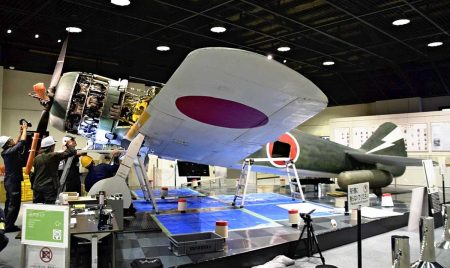
The Hayate fighter aircraft is examined to ensure it is preserved in good condition.
The Hayate, the nickname of the Imperial Japanese Army’s Type 4 fighter aircraft, was put into operational service in 1944 and became the army’s main aircraft during the latter stages of the Pacific War. One Hayate survives, and it is on display at the Chiran Peace Museum in Minamikyushu, Kagoshima Prefecture.
“Is it all right to lubricate this with grease?” Taizo Nakamura, 57, in charge of restoring fighters, asked other specialists during an examination of the aircraft at the museum around the end of August. He had removed the aircraft’s shaft — a component that rotates the inertia starter to start the engine — and was inquiring about how to preserve it.
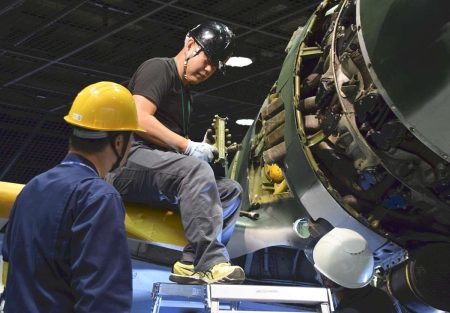
Taizo Nakamura removes the shaft from the Hayate’s body.
“We need to choose the most appropriate method for preserving the aircraft, not flying it,” Nakamura said.
This time, the workers decided to use a high-viscosity lubricant to prevent corrosion. They separated the fuel pump and the starter from the body of the aircraft and examined them. The preserved components were in good condition.
The Hayate is about 10 meters long, 11 meters wide and 3 meters high. About 3,500 units were produced.
Since the end of the war, the Hayate now at the museum had been owned by an American civilian and a Japanese museum before it was acquired by the government of Chiran (now part of Minamikyushu). It has been on display at the museum since 1997.
The examinations have been conducted annually since 2017 by people related to the Tokyo National Research Institute for Cultural Properties and the Japan Aeronautic Association in Tokyo, as well as private-sector experts.
In addition to checking and discussing how best to preserve the parts, the team has examined the serial numbers engraved on the parts and other details and discovered that the aircraft is composed almost entirely of its original parts.
Recognizing its rarity, the Minamikyushu municipal government designated the aircraft as a municipal tangible cultural property in 2020.
Although it is very unlikely that the aircraft was produced in Chiran, records indicate that one of the military airfields from which some Hayate aircraft departed on kamikaze suicide missions was in Chiran.
Only 5 items designated
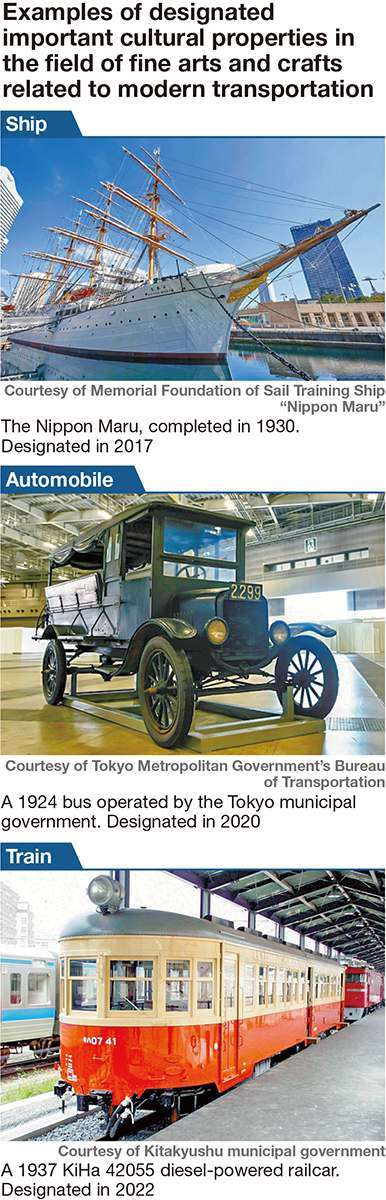
So far, only five aircraft-related items have been designated as cultural properties by local governments. Of them, only the Hayate at the museum is a complete aircraft, with the others being parts, such as propellers, and models.
The newest object designated as an important cultural property by the central government in the transportation category is the KiHa 42055 diesel-powered railcar, a passenger railcar produced in 1937. Objects manufactured earlier tend to have already received designations.
“Consensus has already been reached on preserving the Hayate as a valuable historical artifact,” said Tsuyoshi Chiba, 40, a researcher at the Tokyo National Research Institute for Cultural Properties.
The museum in Minamikyushu says that it will continue to examine the aircraft with the possibility of receiving the central government’s designation in mind.
Some local governments are independently examining local “war relics” remaining in their areas.
“The Hayate represents the pinnacle of technology at the time,” said Satoshi Yamaki, 49, a curator at the Chiran Peace Museum. “Although academic research on war-related cultural properties has tended to be shunned until recently, recognition of their importance as historical materials is spreading, particularly among the postwar generations.”
Only postwar passenger aircraft deteriorates

The first prototype of the YS-11 has a severely damaged window frame.
In December last year, an expert panel was launched at the Museum of Aeronautical Sciences in Shibayama, Chiba Prefecture, to discuss how best to preserve the first prototype of the YS-11, the first passenger aircraft made in Japan after the end of the war.
The aircraft has been on display outside the museum, where it has deteriorated due to exposure to wind and rain.
An interim report issued by the panel in March made recommendations to preserve the aircraft indoors, as well as short-term measures such as partial repainting.
Following the war, Japan’s aircraft production was restricted by the GHQ. After those restrictions were lifted, Japan developed the YS-11 through a joint public-private effort.
Kazuyoshi Suzuki, 67, a member of the panel and honorary researcher at the National Museum of Nature and Science, has been involved with the YS-11 for many years. He played a key role in preserving the first mass-produced YS-11 and displaying it at the Hirosawa City Aviation Museum in Chikusei, Ibaraki Prefecture.
“After the war, Japan lacked technical capabilities, so it used imported parts to develop the YS-11,” Suzuki said. “Gaining know-how through the development processes, like strength testing, was huge for advancing Japan’s technical capabilities. The prototype represents the entire journey of creating the practical aircraft.”
To this day, the YS-11 is still the only passenger aircraft produced in Japan after the war.
“For Japan to remember the history of its manufacturing, [the prototype] should be available as tangible evidence for everyone to see.”
He added, “Passing on the will to preserve these artifacts for posterity is vital for the future.”








Most Read
Popular articles in the past 24 hours
-

Business Hotels Expanding into Regional Areas in Japan, Aiming to...
-

Milano Cortina 2026: Japan Sees Leap in Olympic Performance Throu...
-

Milano Cortina 2026: Japan's Satoshi Furuno Places 4th in Men's S...
-

Fiji Defense Minister Hopes Japan Will Support Stabilization of P...
-

6 Injured at Naked Festival in Japan’s Okayama Prefecture; Police...
-

Milano Cortina 2026: Speed Skater Takagi Finishes 6th in the 1,50...
-

Milano Cortina 2026: Malinin Highlights Dangers of Social Media i...
-

3rd Japan Pacific Islands Defense Dialogue to Begin in Tokyo on S...
Popular articles in the past week
-

Japan PM Takaichi’s Cabinet Resigns en Masse
-

Man Infected with Measles Reportedly Dined at Restaurant in Tokyo...
-

Sanae Takaichi Elected Prime Minister of Japan; Keeps All Cabinet...
-

Japan's Govt to Submit Road Map for Growth Strategy in March, PM ...
-

Bus Carrying 40 Passengers Catches Fire on Chuo Expressway; All E...
-

Milano Cortina 2026: Figure Skaters Riku Miura, Ryuichi Kihara Pa...
-

Japan, U.S. Name 3 Inaugural Investment Projects; Reached Agreeme...
-

U.S. Firm to Build Training Hub in Fukushima N-plant for Debris R...
Popular articles in the past month
-
Japan PM Takaichi’s Cabinet Resigns en Masse
-

Japan Institute to Use Domestic Commercial Optical Lattice Clock ...
-

Israeli Ambassador to Japan Speaks about Japan’s Role in the Reco...
-
Man Infected with Measles Reportedly Dined at Restaurant in Tokyo...
-

Videos Plagiarized, Reposted with False Subtitles Claiming ‘Ryuky...
-

Man Infected with Measles May Have Come in Contact with Many Peop...
-

Prudential Life Insurance Plans to Fully Compensate for Damages C...
-

Woman with Measles Visited Hospital in Tokyo Multiple Times Befor...
Top Articles in Society
-
Man Infected with Measles Reportedly Dined at Restaurant in Tokyo Station
-
Man Infected with Measles May Have Come in Contact with Many People in Tokyo, Went to Store, Restaurant Around When Symptoms Emerged
-
Woman with Measles Visited Hospital in Tokyo Multiple Times Before Being Diagnosed with Disease
-

Australian Woman Dies After Mishap on Ski Lift in Nagano Prefecture
-

Foreign Snowboarder in Serious Condition After Hanging in Midair from Chairlift in Nagano Prefecture
JN ACCESS RANKING
-
Japan PM Takaichi’s Cabinet Resigns en Masse
-
Japan Institute to Use Domestic Commercial Optical Lattice Clock to Set Japan Standard Time
-
Israeli Ambassador to Japan Speaks about Japan’s Role in the Reconstruction of Gaza
-
Man Infected with Measles Reportedly Dined at Restaurant in Tokyo Station
-
Videos Plagiarized, Reposted with False Subtitles Claiming ‘Ryukyu Belongs to China’; Anti-China False Information Also Posted in Japan