
14:00 JST, November 1, 2025
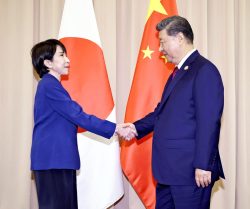
Though the meeting was a brief one, it was appropriate for newly appointed Prime Minister Sanae Takaichi to urge Chinese President Xi Jinping to resolve various pending issues between Japan and China.
Going forward, it is necessary for the leaders to repeat candid discussions and convert them into concrete results.
The Japan-China summit meeting was held in Gyeongju, South Korea. This was the first in-person meeting between the leaders of the two countries since former Prime Minister Shigeru Ishiba met with Xi in Peru last November.
Though the meeting this time lasted only 30 minutes, both leaders reportedly reaffirmed their commitment to promote a “strategic and mutually beneficial relationship” based on common interests and to pursue the building of stable relations.
At the start of the meeting, Takaichi said she wanted to reduce the pending issues and challenges between Japan and China and achieve results.
After the meeting, the prime minister detailed the specific concerns she conveyed to Xi. These included China’s coercive actions around the Senkaku Islands, Beijing’s export controls on rare earths, the detention of Japanese nationals, and human rights abuses in the Xinjiang Uyghur Autonomous Region.
The prime minister did not disclose the Chinese side’s responses, but it is crucial to persistently seek solutions not only at the leadership level but through multiple layers of engagement.
Chinese Coast Guard vessels have repeatedly entered Japan’s territorial waters around the Senkaku Islands. Furthermore, since the beginning of this year, Chinese oceanographic survey ships are said to have conducted underwater surveys in Japan’s exclusive economic zone (EEZ) off Amami Oshima and Tokunoshima islands without Japan’s consent.
If the Xi administration truly wishes to maintain a strategic and mutually beneficial relationship with Japan, it must refrain from activities that threaten Japan’s territory, territorial waters and interests.
For Japan, China is a trading partner on par with the United States. However, in recent years, the anti-espionage law enacted by the Xi administration has led to a series of cases in which Japanese nationals have been detained for unclear reasons, causing many Japanese companies to hesitate about expanding their business into China.
China’s export controls of rare earths are impacting the entire international community. If China regards itself to be a major power, it should refrain from exercising economic coercion.
Prior to her meeting with Xi, Takaichi also met with South Korean President Lee Jae Myung. The two leaders agreed on the need to pursue a future-oriented Japan-South Korea relationship. They reaffirmed their policy of maintaining close coordination among Japan, the United States and South Korea toward the denuclearization of North Korea.
This was the fourth in-person meeting between the leaders of Japan and South Korea since Lee took office. Reciprocal diplomacy between the two countries has also resumed, with Lee set to visit Japan next.
Takaichi is said to be regarded as having hard-line views toward China and South Korea, and many have expressed concerns about diplomacy with neighboring countries. However, by tempering such a stance this time, she appears to have safely managed the meetings with the Chinese and South Korean leaders.
(From The Yomiuri Shimbun, Nov. 1, 2025)



Most Read
Popular articles in the past 24 hours
-

Business Hotels Expanding into Regional Areas in Japan, Aiming to...
-
Milano Cortina 2026: Japan Sees Leap in Olympic Performance Throu...
-

Milano Cortina 2026: Japan's Satoshi Furuno Places 4th in Men's S...
-

Milano Cortina 2026: Speed Skater Takagi Finishes 6th in the 1,50...
-

Fiji Defense Minister Hopes Japan Will Support Stabilization of P...
-

6 Injured at Naked Festival in Japan’s Okayama Prefecture; Police...
-

Milano Cortina 2026: Malinin Highlights Dangers of Social Media i...
-
3rd Japan Pacific Islands Defense Dialogue to Begin in Tokyo on S...
Popular articles in the past week
-

Japan PM Takaichi’s Cabinet Resigns en Masse
-

Man Infected with Measles Reportedly Dined at Restaurant in Tokyo...
-

Sanae Takaichi Elected Prime Minister of Japan; Keeps All Cabinet...
-

Japan's Govt to Submit Road Map for Growth Strategy in March, PM ...
-

Bus Carrying 40 Passengers Catches Fire on Chuo Expressway; All E...
-

Milano Cortina 2026: Figure Skaters Riku Miura, Ryuichi Kihara Pa...
-
Japan, U.S. Name 3 Inaugural Investment Projects; Reached Agreeme...
-
U.S. Firm to Build Training Hub in Fukushima N-plant for Debris R...
Popular articles in the past month
-
Japan PM Takaichi’s Cabinet Resigns en Masse
-

Japan Institute to Use Domestic Commercial Optical Lattice Clock ...
-

Israeli Ambassador to Japan Speaks about Japan’s Role in the Reco...
-
Man Infected with Measles Reportedly Dined at Restaurant in Tokyo...
-

Videos Plagiarized, Reposted with False Subtitles Claiming ‘Ryuky...
-

Man Infected with Measles May Have Come in Contact with Many Peop...
-

Prudential Life Insurance Plans to Fully Compensate for Damages C...
-

Woman with Measles Visited Hospital in Tokyo Multiple Times Befor...
Top Articles in Editorial & Columns
-

Riku-Ryu Pair Wins Gold Medal: Their Strong Bond Leads to Major Comeback Victory
-
China Provoked Takaichi into Risky Move of Dissolving House of Representatives, But It’s a Gamble She Just Might Win
-
University of Tokyo Professor Arrested: Serious Lack of Ethical Sense, Failure of Institutional Governance
-

Policy Measures on Foreign Nationals: How Should Stricter Regulations and Coexistence Be Balanced?
-
Japan’s Plan for Investment in U.S.: Aim for Mutual Development by Ensuring Profitability
JN ACCESS RANKING
-
Japan PM Takaichi’s Cabinet Resigns en Masse
-
Japan Institute to Use Domestic Commercial Optical Lattice Clock to Set Japan Standard Time
-
Israeli Ambassador to Japan Speaks about Japan’s Role in the Reconstruction of Gaza
-
Man Infected with Measles Reportedly Dined at Restaurant in Tokyo Station
-
Videos Plagiarized, Reposted with False Subtitles Claiming ‘Ryukyu Belongs to China’; Anti-China False Information Also Posted in Japan