
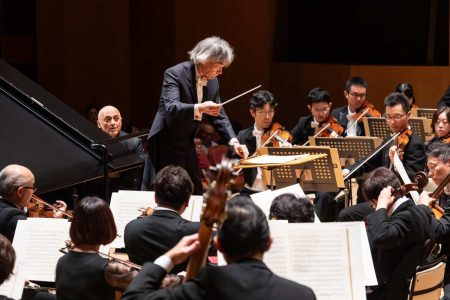
Kent Nagano conducts the Yomiuri Nippon Symphony Orchestra at Yokohama Minato Mirai Hall on Sept. 21.
13:33 JST, October 17, 2025
Kent Nagano made his much-awaited debut with the Yomiuri Nippon Symphony Orchestra (YNSO) with two concerts with different programs in late September.
On Sept. 21, the Japanese American maestro conducted three enjoyable pieces at the Yokohama Minato Mirai Hall in Yokohama.
The matinee concert had a wonderful start with the world premiere of Ichiro Nodaira’s “Le temps tisse IV — Yokohama modernite — pour orchestra” which was commissioned by the YNSO.
The delightful prelude with a fanfare explores the pioneering spirit of Yokohama, where there have been many firsts in Japan, such as trains, newspapers and telephones. It is the first orchestral work in his “Le temps tisse” (The woven time) series, a pageant of orchestral sounds.
Nodaira, a foremost composer of contemporary music in his generation, is also an accomplished conductor and pianist himself. Yet, this time he entrusted the job of conducting to Nagano, who conducted the world premiere of Nodaira’s opera “Madrugada” in 2005.
It was followed by Mozart’s Piano Concerto No. 24, with Italian virtuoso pianist Benedetto Lupo as the soloist. The concerto, composed in 1786, is in C minor, one of the few Mozart concertos in a minor key. Nagano, Lupo and the YNSO created good chemistry from the first movement, during which Lupo demonstrated a fascinating cadenza. The woodwind section of the YNSO stood out in the second movement.
The first half of the concert was already quite pleasing for the audience, but the highlight of the day came in the second half with Schubert’s Symphony No. 8 “The Great” in four movements. Nagano generated dynamism and sheer power of orchestral sounds, and he did so with grace. The oboe solo in the second movement was poignantly beautiful, and the exuberant final movement displayed not only bombastic beats but also clarity of sound.
The concert on Sept. 25 at Suntory Hall in Akasaka, Tokyo, was devoted to Mahler’s magnificent Symphony No. 7 “Lied der Nacht” (Song of the night).
The massive opus with five movements, composed from 1904 to 1905, represents Mahler’s attempt at deconstructing the traditional format of a symphony and expanding the possibility it offered. For one, the symphony is supposed to be in E minor, yet it is only toward the end of the first movement that the music is written in that key.
It was not Mahler’s intention to call the symphony “Lied der Nacht.” The music is full of commotion and emotions to the point of being almost chaotically so. If it expresses a night, it is definitely not a calm, peaceful night but a restless one. Even the second and fourth movements, which are subtitled “Nachtmusik” (night music), are no exceptions.
The first movement is particularly unsettling as the music explores various keys before reaching the root key of E. Nagano’s subtle sense of humor shone in the third movement scherzo, and the conductor found the right balance of chaos and cosmos in the gigantic final movement.
Concertmaster Yusuke Hayashi provided a beautiful violin solo in the middle section of the first movement and the beginning of the fourth movement.
After the performances at both concerts, even after most YNSO members left the stage, the audience did not stop applauding, and Nagano duly appeared on stage to take a final bow, which was a nice gesture indeed.








Most Read
Popular articles in the past 24 hours
-

Voters Using AI to Choose Candidates in Japan's Upcoming General ...
-

Japan's Snow-Clad Beauty: Camellia Flowers Seen in Winter Bloom a...
-

Monkey Strikes Junior High School Girl from Behind in Japan's Yam...
-

Genichiro Inokuma's Mural in Ueno Station That Gave Hope in Postw...
-

Senior Japanese Citizens Return to University to Gain Knowledge, ...
-

Foreign and Security Policy: Political Parties Must Discuss How T...
-

Heavy Snow Linked to 30 Deaths across Japan since Late Jan.; JMA ...
-

Tokyo Police Arrest Head of Resignation Assistance Firm
Popular articles in the past week
-

Japan Institute to Use Domestic Commercial Optical Lattice Clock ...
-
Australian Woman Dies After Mishap on Ski Lift in Nagano Prefectu...
-
Foreign Snowboarder in Serious Condition After Hanging in Midair ...
-

Chinese Embassy in Japan Reiterates Call for Chinese People to Re...
-

Narita Airport, Startup in Japan Demonstrate Machine to Compress ...
-

Toyota Motor Group Firm to Sell Clean Energy Greenhouses for Stra...
-

Sakie Yokota, Last Surviving Parent of a North Korea Abductee, Ur...
-

Beer Yeast Helps Save Labor, Water Use in Growing Rice; Govt Hope...
Popular articles in the past month
-
Univ. in Japan, Tokyo-Based Startup to Develop Satellite for Disa...
-

JAL, ANA Cancel Flights During 3-day Holiday Weekend due to Blizz...
-

China Confirmed to Be Operating Drilling Vessel Near Japan-China ...
-

China Eyes Rare Earth Foothold in Malaysia to Maintain Dominance,...
-
M6.2 Earthquake Hits Japan's Tottori, Shimane Prefectures; No Tsu...
-
Japan Institute to Use Domestic Commercial Optical Lattice Clock ...
-

Japan, Qatar Ministers Agree on Need for Stable Energy Supplies; ...
-

Japan, Italy to Boost LNG Cooperation; Aimed at Diversifying Japa...
Top Articles in Culture
-

Junichi Okada Wears Three Hats in ‘Last Samurai Standing,’ Serving as Star, Producer, Action Choreographer in Thrilling Netflix Period Drama
-
Lifestyle at Kyoto Traditional Machiya Townhouse to Be Showcased in Documentary
-

Maison&Objet Kicks off Near Paris with Japanese Lighting Designers’ Installations on Display, Creating Rich Environment
-

‘Jujutsu Kaisen’ Voice Actor Junya Enoki Discusses Rapid Action Scenes in Season 3, Airing Now
-

Prestigious Japanese Literature Prize Names Toriyama, Hatakeyama as Winners
JN ACCESS RANKING
-
Univ. in Japan, Tokyo-Based Startup to Develop Satellite for Disaster Prevention Measures, Bears
-
JAL, ANA Cancel Flights During 3-day Holiday Weekend due to Blizzard
-
China Confirmed to Be Operating Drilling Vessel Near Japan-China Median Line
-
China Eyes Rare Earth Foothold in Malaysia to Maintain Dominance, Counter Japan, U.S.
-
Japan Institute to Use Domestic Commercial Optical Lattice Clock to Set Japan Standard Time