
Zao ‘Snow Monsters’ Thinning Rapidly Due to Insect, Snow Damage; Research Shows Ice Tree Formations Have Shrunk Greatly in Recent Years
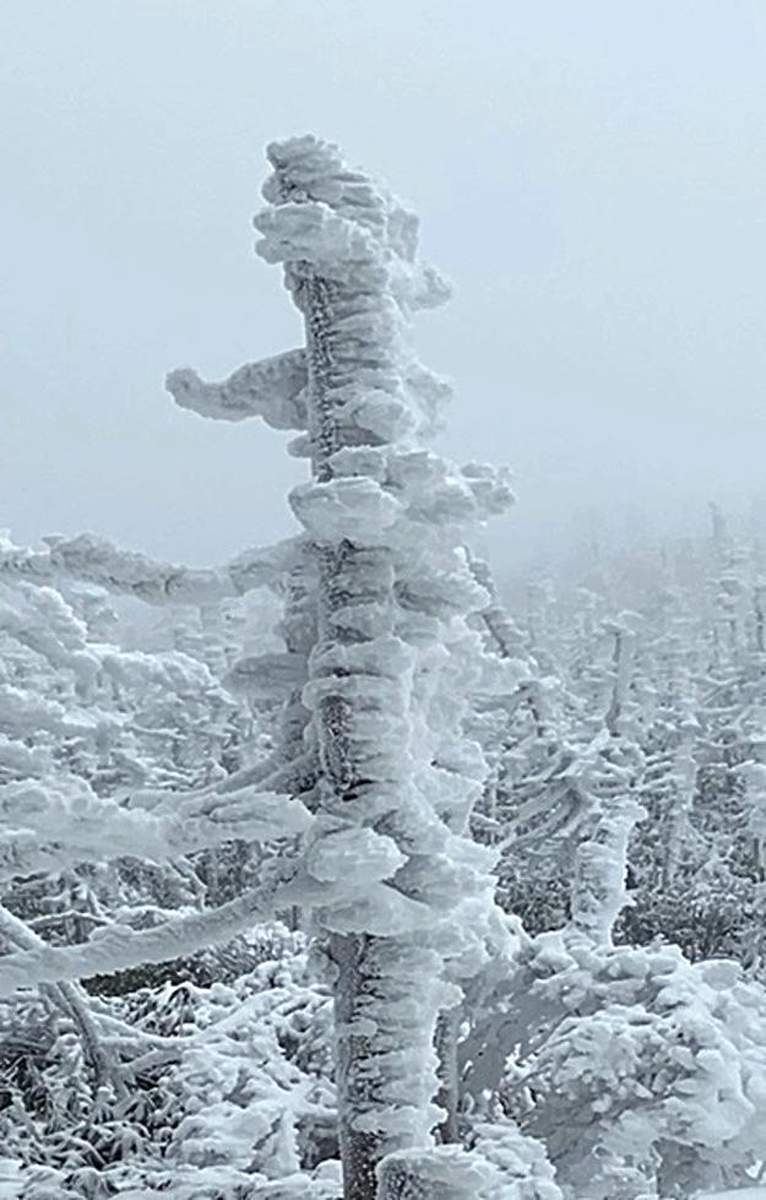
An ice tree thinned by insect damage is seen in this photo taken in 2022
13:00 JST, September 24, 2025
YAMAGATA — The ice formations on trees that create spectacular winter views in the Zao mountain range spanning Yamagata and Miyagi prefectures have been thinning rapidly since 2019, according to research by Yamagata University Prof. Emeritus Fumitaka Yanagisawa and others.
The thinning is attributed to the death from pest damage of many Maries’ fir trees — the conifers on which ice tree formations, also known as snow monsters, develop — causing branches to break under the weight of snow. The Yamagata prefectural government and other groups are planting trees to revitalize this important tourist resource.
Maries’ firs naturally grow in the Zao mountain range at altitudes between 1,300 and 1,700 meters above sea level; snow monsters form on those situated at heights at and above 1,500 meters. They are created when snow and moisture in the air are blown onto these trees. According to the company that operates the Zao Ropeway, 140,000 people visited to see the ice trees during the season from December 2024 to March 2025.
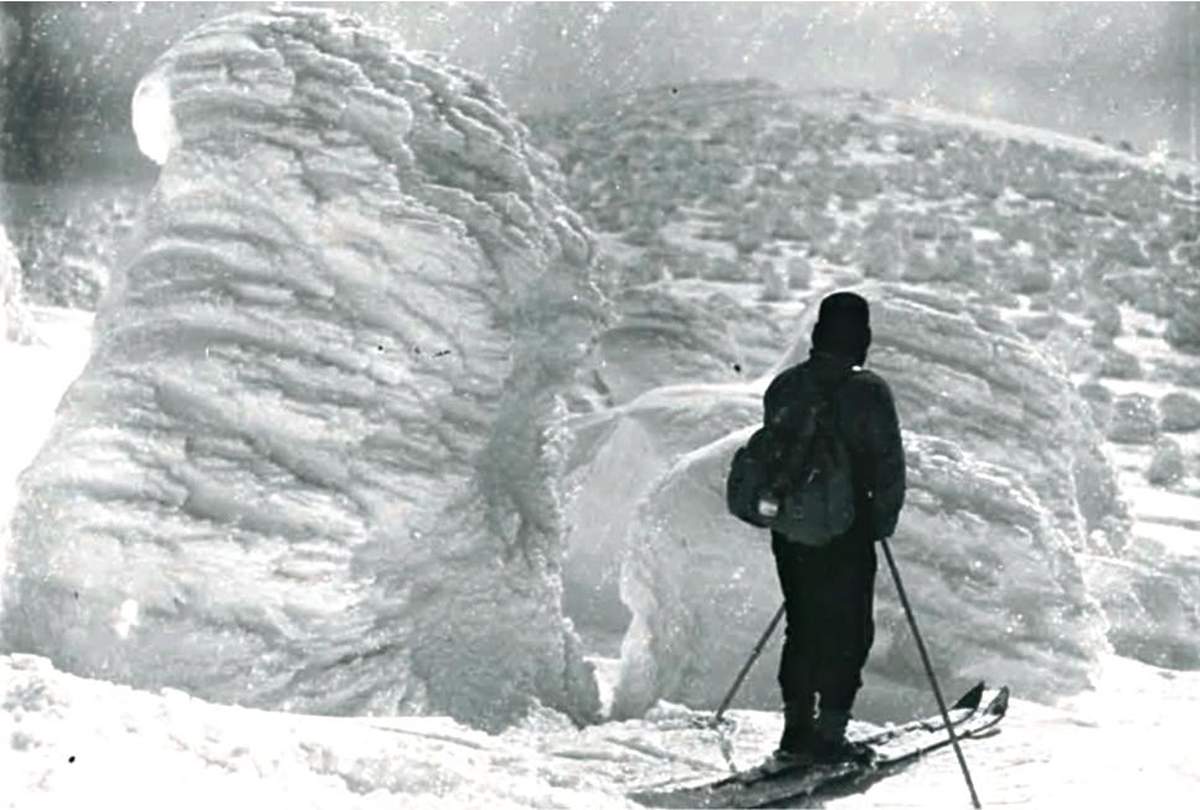
Massive ice trees estimated to be 5 meters to 6 meters thick are seen in this photo taken in 1933.
Juhyo-no-kai (The ice tree association), a society of researchers of which Yanagisawa is a member, analyzed thousands of old photographs of ice tree formations that developed around the ropeway’s Jizo Sancho Station, at an altitude of 1,661 meters, to compare their sizes over time.
The research found that formations with diameters of 5 to 6 meters were common in the 1930s to 1950s. Even after that, ones with diameters of 2 to 3 meters were seen until the 2010s. In recent years, however, the majority have measured only about 0.2 to 1 meter in diameter.
Massive outbreaks of moth larvae and other pests from around 2013-2016 caused the deaths of about 23,000 Maries’ firs across an area of 16 hectares around the station. These accounted for nearly 20% of the roughly 126,000 trees then growing in clusters on the Yamagata side of the mountain range.
Yanagisawa said the rapid thinning of the ice trees began around 2019, when more and more starved or weakened branches started breaking under the weight of accumulated snow. Trees with few branches or leaves cannot support large volumes of snow and ice. Even during this year’s heavy snowfall, most ice trees in areas above 1,600 meters above sea level remained only about 0.5 meters to 1 meter thick.
“We have seen many trees topple over under the weight of the snow,” Yanagisawa said. “We are afraid that the number of ice trees may decrease.”
The prefecture’s division in charge of nature conservation said the Forestry Agency began planting trees in 2019 and has planted 330 saplings around the station to date. In 2023, the agency, the prefecture, tourism groups and experts formed the Prefectural Council for the Restoration of Ice Trees in hopes of restoring Zao’s unusual natural landscape.


Related Tags




Most Read
Popular articles in the past 24 hours
-

Voters Using AI to Choose Candidates in Japan's Upcoming General ...
-
Japan's Snow-Clad Beauty: Camellia Flowers Seen in Winter Bloom a...
-

Monkey Strikes Junior High School Girl from Behind in Japan's Yam...
-
Genichiro Inokuma's Mural in Ueno Station That Gave Hope in Postw...
-

Senior Japanese Citizens Return to University to Gain Knowledge, ...
-

Foreign and Security Policy: Political Parties Must Discuss How T...
-
Heavy Snow Linked to 30 Deaths across Japan since Late Jan.; JMA ...
-

Tokyo Police Arrest Head of Resignation Assistance Firm
Popular articles in the past week
-

Japan Institute to Use Domestic Commercial Optical Lattice Clock ...
-
Australian Woman Dies After Mishap on Ski Lift in Nagano Prefectu...
-
Foreign Snowboarder in Serious Condition After Hanging in Midair ...
-

Chinese Embassy in Japan Reiterates Call for Chinese People to Re...
-

Narita Airport, Startup in Japan Demonstrate Machine to Compress ...
-

Toyota Motor Group Firm to Sell Clean Energy Greenhouses for Stra...
-
Sakie Yokota, Last Surviving Parent of a North Korea Abductee, Ur...
-

Beer Yeast Helps Save Labor, Water Use in Growing Rice; Govt Hope...
Popular articles in the past month
-

Univ. in Japan, Tokyo-Based Startup to Develop Satellite for Disa...
-
JAL, ANA Cancel Flights During 3-day Holiday Weekend due to Blizz...
-

China Confirmed to Be Operating Drilling Vessel Near Japan-China ...
-

China Eyes Rare Earth Foothold in Malaysia to Maintain Dominance,...
-
M6.2 Earthquake Hits Japan's Tottori, Shimane Prefectures; No Tsu...
-
Japan Institute to Use Domestic Commercial Optical Lattice Clock ...
-

Japan, Qatar Ministers Agree on Need for Stable Energy Supplies; ...
-

Japan, Italy to Boost LNG Cooperation; Aimed at Diversifying Japa...
Top Articles in Society
-
JAL, ANA Cancel Flights During 3-day Holiday Weekend due to Blizzard
-
Record-Breaking Snow Cripples Public Transport in Hokkaido; 7,000 People Stay Overnight at New Chitose Airport
-
Australian Woman Dies After Mishap on Ski Lift in Nagano Prefecture
-
Foreign Snowboarder in Serious Condition After Hanging in Midair from Chairlift in Nagano Prefecture
-

Train Services in Tokyo Resume Following Power Outage That Suspended Yamanote, Keihin-Tohoku Lines (Update 4)
JN ACCESS RANKING
-
Univ. in Japan, Tokyo-Based Startup to Develop Satellite for Disaster Prevention Measures, Bears
-
JAL, ANA Cancel Flights During 3-day Holiday Weekend due to Blizzard
-
China Confirmed to Be Operating Drilling Vessel Near Japan-China Median Line
-
China Eyes Rare Earth Foothold in Malaysia to Maintain Dominance, Counter Japan, U.S.
-
Japan Institute to Use Domestic Commercial Optical Lattice Clock to Set Japan Standard Time