
Survivors Honor Victims 1 Year after Torrential Rains in Noto Peninsula, Ishikawa Pref. That Claimed 19 Lives
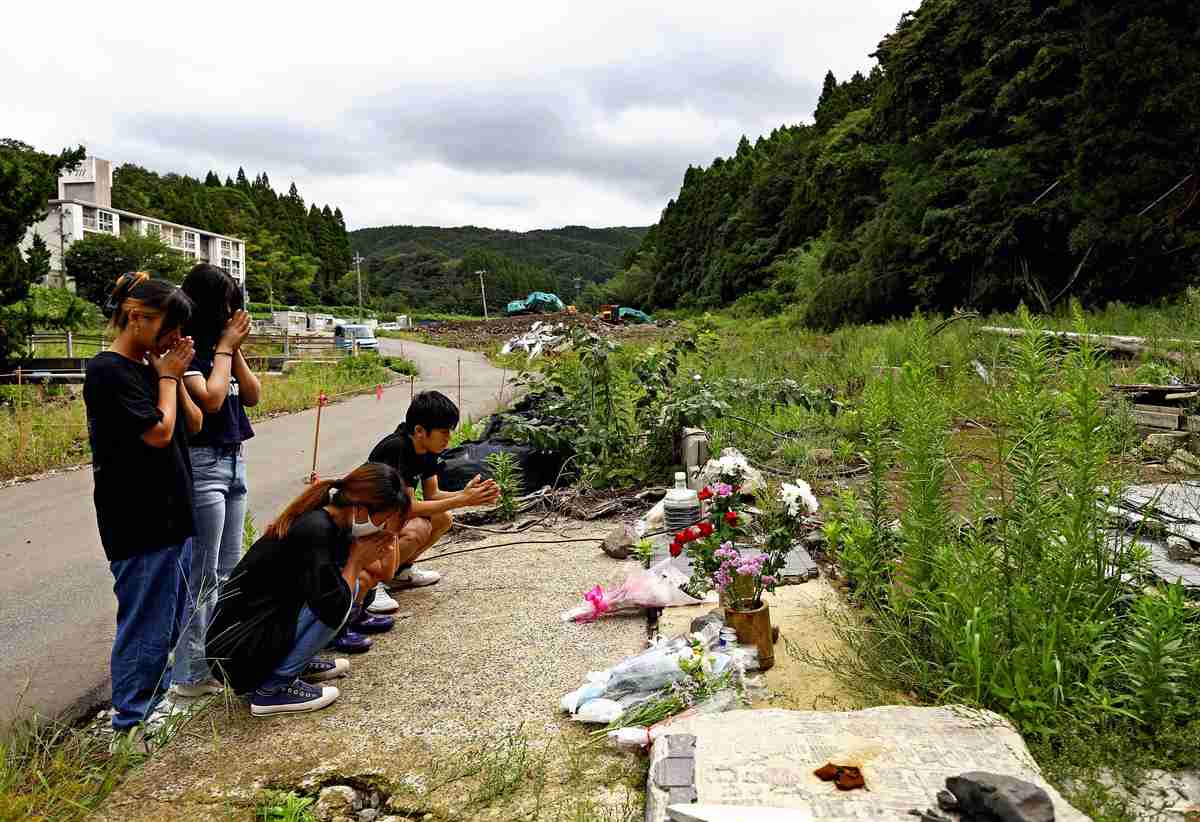
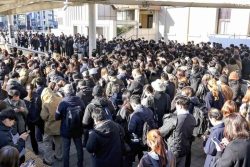
People offer prayers near the Tsukada River in Wajima, Ishikawa Prefecture, on Sunday.
16:24 JST, September 22, 2025
Sunday marked one year since the torrential-rain disaster on the Noto Peninsula that claimed 19 lives. Flower offerings were set up at six locations across Ishikawa Prefecture, where residents and families of the victims offered prayers. In the disaster-stricken areas that were also affected by the 2024 Noto Peninsula Earthquake, recovery remains incomplete, and survivors continue to hope for swift reconstruction.
In Wajima, which set up flower offerings at three sites, Mayor Shigeru Sakaguchi addressed residents at 9;30 a.m. over the government emergency radio system for disaster prevention and relief, saying, “Although times are tough, let us persevere together.” Residents observed a moment of silence.
Ishikawa Gov. Hiroshi Hase visited a section along the Tsukada River in the Futegawa district of Wajima, where four residents died after homes were swept away. “I tried to comprehend the terror they must have felt,” he said. “We must not make excuses about labor shortages or rising material costs. We must press on with recovery efforts.”
According to the prefecture, the torrential rains damaged 1,901 homes. Sixteen people were confirmed to have died directly in the disaster, and three more were recognized as disaster-related deaths.
Debris raises risk of renewed flooding
In the mountainous areas of Wajima, 2.53 million cubic meters of unstable sediment and fallen trees remain, according to estimates by the Land, Infrastructure, Transport and Tourism Ministry. These deposits, left by landslides triggered by the earthquake on New Year’s Day last year, contributed to widespread flooding during September’s torrential rains, when an estimated 650,000 cubic meters of debris was washed downstream. Authorities are working on countermeasures.
The ministry’s analysis, based on aerial laser surveys comparing terrain before and after the heavy rains, found that at least 630,000 cubic meters of soil and 20,000 cubic meters of fallen trees were washed away. Officials concluded that landslide debris from the quake was suddenly swept downstream by the powerful rainfall caused by a linear precipitation zone, creating a “compound disaster.”
Even after the rains, about 2.53 million cubic meters of unstable debris remains upstream, particularly in riverbeds. The largest deposits are along the Suzuya River (970,000 cubic meters) that flows through the center of the Machino district in Wajima, followed by the Ushio River (890,000 cubic meters) and the Tsukada River (350,000 cubic meters).
During the torrential rains of Sept. 21–22 last year, 28 rivers across the prefecture overflowed. Five of them — including the Tsukada River, where four residents died — were severely affected. Given the scale and urgency of the situation, the central government has taken over emergency restoration projects from the prefecture.
However, many of the unstable debris sites are located in steep upstream valleys, making removal work difficult. If washed away again, the debris could cause renewed flooding and destruction.
As a temporary measure, steel wire nets that are 12 meters wide and 5.5 meters high in addition to provisional check dams have been installed along the Tsukada River. Last month, when heavy rainfall of 304.5 millimeters caused the river to swell, these barriers stopped nearly 10,000 cubic meters of debris and prevented further damage.
The central government plans to build around 11 permanent check dams by fiscal 2029, while the prefecture aims to complete 16 additional structures by fiscal 2028.
“Sediment disasters can recur in the same places,” said Prof. Yuji Toda, a river engineering expert at Nagoya University. “Each resident must understand the risks and prepare accordingly.”






Most Read
Popular articles in the past 24 hours
-

Voters Using AI to Choose Candidates in Japan's Upcoming General ...
-

Japan's Snow-Clad Beauty: Camellia Flowers Seen in Winter Bloom a...
-

Monkey Strikes Junior High School Girl from Behind in Japan's Yam...
-
Genichiro Inokuma's Mural in Ueno Station That Gave Hope in Postw...
-

Senior Japanese Citizens Return to University to Gain Knowledge, ...
-

Foreign and Security Policy: Political Parties Must Discuss How T...
-
Heavy Snow Linked to 30 Deaths across Japan since Late Jan.; JMA ...
-

Tokyo Police Arrest Head of Resignation Assistance Firm
Popular articles in the past week
-

Japan Institute to Use Domestic Commercial Optical Lattice Clock ...
-
Australian Woman Dies After Mishap on Ski Lift in Nagano Prefectu...
-
Foreign Snowboarder in Serious Condition After Hanging in Midair ...
-

Chinese Embassy in Japan Reiterates Call for Chinese People to Re...
-

Narita Airport, Startup in Japan Demonstrate Machine to Compress ...
-

Toyota Motor Group Firm to Sell Clean Energy Greenhouses for Stra...
-

Sakie Yokota, Last Surviving Parent of a North Korea Abductee, Ur...
-

Beer Yeast Helps Save Labor, Water Use in Growing Rice; Govt Hope...
Popular articles in the past month
-

Univ. in Japan, Tokyo-Based Startup to Develop Satellite for Disa...
-
JAL, ANA Cancel Flights During 3-day Holiday Weekend due to Blizz...
-

China Confirmed to Be Operating Drilling Vessel Near Japan-China ...
-

China Eyes Rare Earth Foothold in Malaysia to Maintain Dominance,...
-
M6.2 Earthquake Hits Japan's Tottori, Shimane Prefectures; No Tsu...
-
Japan Institute to Use Domestic Commercial Optical Lattice Clock ...
-

Japan, Qatar Ministers Agree on Need for Stable Energy Supplies; ...
-

Japan, Italy to Boost LNG Cooperation; Aimed at Diversifying Japa...
Top Articles in Society
-
JAL, ANA Cancel Flights During 3-day Holiday Weekend due to Blizzard
-
Record-Breaking Snow Cripples Public Transport in Hokkaido; 7,000 People Stay Overnight at New Chitose Airport
-
Australian Woman Dies After Mishap on Ski Lift in Nagano Prefecture
-
Foreign Snowboarder in Serious Condition After Hanging in Midair from Chairlift in Nagano Prefecture
-
Train Services in Tokyo Resume Following Power Outage That Suspended Yamanote, Keihin-Tohoku Lines (Update 4)
JN ACCESS RANKING
-
Univ. in Japan, Tokyo-Based Startup to Develop Satellite for Disaster Prevention Measures, Bears
-
JAL, ANA Cancel Flights During 3-day Holiday Weekend due to Blizzard
-
China Confirmed to Be Operating Drilling Vessel Near Japan-China Median Line
-
China Eyes Rare Earth Foothold in Malaysia to Maintain Dominance, Counter Japan, U.S.
-
Japan Institute to Use Domestic Commercial Optical Lattice Clock to Set Japan Standard Time