
Savor Japanese Artisanal Culture at Cafes; Firms Use Important Cultural Assets to Attract Interest
13:53 JST, September 7, 2025
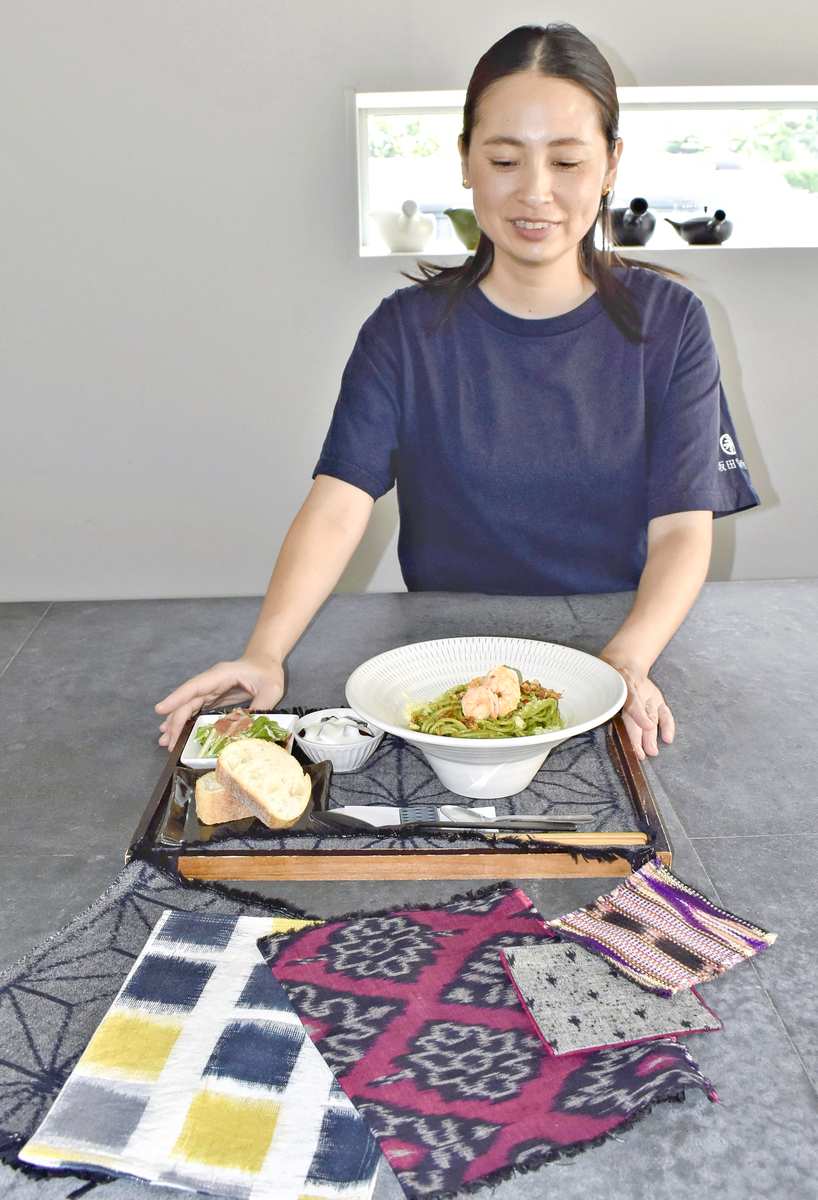
A sakata cafe staff member serves a dish on a Kurume kasuri placemat in Hirokawa, Fukuoka Prefecture.
FUKUOKA — Customers are increasingly able to enjoy traditional Japanese products at cafes run by artisanal businesses, and the trend is expected to contribute to promoting local industry and tourism.
Sakata-Orimono, a manufacturer of traditional Kurume kasuri fabrics using a tie-dying technique, runs sakata cafe in Hirokawa, Fukuoka Prefecture. The cafe sells items such as dresses, shirts and bags, along with a menu of kasuri-inspired food.
The cafe’s shaved ice, for example, is made by freezing butterfly pea herb tea and shaving it to resemble threads. When lemon syrup is poured over the blue-hued ice, it turns purple, and the change of colors is reminiscent of indigo dyeing during the Kurume kasuri manufacturing process.
The cafe also serves coffee brewed from beans cultivated in Guatemala, a country known for its own vibrant cloth-dyeing technique that resembles kasuri.
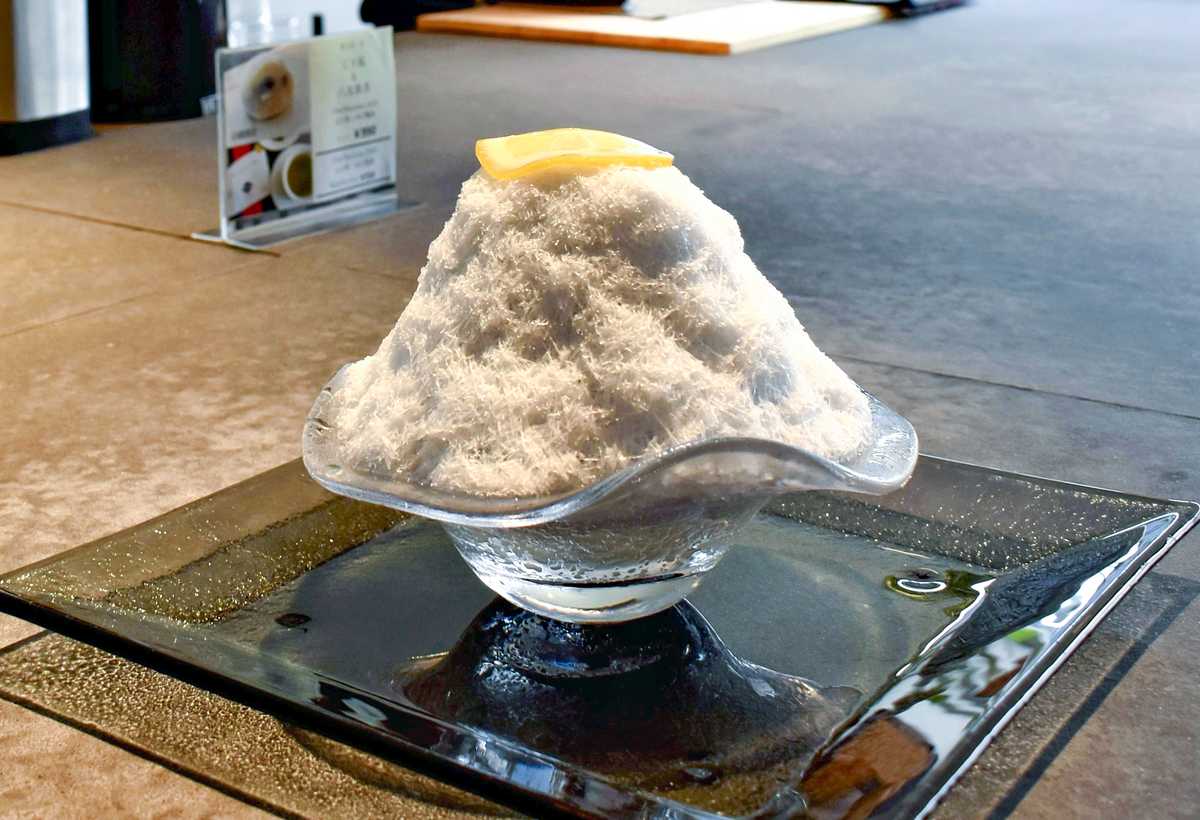
Shaved ice served at sakata cafe
There is also pasta made with green tea paste from the nearby city of Yame, a production area for high-grade green tea. The food is served on kasuri coasters and placemats from various countries.
Kurume kasuri is a traditional cotton textile from the prefecture’s Chikugo area. Bundles of threads are tightly tied up with hemp bark to be dyed so that the tied part remains undyed. Woven into a fabric, the carefully colored threads create various patterns. Some techniques in the process are designated as an important intangible cultural heritage asset.
Sakata Orimono was founded in 1948 and has participated in trade fairs in the United States since 2017 in efforts to cultivate a market abroad. However, kasuri is not well known overseas. Even domestically, changes in lifestyle have spurred the decline in people wearing kimono, and the emergence of diverse products has also led to a decline in the popularity of kasuri.
Sakata Orimono’s third-generation president, Kazuo Sakata, felt a sense of urgency and opened the cafe in 2022.
“If people understand the quality [of kasuri], they will surely appreciate it,” Sakata, 48, said. “I want them to discover its artistic charm through food.”
The cafe has steadily broadened its customer base, attracting younger customers and overseas tourists nowadays, he said.
“The texture of the cotton fabric and the fact that no two patterns are the same are the distinguishing characteristics of kasuri. I want to set some trends in motion to help kasuri survive as both a culture and an industry.”
Storehouse turns into cafe
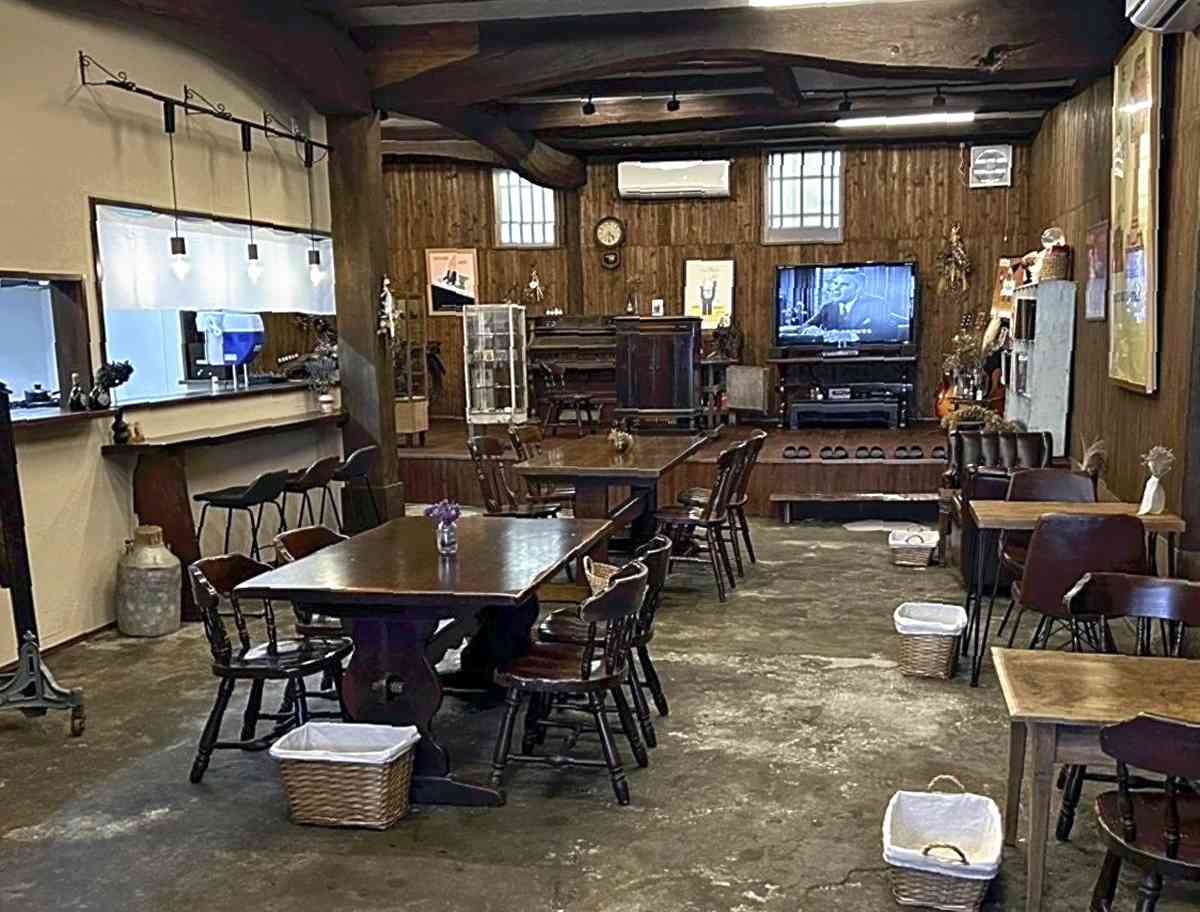
Cafe kULa in Minami-Shimabara, Nagasaki Prefecture, used to be Yoshidaya’s sake storehouse
Yoshidaya, a sake brewery founded in 1917, runs cafe kULa in Minami-Shimabara, Nagasaki Prefecture.
The brewery carries on the traditional sake-making method of squeezing sake with a wooden rod — called hanegi — using the principle of leverage. Cafe kULa was opened in 2023 by renovating an old sake storehouse. It offers coffee brewed from the same water used to make sake, which is served in a tokkuri flask. It also sells shaved ice, sake tasting sets and pudding made using the sweet drink amazake.
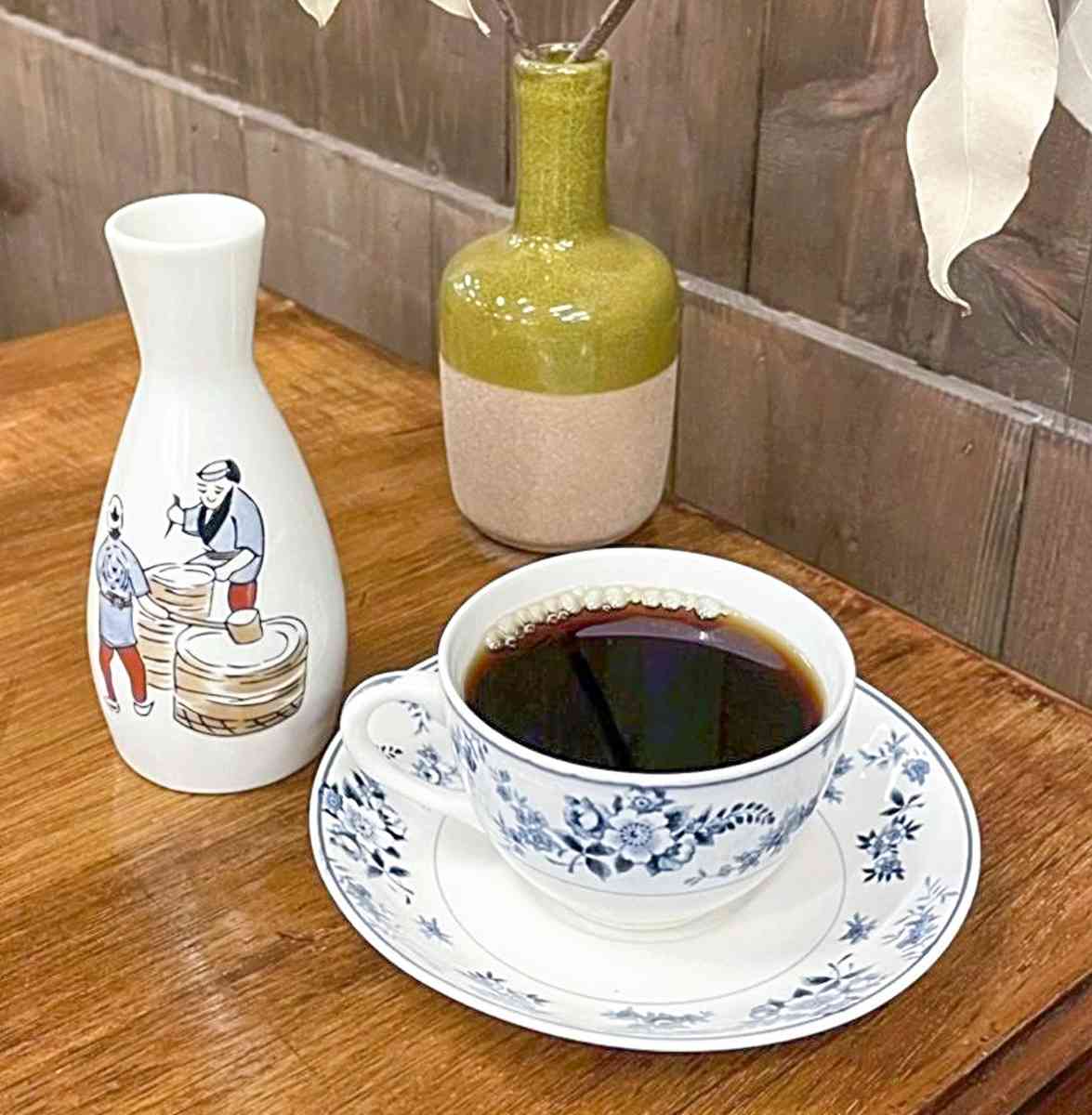
Coffee served in a tokkuri flask at cafe kULa
Customers visit Yoshidaya for more than the cafe. “I want young people who come to this cafe to discover that there is a brewery that has been around for over a century and also find out about this area,” fourth-generation owner Yoshiaki Yoshida, 63, said.
His daughter Hinako, 25, is the cafe’s manager. “We hope the cafe will be a starting point for travel to Minami-Shimabara,” she said.
Cafe at historic house
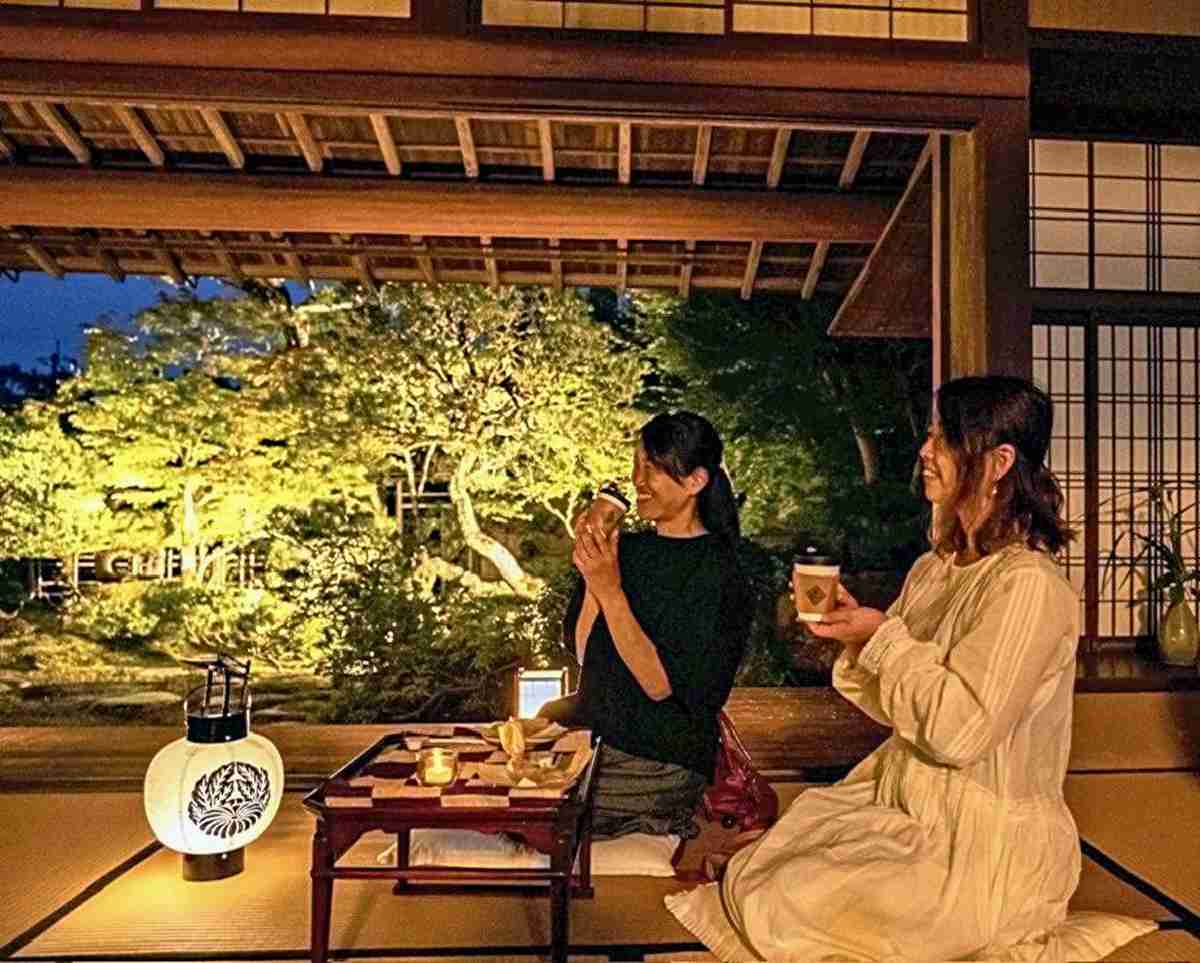
“Night Museum & Night Cafe” at the Kikuya Residence in Hagi, Yamaguchi Prefecture
The nationally designated important cultural property Kikuya Residence in Hagi, Yamaguchi Prefecture, serves drinks and sweets at night.
The house was once the residence of a wealthy merchant who supported the Choshu domain. The property comprises the main house, warehouses and a vast garden. Artworks and artifacts from the time are on display inside the house.
Since June, the Kikuya Residence Preservation Society, a public interest incorporated foundation formed by the family’s descendants, has held “Night Museum & Night Cafe” several times a month on Saturday evenings. It plans to do so until November. Visitors can explore the lantern-illuminated buildings, admire the lit-up garden and enjoy drinks and cheesecake made by a local cafe.
“We hope the event sparks visitors’ interest in this important cultural asset and makes them want to preserve it together for future generations,” said Miyako Kikuya, 66, the executive director of the society.


Related Tags






Most Read
Popular articles in the past 24 hours
-

Japan, U.S. Name 3 Inaugural Investment Projects; Reached Agreeme...
-

3 Brazilians Arrested for Stealing Toyota Land Cruiser; Trio Also...
-

Milano Cortina 2026: Japan’s Kaori Sakamoto Wins Silver; Ami Naka...
-

Andrew Mountbatten-Windsor Arrested on Suspicion of Misconduct in...
-
Kawazu Cherry Blossoms in Full Bloom in Japan's Shizuoka Pref.; F...
-
Japan's PM Takaichi Looks to Establish Dominance as She Follows i...
-
Approval of Takaichi Cabinet Stands at 73%; Yomiuri Survey Finds ...
-

Anonymous Individual Donates Gold Bars Worth ¥566 Mil. to Osaka M...
Popular articles in the past week
-

Japan PM Takaichi’s Cabinet Resigns en Masse
-

Man Infected with Measles Reportedly Dined at Restaurant in Tokyo...
-

Videos Plagiarized, Reposted with False Subtitles Claiming ‘Ryuky...
-

Sanae Takaichi Elected 105th Prime Minister of Japan; Keeps All C...
-

Japan's Govt to Submit Road Map for Growth Strategy in March, PM ...
-

Milano Cortina 2026: Figure Skaters Riku Miura, Ryuichi Kihara Pa...
-

Bus Carrying 40 Passengers Catches Fire on Chuo Expressway; All E...
-

Tokyo’s New Record-Breaking Fountain Named ‘Tokyo Aqua Symphony’
Popular articles in the past month
-
Japan PM Takaichi’s Cabinet Resigns en Masse
-

Japan Institute to Use Domestic Commercial Optical Lattice Clock ...
-

Israeli Ambassador to Japan Speaks about Japan’s Role in the Reco...
-
Man Infected with Measles Reportedly Dined at Restaurant in Tokyo...
-

Man Infected with Measles May Have Come in Contact with Many Peop...
-
Videos Plagiarized, Reposted with False Subtitles Claiming ‘Ryuky...
-

Prudential Life Insurance Plans to Fully Compensate for Damages C...
-

Woman with Measles Visited Hospital in Tokyo Multiple Times Befor...
Top Articles in Society
-
Man Infected with Measles Reportedly Dined at Restaurant in Tokyo Station
-
Man Infected with Measles May Have Come in Contact with Many People in Tokyo, Went to Store, Restaurant Around When Symptoms Emerged
-
Woman with Measles Visited Hospital in Tokyo Multiple Times Before Being Diagnosed with Disease
-
Australian Woman Dies After Mishap on Ski Lift in Nagano Prefecture
-
Foreign Snowboarder in Serious Condition After Hanging in Midair from Chairlift in Nagano Prefecture
JN ACCESS RANKING
-
Japan PM Takaichi’s Cabinet Resigns en Masse
-
Japan Institute to Use Domestic Commercial Optical Lattice Clock to Set Japan Standard Time
-
Israeli Ambassador to Japan Speaks about Japan’s Role in the Reconstruction of Gaza
-
Man Infected with Measles Reportedly Dined at Restaurant in Tokyo Station
-
Man Infected with Measles May Have Come in Contact with Many People in Tokyo, Went to Store, Restaurant Around When Symptoms Emerged