
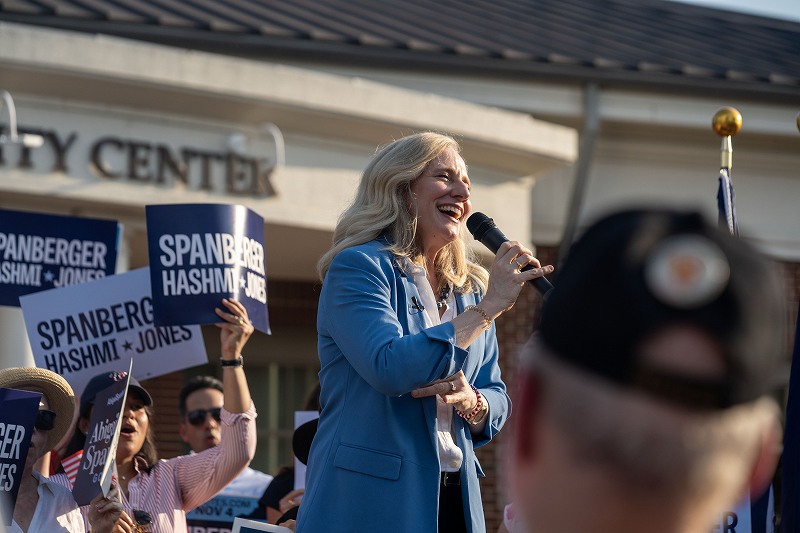
Former congresswoman Abigail Spanberger is running for Virginia governor.
11:22 JST, September 2, 2025
The midterms are over a year away, but both parties are gearing up for a spate of elections in November that could show how voters feel about President Donald Trump’s agenda and a Democratic Party in rebuilding mode.
There will be two closely watched governor’s races in New Jersey and Virginia, plus a ballot measure in California that will determine whether Democrats can counter Republican redistricting gains that Trump has urged in red states. While he is not on the ballot this year, views of Trump and his administration are factoring prominently into the marquee competitions.
On Labor Day, which typically marks the unofficial kickoff of the fall campaign season, here are five big questions as the sprint to Election Day 2025 begins.
1. Will Democrats sweep the governor’s races?
The open races for governor in New Jersey and Virginia will serve as the first major statewide contests since Trump returned to power, and in the latter state, Democrats are looking to flip the office from GOP incumbent Glenn Youngkin. The Democratic candidates – Rep. Mikie Sherrill in New Jersey and former congresswoman Abigail Spanberger in Virginia – are leading in polls.
In New Jersey, the Republican nominee is Jack Ciattarelli, a former state lawmaker who came surprisingly close in the 2021 governor’s race, while in Virginia, the GOP candidate is Lt. Gov. Winsome Earle-Sears. Trump has endorsed Ciattarelli, who is running as a counterweight to long-running liberal leadership in the state, while he has withheld support for Earle-Sears, whose campaign has faced intraparty criticism that it is not organized enough.
Democrats are cautiously optimistic and see helpful similarities between their two candidates, both centrists. Sherrill and Spanberger are moms with national security backgrounds who are running on lowering costs and seeking to tie their opponents to Trump’s agenda. Some Democrats see their politics as an effective blueprint for 2026 and are eager to hold up potential victories as evidence of success.
In Virginia, history is on the Democrats’ side this time around: Since 1977, only once has the state voted for a governor of the sitting president’s political party.
2. What will the elections say about Trump? And how will Republicans talk about him?
Trump has exuded confidence about the November 2026 elections, even as his polling numbers have been largely negative, predicting his party will “WIN BIG” and floating the prospect of an unusual national GOP convention before the midterms.
This year’s elections could provide clues about whether he is right – or whether Democrats will be well-positioned to reclaim some of the power they lost in 2024 by running against his agenda.
Both Ciattarelli (a former Trump critic) and Earle-Sears have done little to separate themselves from Trump, who lost New Jersey and Virginia last year by 6 percentage points apiece – nonetheless an improvement from his previous showings there. Nationally, Trump remains unpopular, receiving a 37 percent approval rating in a Quinnipiac University survey released last week.
Democrats in the races have especially seized on the massive tax and immigration law that Trump signed this summer. Spanberger’s campaign recently released a TV ad attacking Earle-Sears for saying the law “does so many great things.”
While Trump has not formally backed Earle-Sears, he said last month that he “would,” adding, “The candidate she’s running against is not very good, but I think she’s got a tough race.”
One variable is whether Trump will involve himself directly in the governor’s races, and whether his presence will be welcome. The Democratic candidates, who represent a party with drawing starkly negative polling numbers, will also have to decide which if any surrogates will be helpful to bring in.
Trump also looms large in the California redistricting battle, where Gov. Gavin Newsom (D) has cast his state’s ballot measure as a chance for voters to “fight back” against Trump’s “power grab.”
3. Will California voters approve Newsom’s redistricting gambit?
In California, Democrats are betting that voters will approve the measure to bypass the state’s independent redistricting commission and implement a congressional map that could turn five seats blue. Newsom, a potential 2028 presidential candidate, is spearheading the effort to push back against Texas’s redistricting at the behest of Trump, which created five new seats favoring Republicans.
A recent Berkeley IGS poll found voters supported the measure, 48 percent to 32 percent. However, a large chunk was undecided, and both sides are already raising tens of millions of dollars for a two-month sprint to sway public opinion.
There’s a lot at stake for both parties and for Newsom’s presidential ambitions. A win could raise his profile with Democrats, but a defeat would be an embarrassing setback.
Both sides are set to start airing TV ads this week, while another red state – Missouri – pushes forward with redistricting at Trump’s request.
4. Will New York City elect a democratic socialist mayor?
Voters in the most populous U.S. city have a mayoral election, and the front-runner is Zohran Mamdani, a 33-year-old state legislator and democratic socialist. He triumphed in the June Democratic primary over a crowded field that included former governor Andrew M. Cuomo, who is now challenging Mamdani in the general election as an independent.
The incumbent mayor, Eric Adams, has had a rocky tenure in office and is also running as an independent. He opted against seeking reelection as a Democrat after the party largely balked at his warming relationship with Trump; Justice Department this year successfully pushed to end a corruption case against Adams.
Mamdani has run emphatically on making life more affordable for New Yorkers, promising to “freeze the rent” in rent-stabilized apartments and make bus fares free. While he has not shied from the democratic socialist label, he has sought to distinguish himself from the Democratic Socialists of America and its platform.
The Democratic nominee’s ascent has stirred some debate in the party. Some Democrats say his election would give the party a badly needed, fresh-faced national leader. However, his liberal politics – and criticism of Israel – have given pause to others, including two fellow New York Democrats, Senate Minority Leader Charles E. Schumer and House Minority Leader Hakeem Jeffries, who have yet to endorse Mamdani.
Mamdani, who would be New York’s first Muslim mayor, has been ahead in polls, though his level of support is often below 50 percent, showing how he is benefiting from fractured opposition.
“Zohran Mamdani is positioned to win this election, and the only real question … is does Zohran win with a plurality or a majority and how strong is his mandate coming into office?” said Evan Roth Smith, a New York Democratic strategist, who is not working for any of the candidates.
5. What else will the elections tell us about the state of the Democratic Party?
The Democratic Party is in the midst of a spirited debate over generational change and how best to fight Trump, especially after then-President Joe Biden abandoned his reelection bid last year at age 81.
In Texas, there will be a Nov. 4 special election that carries echoes of the debate.
The contest is to fill the seat left vacant after Rep. Sylvester Turner (D) died in March at age 70. He briefly served after succeeding longtime Rep. Sheila Jackson Lee (D), who also died in office, at age 74.
The best-known Democratic candidates for the seat, which heavily skews blue, are all much younger, though they have sounded different notes on how hard Democrats should push back in Trump’s second term.
“We are not in normal times,” one of the candidates, 27-year-old Isaiah Martin, said Thursday during a debate, scoffing at rivals’ talk of bipartisanship earlier in the event. “We’ve got to fight back with everything we have.







Most Read
Popular articles in the past 24 hours
-

Man Infected with Measles May Have Come in Contact with Many Peop...
-

Tokyo Had 65,000 More People Move In Than Out In 2025; Osaka Area...
-

Green Tea Exports Hit Record High in 2025 Amid Growing Demand, Li...
-

Russia: Visa Required for Visiting Graves in Northern Territories...
-

Earthquake with Magnitude 4.8 Occurs off Japan’s Ibaraki Pref., S...
-

Hunting for Small Details in PokéPark KANTO, Keep a Sharp Eye Out...
-

Japan's Nikkei Stock Average Slips after Sharp Gain as Software F...
-

Not Ready for Robots in Homes? The Maker of a Friendly New Humano...
Popular articles in the past week
-
Australian Woman Dies After Mishap on Ski Lift in Nagano Prefectu...
-
Foreign Snowboarder in Serious Condition After Hanging in Midair ...
-

Chinese Embassy in Japan Reiterates Call for Chinese People to Re...
-

Narita Airport, Startup in Japan Demonstrate Machine to Compress ...
-

Toyota Motor Group Firm to Sell Clean Energy Greenhouses for Stra...
-

Sakie Yokota, Last Surviving Parent of a North Korea Abductee, Ur...
-

Beer Yeast Helps Save Labor, Water Use in Growing Rice; Govt Hope...
-

Japan Tourism Agency Calls for Strengthening Measures Against Ove...
Popular articles in the past month
-

Univ. in Japan, Tokyo-Based Startup to Develop Satellite for Disa...
-
JAL, ANA Cancel Flights During 3-day Holiday Weekend due to Blizz...
-
China Confirmed to Be Operating Drilling Vessel Near Japan-China ...
-
China Eyes Rare Earth Foothold in Malaysia to Maintain Dominance,...
-

Japan Institute to Use Domestic Commercial Optical Lattice Clock ...
-
M6.2 Earthquake Hits Japan's Tottori, Shimane Prefectures; No Tsu...
-

Japan, Qatar Ministers Agree on Need for Stable Energy Supplies; ...
-
Japan, Italy to Boost LNG Cooperation; Aimed at Diversifying Japa...
Top Articles in News Services
-

Prudential Life Expected to Face Inspection over Fraud
-

Arctic Sees Unprecedented Heat as Climate Impacts Cascade
-

South Korea Prosecutor Seeks Death Penalty for Ex-President Yoon over Martial Law (Update)
-
Trump Names Former Federal Reserve Governor Warsh as the Next Fed Chair, Replacing Powell
-

Suzuki Overtakes Nissan as Japan’s Third‑Largest Automaker in 2025
JN ACCESS RANKING
-
Univ. in Japan, Tokyo-Based Startup to Develop Satellite for Disaster Prevention Measures, Bears
-
JAL, ANA Cancel Flights During 3-day Holiday Weekend due to Blizzard
-
China Confirmed to Be Operating Drilling Vessel Near Japan-China Median Line
-
China Eyes Rare Earth Foothold in Malaysia to Maintain Dominance, Counter Japan, U.S.
-
Japan Institute to Use Domestic Commercial Optical Lattice Clock to Set Japan Standard Time