
13:37 JST, September 1, 2025
TIANJIN, China – Chinese leader Xi Jinping has welcomed a large group of foreign dignitaries to China for meetings that he hopes will unite regional powers in their shared grievances with the U.S.-led global order and the policies of President Donald Trump.
President Vladimir Putin of Russia, Alexander Lukashenko of Belarus and India’s Narendra Modi are among 20 foreign leaders attending the two-day Shanghai Cooperation Organization summit, which began Sunday in this port city 90 miles southeast of Beijing.
The forum is a key part of China’s campaign to be seen as a reliable partner and a counterweight to U.S. unpredictability in an increasingly multipolar world. Modi’s attendance in particular – his first visit to the country in seven years – is a milestone in Beijing’s attempt to mend ties with an influential U.S. partner that has been alienated by Trump’s tariffs.
For now, the 26-country grouping is primarily “united in a sense of aggrievement with the U.S. rather than a sense of common purpose,” said Carla Freeman, director of the Foreign Policy Institute at Johns Hopkins University’s School of Advanced International Studies. “These are big countries with their own agendas.”
The ceremonies will probably be as much about optics as about deals. Many of the dignitaries will stay on for a huge military parade in Beijing next week to mark the 80th anniversary of victory in World War II. North Korean leader Kim Jong Un, despite not attending in Tianjin, is expected to join Putin and Xi on the rostrum overlooking Tiananmen Square for Wednesday’s parade.
Originally founded by China and Russia in 2001 to cooperate on Central Asian militant threats, the SCO has taken on a broader economic and security mandate in recent years. Attracting leaders from across Asia, its annual meetings have become an important venue for Beijing and Moscow to jointly reshape international norms.
Despite deep divisions among members, Trump’s unpredictable policies have helped create “a coalition of like-minded countries against the U.S.,” said Claus Soong, an analyst at the Mercator Institute for China Studies, a think tank based in Berlin.
Alongside the BRICS economic grouping of Brazil, Russia, India, China, South Africa and others, the SCO has become central to Beijing’s message that “the West is not the dominating power or the sole answer,” Soong said. “It’s a highly political message.”
Even if the meeting in Tianjin achieves little, analysts said that simply attending can be valuable for autocratic governments and leaders – such as Putin and Iranian President Masoud Pezeshkian – to show they are not isolated despite Western sanctions.
Xi on Saturday pledged to support Myanmar to “unify all domestic political forces as much as possible and restore stability” in a meeting with Min Aung Hlaing, the head of the country’s military.
The forum was not founded to oppose Washington, said Zhu Yongbiao, an international relations scholar at Lanzhou University in northwest China, but Trump’s trade and foreign policies have contributed to global instability that is driving the group closer together.
“There is significant instability in the region and internationally, whether it’s the Russia-Ukraine conflict or the situation in the Middle East. Virtually all nations now have more security concerns,” Zhu said.
The bloc has grown from its original six countries to 10 full members. The expansion began with countries on China’s borders – India and Pakistan joined in 2017 – but it has since shifted farther west: Belarus became a full member last year. Turkey, Egypt and Saudi Arabia are among 14 dialogue partners, while Mongolia and Afghanistan are observers.
It has also shifted focus away from border security into broader economic dealmaking and visions of an alternative world order. Tianjin was chosen as host city this year in part because it pioneered the state-backed Luban workshops that have become a tool of Chinese influence under Xi’s trillion-dollar Belt and Road infrastructure and investment initiative.
China likes to emphasize the SCO’s reach – state media has highlighted that the grouping accounts for about a quarter of the global economy and 40 percent of the world’s population – but its members remain divided by long-standing rivalries that the yearly confabs have made little progress toward resolving.
In an act of careful diplomatic balancing, Modi visited Japan – another member of the Quadrilateral Security Dialogue that also includes Australia and the United States – before coming to Tianjin. He will skip the parade and its display of Chinese-made weapons, some of which have been used by Pakistan in the conflict between the two rivals in May.
Afghanistan’s absence is another example of the group’s limits. It has been an observer member since 2012 and China was the first country to accept a Taliban-appointed ambassador. But the Taliban were left out of this year’s gathering, likely thanks to U.S. and United Nations sanctions that prevent its leaders from international travel.
Beijing itself rejects the idea that the grouping should develop into a formal bloc. Instead, it casts the group as expanding the international influence of non-Western countries.
Zhu, the Lanzhou University scholar, described its function as more like a safe space for governments such as Iran to receive “moral support and public sympathy.”
But even if the organization is just a talk shop for now, it allows China to “be magnanimous and win friends and influence people,” said Freeman, the SAIS scholar: “Xi Jinping sees it as important opportunity to promote his vision for a different global order.”






Most Read
Popular articles in the past 24 hours
-

Man Infected with Measles May Have Come in Contact with Many Peop...
-
Tokyo Had 65,000 More People Move In Than Out In 2025; Osaka Area...
-
Green Tea Exports Hit Record High in 2025 Amid Growing Demand, Li...
-
Russia: Visa Required for Visiting Graves in Northern Territories...
-

Earthquake with Magnitude 4.8 Occurs off Japan’s Ibaraki Pref., S...
-

Hunting for Small Details in PokéPark KANTO, Keep a Sharp Eye Out...
-

Japan's Nikkei Stock Average Slips after Sharp Gain as Software F...
-
Not Ready for Robots in Homes? The Maker of a Friendly New Humano...
Popular articles in the past week
-
Australian Woman Dies After Mishap on Ski Lift in Nagano Prefectu...
-
Foreign Snowboarder in Serious Condition After Hanging in Midair ...
-
Chinese Embassy in Japan Reiterates Call for Chinese People to Re...
-
Narita Airport, Startup in Japan Demonstrate Machine to Compress ...
-

Toyota Motor Group Firm to Sell Clean Energy Greenhouses for Stra...
-
Sakie Yokota, Last Surviving Parent of a North Korea Abductee, Ur...
-

Beer Yeast Helps Save Labor, Water Use in Growing Rice; Govt Hope...
-
Japan Tourism Agency Calls for Strengthening Measures Against Ove...
Popular articles in the past month
-
Univ. in Japan, Tokyo-Based Startup to Develop Satellite for Disa...
-
JAL, ANA Cancel Flights During 3-day Holiday Weekend due to Blizz...
-
China Confirmed to Be Operating Drilling Vessel Near Japan-China ...
-

China Eyes Rare Earth Foothold in Malaysia to Maintain Dominance,...
-

Japan Institute to Use Domestic Commercial Optical Lattice Clock ...
-
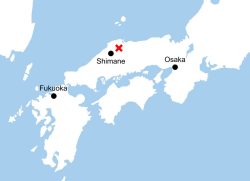
M6.2 Earthquake Hits Japan's Tottori, Shimane Prefectures; No Tsu...
-
Japan, Qatar Ministers Agree on Need for Stable Energy Supplies; ...
-
Japan, Italy to Boost LNG Cooperation; Aimed at Diversifying Japa...
Top Articles in News Services
-

Prudential Life Expected to Face Inspection over Fraud
-
Arctic Sees Unprecedented Heat as Climate Impacts Cascade
-

South Korea Prosecutor Seeks Death Penalty for Ex-President Yoon over Martial Law (Update)
-
Trump Names Former Federal Reserve Governor Warsh as the Next Fed Chair, Replacing Powell
-

Suzuki Overtakes Nissan as Japan’s Third‑Largest Automaker in 2025
JN ACCESS RANKING
-
Univ. in Japan, Tokyo-Based Startup to Develop Satellite for Disaster Prevention Measures, Bears
-
JAL, ANA Cancel Flights During 3-day Holiday Weekend due to Blizzard
-
China Confirmed to Be Operating Drilling Vessel Near Japan-China Median Line
-
China Eyes Rare Earth Foothold in Malaysia to Maintain Dominance, Counter Japan, U.S.
-
Japan Institute to Use Domestic Commercial Optical Lattice Clock to Set Japan Standard Time