
Statues of Naked Women Being Removed From Public Spaces; Meant As Symbols of Peace, Now Thought Inappropriate
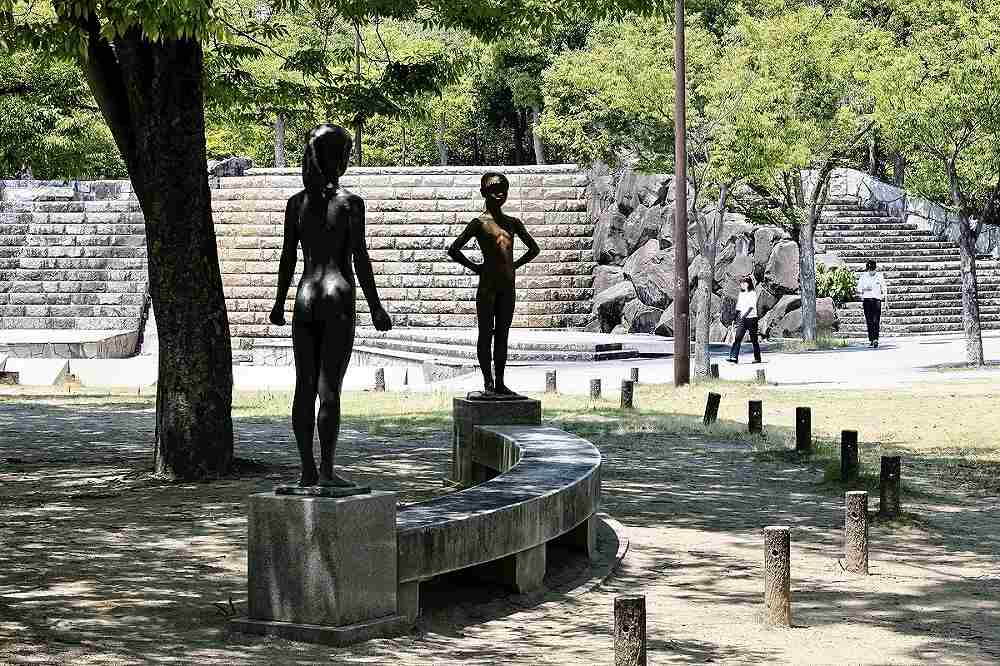
Two statues of naked girls in Central Park in Takamatsu
6:00 JST, August 28, 2025
TAKAMATSU — Statues of naked women are being removed from parks and other locations nationwide, in keeping with modern sentiments that they are inappropriate for public places.
The statues were set up in many locations as symbols of peace, replacing those of military officers after the end of World War II. Recently, however, many people believe they are incongruous with today’s values or should only be exhibited in museums.
Children embarrassed
Central Park in Takamatsu City has 31 statues on its grounds, which cover 3.5 hectares. They include depictions of Kan Kikuchi, who was a novelist from the city, and Shigeru Mizuhara, who was a manager of the Yomiuri Giants professional baseball team.
There are also two statues of naked girls facing each other. According to the city government, they were donated by a local branch of the Lions Club in 1989.
Beginning in 2023, experts in charge of the park’s refurbishment have said at related meetings that certain monuments in the park do not align with modern values. Some elementary school students who have visited the park on field trips have said the statues made them feel embarrassed.
“People’s values have changed, so we decided it’s undesirable for a large number of the general public to see statues of naked minors in a public space,” a city official said. The Takamatsu City government aims to move the two statues during refurbishment work that started in late August.
The sculptor who created the statues — Seiichi Abe, 94, of Imabari, Ehime Prefecture — called the removal “regrettable.” Titled “Onna no ko, futari (Two girls),” the artwork was produced to commemorate the opening of Seto Ohashi bridge in 1988.
“The statues of naked girls symbolize a fresh lifeforce,” Abe said. “I expressed the beauty of the Shikoku and Honshu regions, which would grow because of the bridge. I think they should be kept in the park.”
Abe said he had not received any notice about the removal from the city government.
Only in Japan
According to Asia University Prof. Yoko Takayama, who studies monuments across the nation, statues of soldiers, military officers and historical figures were built in public spaces in the prewar era. They were later removed due to a shortage of metals during World War II and in keeping with the policy of the General Headquarters of the Supreme Commander for the Allied Powers afterward.
Statues of naked women were put in their place. Heiwa no Gunzo (Statues of a group for peace), which were set up in Chiyoda Ward, Tokyo, in 1951 are believed to be the first such artworks to be exhibited in a public space in Japan.
After that, displaying such artwork became a nationwide trend symbolizing peace or love.
“Japan is the only country with so many statues of naked women in public spaces,” Takayama said. In Europe and other Asian countries, they are only displayed in certain places, such as withing the grounds of art museums or garden parks.”
Such statues are being reconsidered in many other parts of the nation as well.
A statue of a naked woman dancing on a large hand used to stand on Takarazuka Ohashi bridge in Takarazuka, Hyogo Prefecture. It was removed during renovations on the bridge, and controversy ensued over whether it would be returned.
The prefectural government, which manages the bridge, decided not to return the statue because a sizable number of residents said they did not want to see it there. It is currently stored in the prefectural government’s civil engineering office.
In Shizuoka, seven statues of naked women and girls stand in Sumpu Castle Park in the central part of the city. There are also two statues of naked women by French painter Pierre-Auguste Renoir in a plaza in front of Shizuoka Station.
“There are too many statues of naked women in the city,” Shizuoka Mayor Takashi Nanba said at a press conference in December last year. “Shouldn’t they be in art museums or elsewhere so that people can see them purely as art?”
Officials of the city government have sought the advice of experts on how to deal with the issue.
“People’s opinions about naked minors in the society have become stricter in recent years,” said Prof. Kikuro Miyashita of Kobe University, an expert in the history of art.
“At the same time, there are statues of naked women that have been in place for many decades and are an inseparable part of the scenery. Whether they should be removed should be considered very carefully, after collecting opinions from residents.”






Most Read
Popular articles in the past 24 hours
-

Voters Using AI to Choose Candidates in Japan's Upcoming General ...
-

Japan's Snow-Clad Beauty: Camellia Flowers Seen in Winter Bloom a...
-

Monkey Strikes Junior High School Girl from Behind in Japan's Yam...
-
Genichiro Inokuma's Mural in Ueno Station That Gave Hope in Postw...
-

Senior Japanese Citizens Return to University to Gain Knowledge, ...
-

Foreign and Security Policy: Political Parties Must Discuss How T...
-
Heavy Snow Linked to 30 Deaths across Japan since Late Jan.; JMA ...
-

Tokyo Police Arrest Head of Resignation Assistance Firm
Popular articles in the past week
-

Japan Institute to Use Domestic Commercial Optical Lattice Clock ...
-
Australian Woman Dies After Mishap on Ski Lift in Nagano Prefectu...
-
Foreign Snowboarder in Serious Condition After Hanging in Midair ...
-

Chinese Embassy in Japan Reiterates Call for Chinese People to Re...
-

Narita Airport, Startup in Japan Demonstrate Machine to Compress ...
-

Toyota Motor Group Firm to Sell Clean Energy Greenhouses for Stra...
-

Sakie Yokota, Last Surviving Parent of a North Korea Abductee, Ur...
-

Beer Yeast Helps Save Labor, Water Use in Growing Rice; Govt Hope...
Popular articles in the past month
-
Univ. in Japan, Tokyo-Based Startup to Develop Satellite for Disa...
-
JAL, ANA Cancel Flights During 3-day Holiday Weekend due to Blizz...
-
China Confirmed to Be Operating Drilling Vessel Near Japan-China ...
-

China Eyes Rare Earth Foothold in Malaysia to Maintain Dominance,...
-
M6.2 Earthquake Hits Japan's Tottori, Shimane Prefectures; No Tsu...
-
Japan Institute to Use Domestic Commercial Optical Lattice Clock ...
-

Japan, Qatar Ministers Agree on Need for Stable Energy Supplies; ...
-

Japan, Italy to Boost LNG Cooperation; Aimed at Diversifying Japa...
Top Articles in Society
-
JAL, ANA Cancel Flights During 3-day Holiday Weekend due to Blizzard
-
Record-Breaking Snow Cripples Public Transport in Hokkaido; 7,000 People Stay Overnight at New Chitose Airport
-
Australian Woman Dies After Mishap on Ski Lift in Nagano Prefecture
-
Foreign Snowboarder in Serious Condition After Hanging in Midair from Chairlift in Nagano Prefecture
-

Train Services in Tokyo Resume Following Power Outage That Suspended Yamanote, Keihin-Tohoku Lines (Update 4)
JN ACCESS RANKING
-
Univ. in Japan, Tokyo-Based Startup to Develop Satellite for Disaster Prevention Measures, Bears
-
JAL, ANA Cancel Flights During 3-day Holiday Weekend due to Blizzard
-
China Confirmed to Be Operating Drilling Vessel Near Japan-China Median Line
-
China Eyes Rare Earth Foothold in Malaysia to Maintain Dominance, Counter Japan, U.S.
-
Japan Institute to Use Domestic Commercial Optical Lattice Clock to Set Japan Standard Time