
Japan, India Eye Revising Joint Security Declaration to Expand Cooperation to Economic Security, Cyber Areas
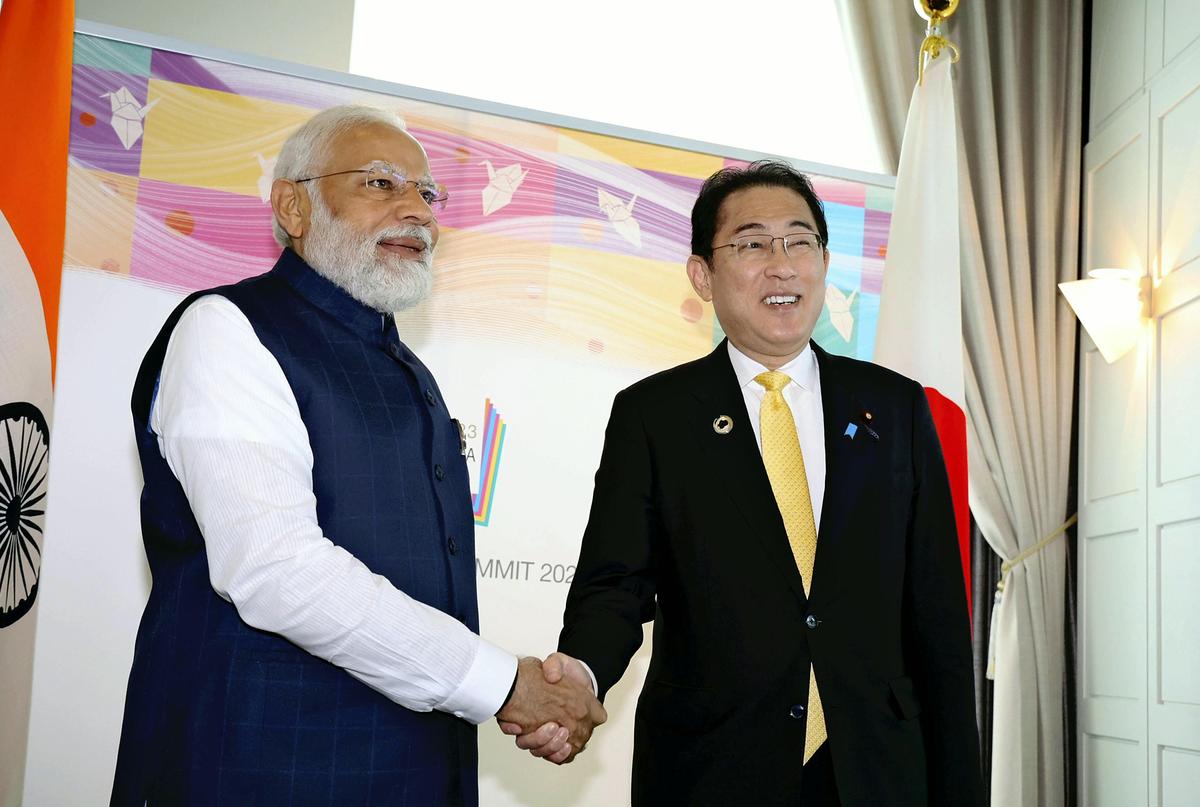
Indian Prime Minister Narendra Modi, left, shakes hands with then Prime Minister Fumio Kishida in Hiroshima in May 2023.
15:07 JST, August 25, 2025
Japan and India are set to add economic security, the defense industry and cyber issues to their areas of cooperation in revisions to the two nations’ Joint Declaration on Security Cooperation, according to government sources.
Prime Minister Shigeru Ishiba and Indian Prime Minister Narendra Modi, who is scheduled to visit Japan this week, plan to hold talks on Friday. They are expected to sign and exchange the revised declaration.
The joint declaration was originally signed in 2008 by the then leaders of both countries. Japan and India intend to revise the agreement to help them work together to address new security challenges that have emerged over the past 17 years.
Regarding economic security, the revised declaration is expected to state Japan and India’s commitment to strengthening supply chains for items such as critical minerals and cooperating in response to economic coercion. Behind this revision is believed to be China’s use of rare earth export restrictions as a means to apply economic pressure.
Japan and India also intend to affirm their commitment to the joint development and production of equipment and technology in the defense industry. The revised declaration is likely to state their cooperation in promoting joint research and development as well as collaboration among the government, industries and academia in such new areas as cyber security and fields that will likely influence future warfare, including artificial intelligence and semiconductors.
The two nations also plan to mention effective use of the bilateral Acquisition and Cross-Servicing Agreement (ACSA), which came into effect in 2021, while seeking ways to cooperate in defense against chemical and biological weapons.
In addition, they are expected to stress their commitment to strengthening the frameworks of cooperation and dialogue that they have continued to pursue, such as that among the Quad, made up of Japan, India, the United States and Australia.
Such amendments are intended to respond to China’s coercive actions in such areas as the South China Sea. Japan and India plan to stress the importance of efforts to ensure maritime order based on the rule of law.






Most Read
Popular articles in the past 24 hours
-

Voters Using AI to Choose Candidates in Japan's Upcoming General ...
-

Japan's Snow-Clad Beauty: Camellia Flowers Seen in Winter Bloom a...
-

Monkey Strikes Junior High School Girl from Behind in Japan's Yam...
-

Genichiro Inokuma's Mural in Ueno Station That Gave Hope in Postw...
-

Senior Japanese Citizens Return to University to Gain Knowledge, ...
-

Foreign and Security Policy: Political Parties Must Discuss How T...
-

Heavy Snow Linked to 30 Deaths across Japan since Late Jan.; JMA ...
-

Tokyo Police Arrest Head of Resignation Assistance Firm
Popular articles in the past week
-

Japan Institute to Use Domestic Commercial Optical Lattice Clock ...
-
Australian Woman Dies After Mishap on Ski Lift in Nagano Prefectu...
-
Foreign Snowboarder in Serious Condition After Hanging in Midair ...
-
Chinese Embassy in Japan Reiterates Call for Chinese People to Re...
-
Narita Airport, Startup in Japan Demonstrate Machine to Compress ...
-

Toyota Motor Group Firm to Sell Clean Energy Greenhouses for Stra...
-

Sakie Yokota, Last Surviving Parent of a North Korea Abductee, Ur...
-

Beer Yeast Helps Save Labor, Water Use in Growing Rice; Govt Hope...
Popular articles in the past month
-
Univ. in Japan, Tokyo-Based Startup to Develop Satellite for Disa...
-

JAL, ANA Cancel Flights During 3-day Holiday Weekend due to Blizz...
-
China Confirmed to Be Operating Drilling Vessel Near Japan-China ...
-

China Eyes Rare Earth Foothold in Malaysia to Maintain Dominance,...
-
M6.2 Earthquake Hits Japan's Tottori, Shimane Prefectures; No Tsu...
-
Japan Institute to Use Domestic Commercial Optical Lattice Clock ...
-

Japan, Qatar Ministers Agree on Need for Stable Energy Supplies; ...
-

Japan, Italy to Boost LNG Cooperation; Aimed at Diversifying Japa...
Top Articles in Society
-
JAL, ANA Cancel Flights During 3-day Holiday Weekend due to Blizzard
-
Record-Breaking Snow Cripples Public Transport in Hokkaido; 7,000 People Stay Overnight at New Chitose Airport
-
Australian Woman Dies After Mishap on Ski Lift in Nagano Prefecture
-
Foreign Snowboarder in Serious Condition After Hanging in Midair from Chairlift in Nagano Prefecture
-

Train Services in Tokyo Resume Following Power Outage That Suspended Yamanote, Keihin-Tohoku Lines (Update 4)
JN ACCESS RANKING
-
Univ. in Japan, Tokyo-Based Startup to Develop Satellite for Disaster Prevention Measures, Bears
-
JAL, ANA Cancel Flights During 3-day Holiday Weekend due to Blizzard
-
China Confirmed to Be Operating Drilling Vessel Near Japan-China Median Line
-
China Eyes Rare Earth Foothold in Malaysia to Maintain Dominance, Counter Japan, U.S.
-
Japan Institute to Use Domestic Commercial Optical Lattice Clock to Set Japan Standard Time