
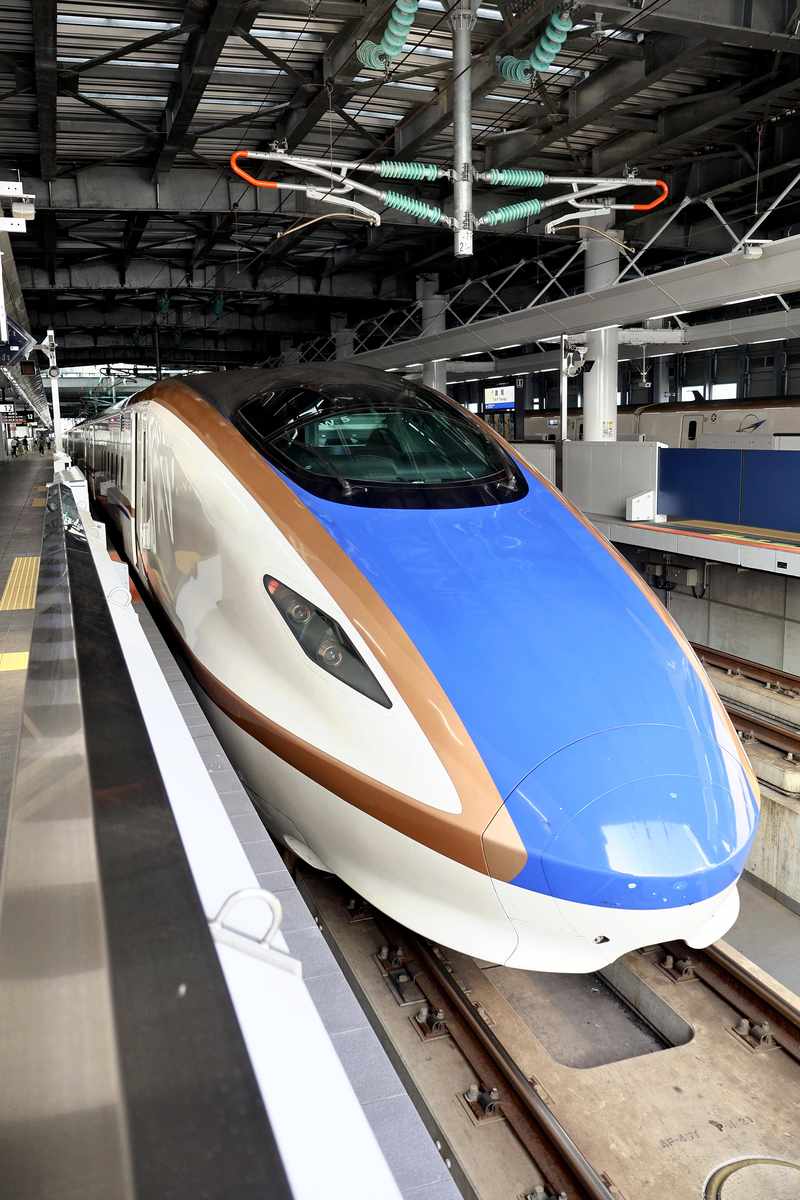
A Hokuriku Shinkansen train waits at JR Tsuruga Station in Tsuruga, Fukui Prefecture.
1:00 JST, August 23, 2025
The planned extension of the Hokuriku Shinkansen line, which would connect Tsuruga, Fukui Prefecture, and Shin-Osaka Station in Osaka, has stalled, and the debate over which route the section should take is flaring up again.
The current plan is for the line to go through Obama, Fukui Prefecture, and Kyoto. However, delays to environmental impact assessment procedures has prevented a start date for construction work from being set. Consequently, some local governments in the region have called for a different route to be adopted so the extension can move forward.
A construction committee formed by lawmakers from the ruling coalition of the Liberal Democratic Party and Komeito plans to soon reexamine the suitability of the current route.
In its appropriation requests for the fiscal 2026 budget, the Land, Infrastructure, Transport and Tourism Ministry plans to make an item request for the extension section instead of specifying the amount needed for the construction costs. This will be the second consecutive year the ministry has made such a request. “Local governments and other entities along the line oppose the extension plan, so we can’t forecast when construction will start,” a senior ministry official explained.
The government and ruling parties selected the Obama-Kyoto route for the new section from Tsuruga Station in 2016. Under the plan, a line would be built exclusively for the Hokuriku Shinkansen and be operated by West Japan Railway Co. (JR West). The ministry’s 2016 estimate put construction costs at ¥2.1 trillion, but this figure had ballooned to up to ¥3.9 trillion in the latest estimate made in 2024.
The Obama-Kyoto route was chosen over two other options: the Maibara route, which would go as far as Maibara Station in Maibara, Shiga Prefecture, through which the Tokaido Shinkansen line passes, and the Maizuru route, which would go through Obama, Maizuru, Kyoto Prefecture, and Kyoto before terminating at Shin-Osaka Station. The Obama-Kyoto route got the nod due to factors including its convenience, as it offered the shortest traveling time and would not require passengers to transfer to the Tokaido Shinkansen.
However, local governments along the Obama-Kyoto route have expressed concerns over the plan’s soaring construction costs. Deep-rooted opposition to the plan also has been persistent in Kyoto.
Maibara route touted
Local municipalities calling for the extension to be swiftly completed are growing increasingly frustrated, as the start of construction has been pushed back several times since the route was chosen.
At a press conference on July 29, Osaka Gov. Hirofumi Yoshimura touched on recent moves in Kyoto and other developments. “New circumstances have emerged,” Yoshimura said, calling for the Maibara route to at least be reconsidered.
Ishikawa Gov. Hiroshi Hase also weighed in on the issue. “If there’s no prospect of these problems being resolved, various options should be considered – including the Maibara route,” he said at an event in Kanazawa on Aug. 8.
However, local leaders’ opinions are split. Fukui Gov. Tatsuji Sugimoto and Shiga Gov. Taizo Mikazuki both support pushing ahead with the Obama-Kyoto route.
Given the divergence of views, Shoji Nishida, a House of Councillors member from the LDP and head of the ruling parties’ committee, plans to soon hold a meeting and decide whether to conduct a reexamination of the route options.
Alternative to Tokaido line
The original project to construct the Hokuriku Shinkansen was decided on in 1973. Branching off the Joetsu Shinkansen line – which links Tokyo and Niigata Prefecture – at Takasaki Station in Takasaki, Gunma Prefecture, the first section until Nagano, Nagano Prefecture, of the Hokuriku line opened in 1997.
It was then extended to Kanazawa Station in Kanazawa in 2015 and to Tsuruga Station in 2024. The government expects the final section to Shin-Osaka Station, and therefore the line as a whole, to be completed by 2046.
The Tokaido Shinkansen line could very likely suffer damage in the event of a disaster such as a massive earthquake in the Nankai Trough, which extends from off the coast of Shizuoka Prefecture to off the coast of Miyazaki Prefecture. In such circumstances, the Hokuriku Shinkansen line would be expected to be an alternative option for transportation.



Most Read
Most read in the last 24 hours
-

India's Arms Indigenization Quest for Self-Reliance / Desert Dril...
-
26-year-old U.S. National Falls While Climbing Mt. Fuji; Accompan...
-
Japan Passport Fees Going Down to ¥9,000 in July
-

Japanese Side Machida Zelvia Faces Ah-Ahli in Asian Champions Lea...
-

Transfer of Defense Equipment: Increase the Number of Like-minded...
-

Japan Eyes Trialing Dual-Use Tech Developed by Startups to Promot...
-

Charm of Meiji-Era Poet Takuboku Examined from Viewpoint of Donal...
-

Cherry Blossoms in Full Bloom in Hokkaido's Hakodate; Tourists Fl...
Most read in the last 7 days
-
Earthquake Hits Japan's Tohoku Region; 3-meter Tsunami Warning Is...
-

Trump Extends the Ceasefire with Iran but Keeps the Blockade
-

China, South Korea Object to Japanese PM Takaichi's Ritual Offeri...
-

India's Arms Indigenization Quest for Self-Reliance / New Delhi S...
-

Japan to Ban Use of Portable Chargers on Airplanes from April 24,...
-

¥1,000 Coins to Be Issued to Mark Anniversary of Beginning of Jap...
-

Most Serious Cyberattacks against the UK Now from Russia, Iran an...
-

New Challenges Await as Miura-Kihara Retires; Blade Maker, Ex-Coa...
Most read in the last 30 days
-
Earthquake Hits Japan's Tohoku Region; 3-meter Tsunami Warning Is...
-
Police Find Child's Shoe During Search for Missing Boy in Nantan,...
-
Body Found in Nantan, Kyoto Prefecture, During Search for 11-Year...
-
Cherry Blossoms, Rapeseed Flowers Perform Colorful ‘Duet’ in Niig...
-
Trump Extends the Ceasefire with Iran but Keeps the Blockade
-

Olympic Gold Medal-Winning Figure Skaters Riku-Ryu Announce Retir...
-

Nori Prices Surge in Japan Due to Poor Seaweed Production Amid Ri...
-
China, South Korea Object to Japanese PM Takaichi's Ritual Offeri...
Top Articles in Society
-
Earthquake Hits Japan’s Tohoku Region; 3-meter Tsunami Warning Issued (Update 1)
-
Police Find Child’s Shoe During Search for Missing Boy in Nantan, Kyoto Prefecture
-
Body Found in Nantan, Kyoto Prefecture, During Search for 11-Year-Old Boy in Area (Update 1)
-
Cherry Blossoms, Rapeseed Flowers Perform Colorful ‘Duet’ in Niigata
-

Two Women in Osaka Found Lying on Floor Bleeding, Later Pronounced Dead
JN ACCESS RANKING
-
Earthquake Hits Japan’s Tohoku Region; 3-meter Tsunami Warning Issued (Update 1)
-
Police Find Child’s Shoe During Search for Missing Boy in Nantan, Kyoto Prefecture
-
Body Found in Nantan, Kyoto Prefecture, During Search for 11-Year-Old Boy in Area (Update 1)
-
Cherry Blossoms, Rapeseed Flowers Perform Colorful ‘Duet’ in Niigata
-
Trump Extends the Ceasefire with Iran but Keeps the Blockade
Most read in the last 24 hours
-
India's Arms Indigenization Quest for Self-Reliance / Desert Dril...
-
26-year-old U.S. National Falls While Climbing Mt. Fuji; Accompan...
-
Japan Passport Fees Going Down to ¥9,000 in July
-
Japanese Side Machida Zelvia Faces Ah-Ahli in Asian Champions Lea...
-
Transfer of Defense Equipment: Increase the Number of Like-minded...
Most read in the last 7 days
-
Earthquake Hits Japan's Tohoku Region; 3-meter Tsunami Warning Is...
-
Trump Extends the Ceasefire with Iran but Keeps the Blockade
-
China, South Korea Object to Japanese PM Takaichi's Ritual Offeri...
-
India's Arms Indigenization Quest for Self-Reliance / New Delhi S...
-
Japan to Ban Use of Portable Chargers on Airplanes from April 24,...
Most read in the last 30 days
-
Earthquake Hits Japan's Tohoku Region; 3-meter Tsunami Warning Is...
-
Police Find Child's Shoe During Search for Missing Boy in Nantan,...
-
Body Found in Nantan, Kyoto Prefecture, During Search for 11-Year...
-
Cherry Blossoms, Rapeseed Flowers Perform Colorful ‘Duet’ in Niig...
-
Trump Extends the Ceasefire with Iran but Keeps the Blockade