
South Korea President Hints at Prizing Japan Over Tradition, Ahead of Visits to Japan, United States
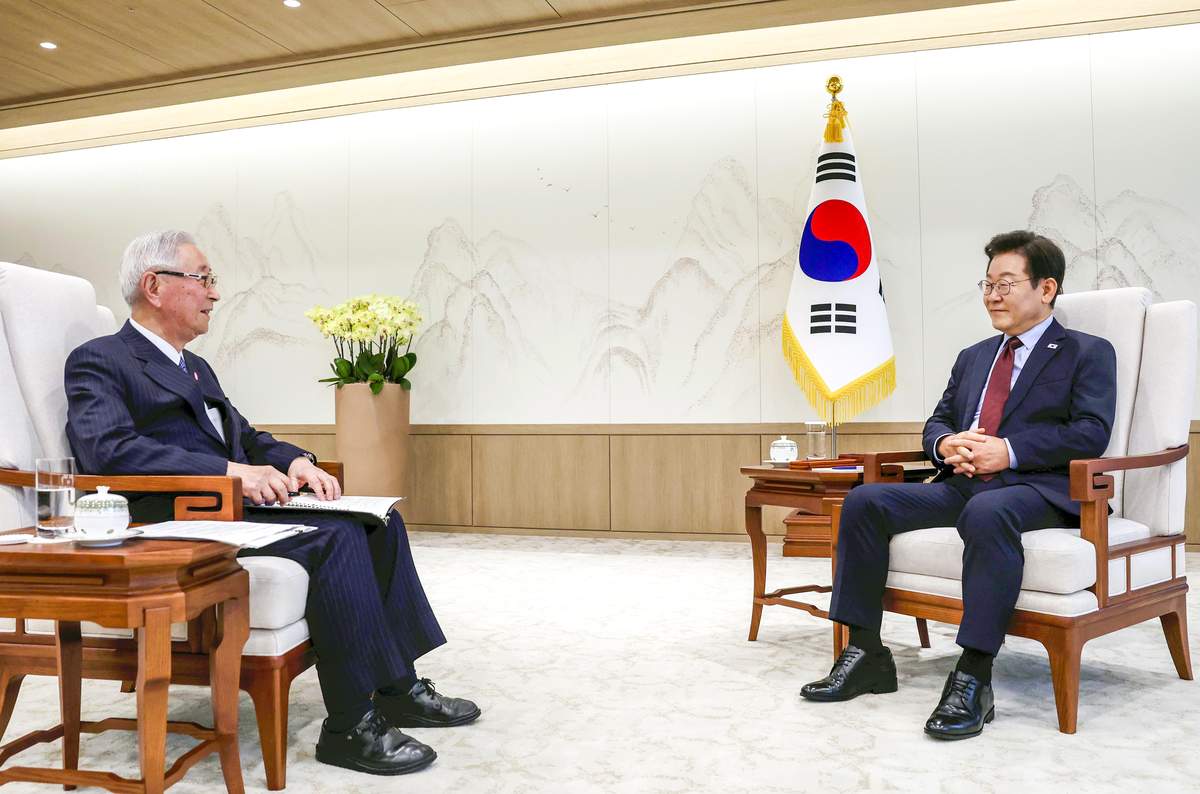
South Korean President Lee Jae Myung, right, speaks during an interview with Shoichi Oikawa in Seoul on Tuesday.
0:01 JST, August 21, 2025
SEOUL — South Korean President Lee Jae Myung implied that his decision to visit Japan before the United States shows a willingness to buck convention and reflects a practical diplomacy that prioritizes national interests.
Lee hinted at this stance during an interview with The Yomiuri Shimbun on Tuesday.
Lee is scheduled to visit Japan on Saturday and Sunday and then travel to the United States for a three-day visit from Sunday. It is unusual for a South Korean president to visit Japan before the United States, a key ally.
In their first face-to-face meeting on the sidelines of the Group of Seven summit meeting in June, Lee and Prime Minister Shigeru Ishiba agreed to a policy of steadily improving their countries’ ties through close communication, including reciprocal visits of their heads of government.
Lee explained that he decided to visit Japan before the United States to “put into practice” what he and Ishiba agreed on during the June meeting.
Quoting a Korean proverb that means, “Out of sight, out of mind,” Lee stressed the significance of reciprocal visits. “The more often we see each other, the closer we become and the more trust we can build,” he said.
“I hope the Japanese prime minister will also visit South Korea when his schedule allows, so that we can strengthen our substantive cooperation through frequent exchanges,” he added.
Lee also said he intended to exchange views with Ishiba on “areas of mutual benefit, such as economic and sociocultural issues, private-sector exchanges, the environment and security.”
He added that trilateral cooperation among Japan, the United States and South Korea, along with the U.S.-South Korea alliance, “will be a fundamental axis in the economic and security fields,” indicating he will link his visit to Japan and to the United States to trilateral cooperation.




Most Read
Popular articles in the past 24 hours
-

Japan Defense Agency to Develop AI Intelligence Analysis System f...
-

Moai Statue Shows Lasting Bond Between Miyagi Pref. Town, Easter ...
-

Milano Cortina 2026: Japan’s Oguri Wins Para Snowboard Silver at ...
-
Japan's Defense Ministry: North Korea Appears to Have Fired Balli...
-
Aichi Fisheries Cooperatives Use Smart Tech to Farm Triploid Oyst...
-
Teachers Support Students’ Inquiry Learning behind the Scenes
-

National Intelligence Council: Proposed Body Must Be Utilized To ...
-
Japan's Lower House Passes Budget Proposal; Could Be Delayed in U...
Popular articles in the past week
-
Japan Figure Skating Legend Yuzuru Hanyu Is Proud Disaster Surviv...
-
Govt to Utilize ODA for Ensuring Economic Security; Securing Ener...
-
15 Measles Patients Confirmed in Tokyo in Past 6 Days; 1 May Have...
-
Massive Sewer Pipe Found Jutting Out of Highway in Osaka
-
Japan Govt to Tighten Requirements to Receive Permanent Residency...
-
JR Tokai Breaks Ground on Yamanashi Maglev Station; Will Be Part ...
-

Beckoning Cats Get Makeover to Fit Modern Lifestyles with Sleek D...
-
Power Outage Forces About 980 Passengers in Yokohama to Walk to T...
Popular articles in the past month
-

Producer Behind Pop Group XG Arrested for Cocaine Possession
-

Japan PM Takaichi’s Cabinet Resigns en Masse
-

Man Infected with Measles Reportedly Dined at Restaurant in Tokyo...
-

Videos Plagiarized, Reposted with False Subtitles Claiming ‘Ryuky...
-
Japan Figure Skating Legend Yuzuru Hanyu Is Proud Disaster Surviv...
-

iPS Treatments Pass Key Milestone, but Broader Applications Far f...
-

Sanae Takaichi Elected Prime Minister of Japan; Keeps All Cabinet...
-

Nepal Bus Crash Kills 19 People, Injures 25 Including One Japanes...
Top Articles in World
-
Videos Plagiarized, Reposted with False Subtitles Claiming ‘Ryukyu Belongs to China’; Anti-China False Information Also Posted in Japan
-
Nepal Bus Crash Kills 19 People, Injures 25 Including One Japanese National
-
South Korea Tightens Rules on Foreigners Buying Homes in Seoul Metro Area
-
Govt to Utilize ODA for Ensuring Economic Security; Securing Energy, Critical Minerals Sought
-

Ukrainian Ambassador Closely Watching Japan’s Revision of Defense Export Rules, Hopes for Future Arms Support
JN ACCESS RANKING
-
Producer Behind Pop Group XG Arrested for Cocaine Possession
-
Japan PM Takaichi’s Cabinet Resigns en Masse
-
Man Infected with Measles Reportedly Dined at Restaurant in Tokyo Station
-
Videos Plagiarized, Reposted with False Subtitles Claiming ‘Ryukyu Belongs to China’; Anti-China False Information Also Posted in Japan
-
Japan Figure Skating Legend Yuzuru Hanyu Is Proud Disaster Survivor and Gold Medalist, Vows to Continue Support Efforts