
Emperor Speaks of Passing Memory of World War II to Younger Generations as Memorial Ceremony Remembers Japanese War Dead
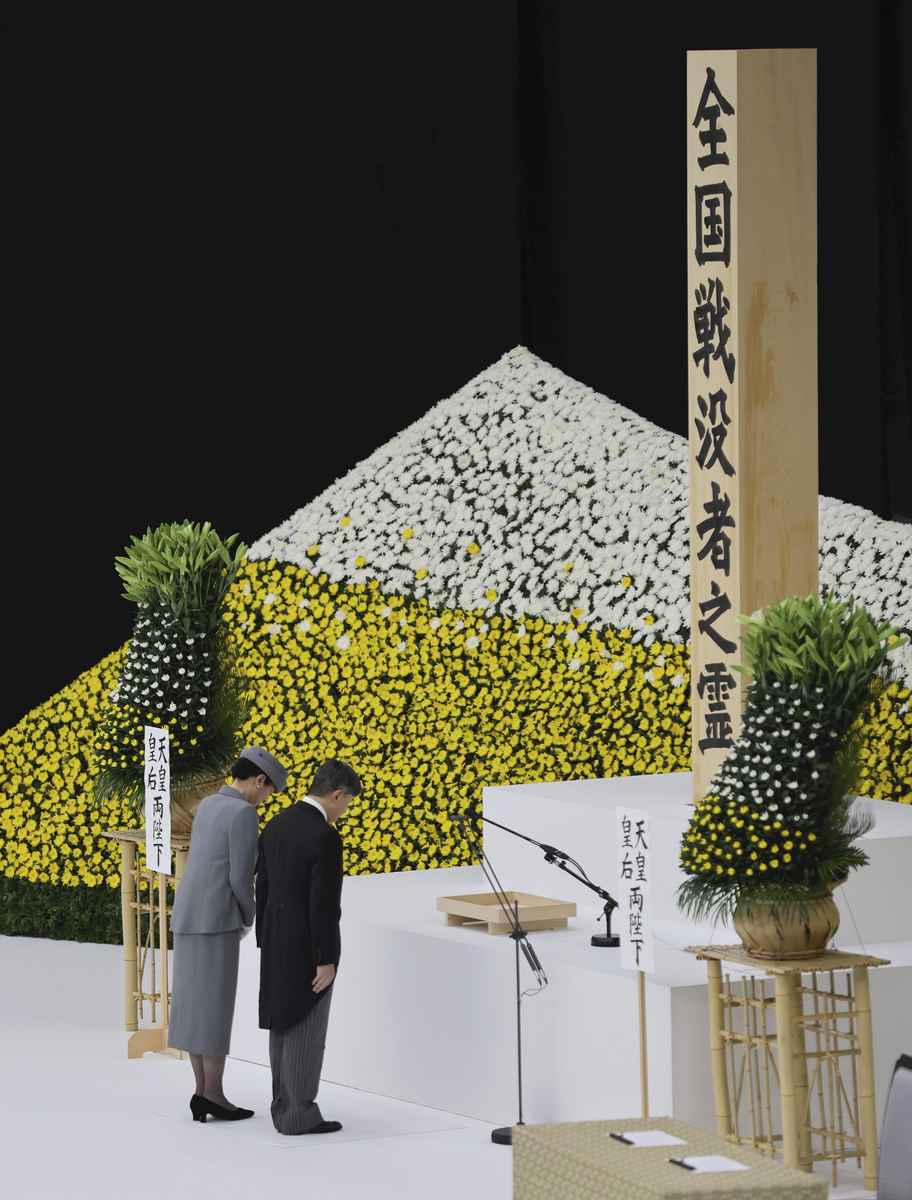
The Emperor and Empress observe a moment of silence during the annual memorial ceremony for the war dead at the Nippon Budokan hall in Chiyoda Ward, Tokyo, on Friday.
17:23 JST, August 15, 2025
The annual memorial ceremony for Japan’s war dead was held at the Nippon Budokan hall in Chiyoda Ward, Tokyo, on Friday, as the country marked the 80th anniversary of the end of World War II.
About 4,500 people, including family members of the war dead and representatives from various fields, attended the government-organized memorial service.
The attendees remembered the about 3.1 million Japanese people who lost their lives in the war and renewed their vow to never fight a war again and extend the 80 years of peace since.
The Emperor and Empress and Prime Minister Shigeru Ishiba were in attendance at the ceremony, which began at 11:51 a.m. A minute of silence was observed as the clock struck noon.
In his address, the Emperor used the expression “deep remorse” again this year, marking the 11th consecutive year that the expression has been used in the Imperial address.
The Emperor spoke for the first time about passing on the memory of the war, saying, “It is my sincere hope that we shall continue to pass down the memories of the sufferings endured during and after the war, and in unity of spirit, to seek peace and the happiness of the people in the future.”
The oldest attendee at the ceremony was Shoji Nagaya, 98, of Hokkaido, who lost his older brother in the war, while the youngest was a 3-year-old from Mie Prefecture who is the great-great-grandson of a war casualty.
Representing the families of the war dead, Hajime Eda, 82, of Kawagoe, Saitama Prefecture, whose father died in the Korea Strait, delivered a message of remembrance.
Of the 3,432 family members of the war dead scheduled to attend Friday’s ceremony as of Aug. 8, 3,380 were related to deceased Imperial military personnel or employees, according to the Health, Labor and Welfare Ministry. Family members of those killed in the atomic bombings and other war victims totaled 52.
Of those, a record 1,826 were born in the postwar period. At 53.2%, they made up over half the group for the first time.
No parents of war dead have been in attendance for 15 years. This year’s ceremony was the first with no spouses of war dead, except for 2021, when attendance was severely restricted due to the COVID-19 pandemic. Passing on the experiences of the war to future generations remains an issue to be addressed.
Flowers were given by children to attendees to offer at the memorial for the first time in six years, as the custom was suspended in 2020 due to the COVID-19 pandemic. The custom began in 2016 with the aim of passing on the memories of the war to younger generations. This year, 14 children between the ages of 8 and 17, including a great-grandchild of a person who died in the war, handed out yellow chrysanthemums.
From the start of the Second Sino-Japanese War in 1937 to the end of World War II in 1945, about 2.3 million Japanese military personnel and employees, including those detained in Siberia after the war, lost their lives. About 800,000 civilians were killed in air raids and the two atomic bombings.





Most Read
Popular articles in the past 24 hours
-

Voters Using AI to Choose Candidates in Japan's Upcoming General ...
-

Japan's Snow-Clad Beauty: Camellia Flowers Seen in Winter Bloom a...
-
Monkey Strikes Junior High School Girl from Behind in Japan's Yam...
-
Genichiro Inokuma's Mural in Ueno Station That Gave Hope in Postw...
-
Senior Japanese Citizens Return to University to Gain Knowledge, ...
-

Foreign and Security Policy: Political Parties Must Discuss How T...
-
Heavy Snow Linked to 30 Deaths across Japan since Late Jan.; JMA ...
-
Tokyo Police Arrest Head of Resignation Assistance Firm
Popular articles in the past week
-

Japan Institute to Use Domestic Commercial Optical Lattice Clock ...
-
Australian Woman Dies After Mishap on Ski Lift in Nagano Prefectu...
-
Foreign Snowboarder in Serious Condition After Hanging in Midair ...
-

Chinese Embassy in Japan Reiterates Call for Chinese People to Re...
-
Narita Airport, Startup in Japan Demonstrate Machine to Compress ...
-

Toyota Motor Group Firm to Sell Clean Energy Greenhouses for Stra...
-
Sakie Yokota, Last Surviving Parent of a North Korea Abductee, Ur...
-

Beer Yeast Helps Save Labor, Water Use in Growing Rice; Govt Hope...
Popular articles in the past month
-
Univ. in Japan, Tokyo-Based Startup to Develop Satellite for Disa...
-
JAL, ANA Cancel Flights During 3-day Holiday Weekend due to Blizz...
-
China Confirmed to Be Operating Drilling Vessel Near Japan-China ...
-
China Eyes Rare Earth Foothold in Malaysia to Maintain Dominance,...
-
M6.2 Earthquake Hits Japan's Tottori, Shimane Prefectures; No Tsu...
-
Japan Institute to Use Domestic Commercial Optical Lattice Clock ...
-
Japan, Qatar Ministers Agree on Need for Stable Energy Supplies; ...
-

Japan, Italy to Boost LNG Cooperation; Aimed at Diversifying Japa...
Top Articles in Society
-
JAL, ANA Cancel Flights During 3-day Holiday Weekend due to Blizzard
-
Record-Breaking Snow Cripples Public Transport in Hokkaido; 7,000 People Stay Overnight at New Chitose Airport
-
Australian Woman Dies After Mishap on Ski Lift in Nagano Prefecture
-
Foreign Snowboarder in Serious Condition After Hanging in Midair from Chairlift in Nagano Prefecture
-
Train Services in Tokyo Resume Following Power Outage That Suspended Yamanote, Keihin-Tohoku Lines (Update 4)
JN ACCESS RANKING
-
Univ. in Japan, Tokyo-Based Startup to Develop Satellite for Disaster Prevention Measures, Bears
-
JAL, ANA Cancel Flights During 3-day Holiday Weekend due to Blizzard
-
China Confirmed to Be Operating Drilling Vessel Near Japan-China Median Line
-
China Eyes Rare Earth Foothold in Malaysia to Maintain Dominance, Counter Japan, U.S.
-
Japan Institute to Use Domestic Commercial Optical Lattice Clock to Set Japan Standard Time