
Nagasaki A-Bomb Survivor Urges N-Arms Never Be Used; 93-Year-Old Tells of Gruesome Scenes Witnessed at 13
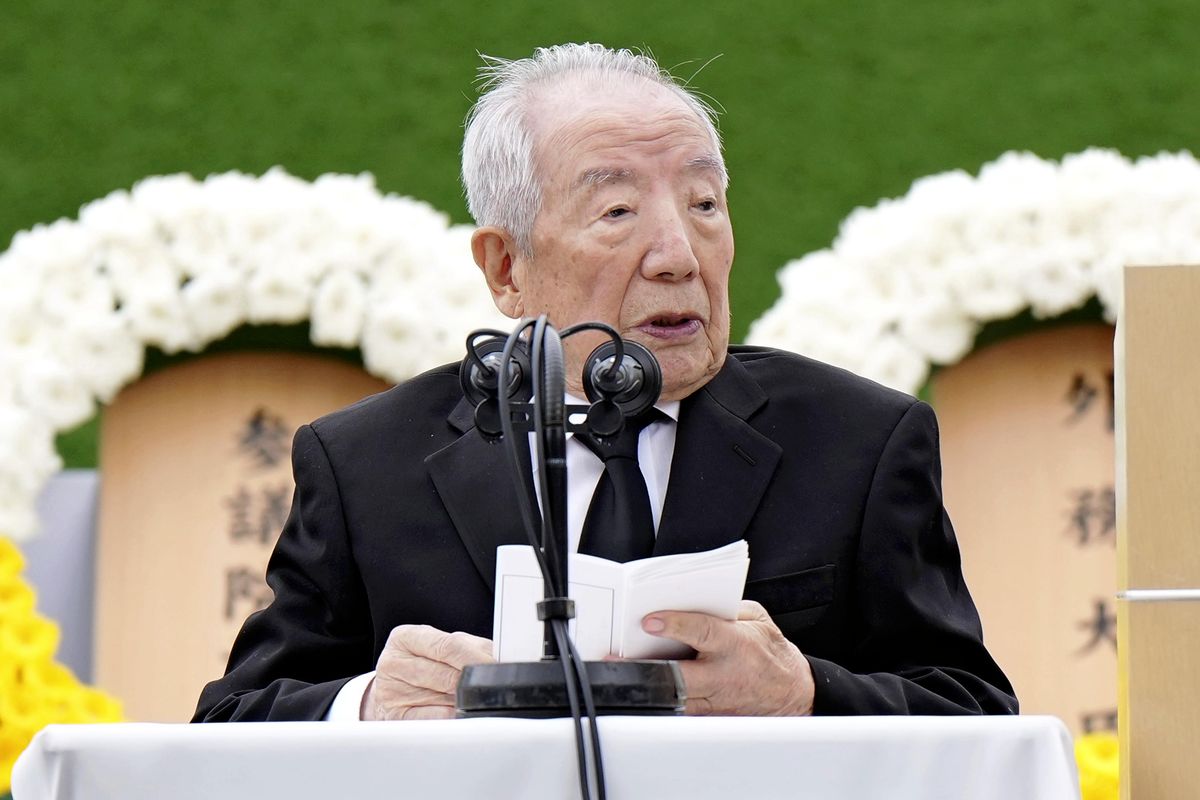
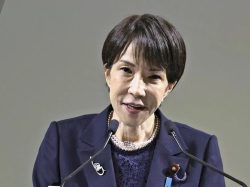
Hiroshi Nishioka reads out the Pledge for Peace at the peace memorial ceremony held in Nagasaki City on Saturday.
20:00 JST, August 9, 2025
Nagasaki atomic bomb survivor Hiroshi Nishioka, 93, read out the “Pledge for Peace” at the peace memorial ceremony as a representative of survivors in Nagasaki City on Saturday.
Nishioka, the oldest person ever to serve as the representative, devoted most of his speech to his own experience of the atomic bombing and appealed for nuclear weapons never to be used.
Ahead of the ceremony, he had said: “There are very few people left who know what the atomic bombing was like. So I would like to talk about what I know as much as I can.”
On August 9, 1945, Nishioka, then 13 years old, was in the medical supply room of a middle school in Nagasaki, about 3.3 kilometers from the hypocenter. The echoing roar of an American B-29 bomber drew him to the window, where he was enveloped in a light that seemed to blend orange and yellow.
“I thought, ‘A bomb has been dropped on the school’s tennis court,’” Nishioka said in his speech. “I lay flat on the floor.”
He was struck by the blast wave, and classmates who had fallen on top of him were drenched in blood as their flesh was pierced with numerous shards of glass from the shattered windows. On the way home, he saw evacuees streaming away from the area where the center of the blast had been.
“A man with his entire body covered in blood. A mother holding a baby as she walked, with blood streaming from the baby’s face. A person whose arm, hanging limply, appeared to be severed.”
Facing countless injured people, Nishioka recalled that “my senses became numb, and I did not even feel pity for them.”
The next day, he joined the rescue activities at another middle school, closer to the hypocenter. The uniformed bodies of many students who had been crushed under the school building were laid out on the sports ground along with the bodies of teachers who also died in the bombing.
On his way back, he saw many bodies scattered on the road. An injured person begged him for water.
“I might die myself,” the young Nishioka thought. Afraid that the water bottle hanging from his waist might be taken, he had no choice but to shake off the person’s arms, which were stretched out for help, and move on. “Even now, when I recall the moment, my heart still aches.”
He left Nagasaki and moved to Tokyo to attend university. He got a job at a major trading company, and worked on trade with the United States, among others.
When he retired about 30 years ago, an acquaintance who is also a hibakusha atomic bomb survivor urged him to speak up, saying, “Anybody who was in Nagasaki [at that time] needs to tell the world.”
He visited the United States and spoke in English about the damage caused by the atomic bomb. Seeing how intensely the audience listened to his testimony, he realized the importance of sharing his story. He began his activities as a storyteller for the atomic bomb survivors’ association in Kanagawa Prefecture and has continued to give lectures on the atomic bombings at schools.
At the same time, he was also feeling powerless due to the idea that a single voice would not make nuclear threat disappear. However, when Nihon Hidankyo (Japan Confederation of A- and H-Bomb Sufferers Organizations), to which his association belongs, was awarded with the Nobel Peace Prize last year, he felt encouraged to keep going.
On Saturday, he said in his speech: “We should never stop the movement that leads toward peace. We should keep moving forward, and have more people join us. This is what we are aiming for.”
Nishioka collaborated with a Kanagawa prefectural government project that utilizes AI in storytelling activities, pre-recording testimony plus answers to anticipated questions. These materials are already used in school education, and he feels they are effective tools in anticipation of an era when there are no longer any living atomic bomb survivors.
At the ceremony on Saturday, ambassadors from countries that possess nuclear arms, including the United States and Russia, were listening to Nishioka’s words.
Amid the deteriorating international situation surrounding nuclear weapons, he concluded his speech with the following words.
“Nuclear weapons should never be used. Everything will be over if they are used. Let us protect this beautiful Earth.”


Related Tags



Most Read
Most read in the last 24 hours
-
Trump Extends the Ceasefire with Iran but Keeps the Blockade
-
China, South Korea Object to Japanese PM Takaichi's Ritual Offeri...
-

Florida Launches Criminal Probe into OpenAI and ChatGPT over Dead...
-

Trump Opposes United–American Merger, Signals Support for Spirit
-

Trump Picks a University of Minnesota Professor to Lead His Econo...
-

Japan's ANA to Introduce Fuel Surcharges to Domestic Flights from...
-
Taiwan President Cancels Africa Trip Blaming Chinese Pressure
-

Fired Former UK Official Says He Felt Political Pressure to Appro...
Most read in the last 7 days
-
Earthquake Hits Japan's Tohoku Region; 3-meter Tsunami Warning Is...
-
Trump Extends the Ceasefire with Iran but Keeps the Blockade
-

Olympic Gold Medal-Winning Figure Skaters Riku-Ryu Announce Retir...
-
China, South Korea Object to Japanese PM Takaichi's Ritual Offeri...
-
Japan to Ban Use of Portable Chargers on Airplanes from April 24,...
-

New Challenges Await as Miura-Kihara Retires; Blade Maker, Ex-Coa...
-
Florida Launches Criminal Probe into OpenAI and ChatGPT over Dead...
-
Trump Opposes United–American Merger, Signals Support for Spirit
Most read in the last 30 days
-
Earthquake Hits Japan's Tohoku Region; 3-meter Tsunami Warning Is...
-
Police Find Child's Shoe During Search for Missing Boy in Nantan,...
-
Body Found in Nantan, Kyoto Prefecture, During Search for 11-Year...
-
Cherry Blossoms, Rapeseed Flowers Perform Colorful ‘Duet’ in Niig...
-
Trump Extends the Ceasefire with Iran but Keeps the Blockade
-
Olympic Gold Medal-Winning Figure Skaters Riku-Ryu Announce Retir...
-

Nori Prices Surge in Japan Due to Poor Seaweed Production Amid Ri...
-
Japanese Prime Minister Takaichi Speaks to Pakistani Prime Minist...
Top Articles in Society
-
Earthquake Hits Japan’s Tohoku Region; 3-meter Tsunami Warning Issued (Update 1)
-
Police Find Child’s Shoe During Search for Missing Boy in Nantan, Kyoto Prefecture
-
Body Found in Nantan, Kyoto Prefecture, During Search for 11-Year-Old Boy in Area (Update 1)
-
Cherry Blossoms, Rapeseed Flowers Perform Colorful ‘Duet’ in Niigata
-

Two Women in Osaka Found Lying on Floor Bleeding, Later Pronounced Dead
JN ACCESS RANKING
-
Earthquake Hits Japan’s Tohoku Region; 3-meter Tsunami Warning Issued (Update 1)
-
Police Find Child’s Shoe During Search for Missing Boy in Nantan, Kyoto Prefecture
-
Body Found in Nantan, Kyoto Prefecture, During Search for 11-Year-Old Boy in Area (Update 1)
-
Cherry Blossoms, Rapeseed Flowers Perform Colorful ‘Duet’ in Niigata
-
Trump Extends the Ceasefire with Iran but Keeps the Blockade
Most read in the last 24 hours
-
Trump Extends the Ceasefire with Iran but Keeps the Blockade
-
China, South Korea Object to Japanese PM Takaichi's Ritual Offeri...
-
Florida Launches Criminal Probe into OpenAI and ChatGPT over Dead...
-
Trump Opposes United–American Merger, Signals Support for Spirit
-
Trump Picks a University of Minnesota Professor to Lead His Econo...
Most read in the last 7 days
-
Earthquake Hits Japan's Tohoku Region; 3-meter Tsunami Warning Is...
-
Trump Extends the Ceasefire with Iran but Keeps the Blockade
-
Olympic Gold Medal-Winning Figure Skaters Riku-Ryu Announce Retir...
-
China, South Korea Object to Japanese PM Takaichi's Ritual Offeri...
-
Japan to Ban Use of Portable Chargers on Airplanes from April 24,...
Most read in the last 30 days
-
Earthquake Hits Japan's Tohoku Region; 3-meter Tsunami Warning Is...
-
Police Find Child's Shoe During Search for Missing Boy in Nantan,...
-
Body Found in Nantan, Kyoto Prefecture, During Search for 11-Year...
-
Cherry Blossoms, Rapeseed Flowers Perform Colorful ‘Duet’ in Niig...
-
Trump Extends the Ceasefire with Iran but Keeps the Blockade