
Plastic Waste Covers Bottom of Japanese Waters; Items Found Dating Back to Twentieth Century
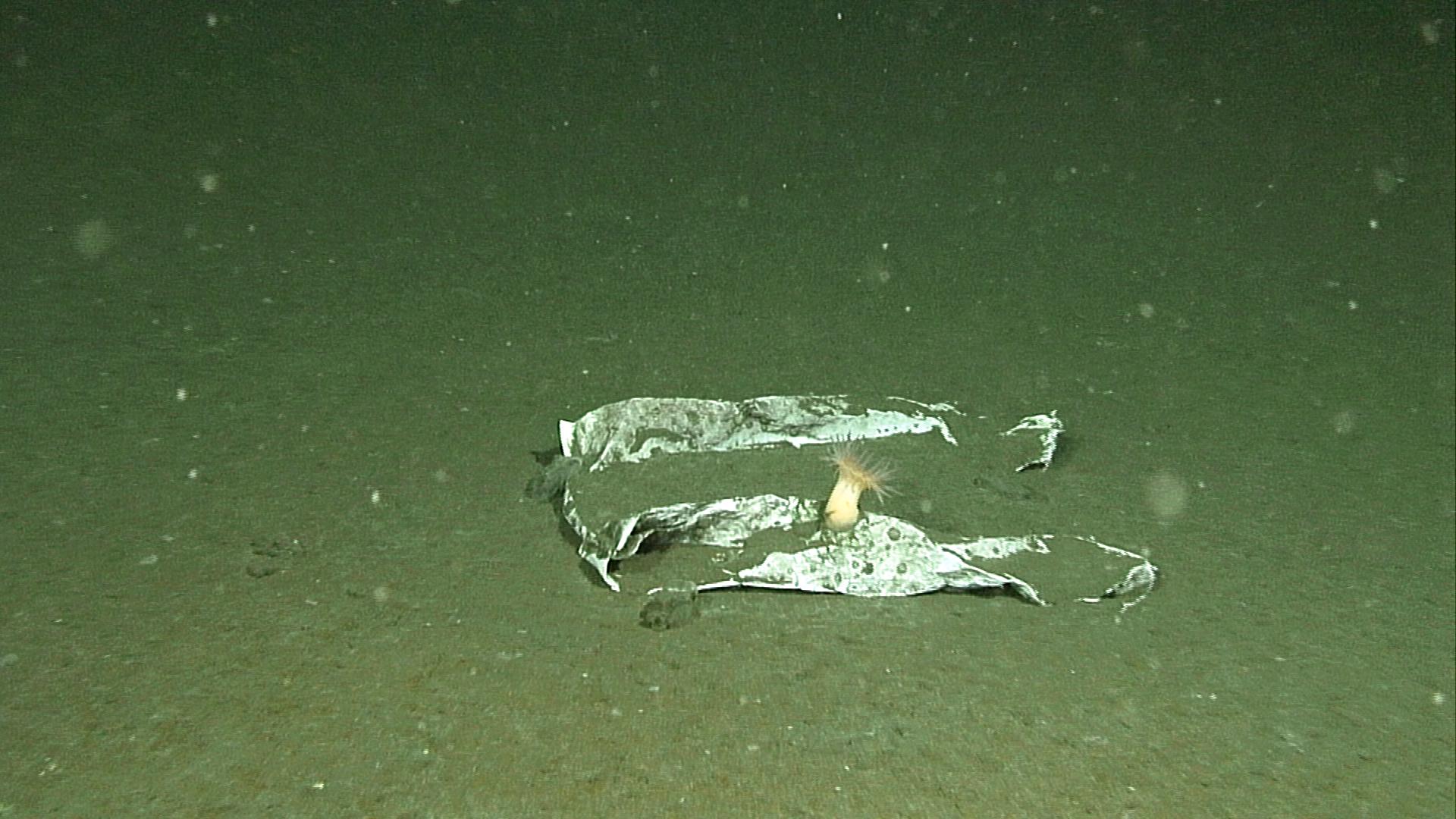
A sea anemone is seen on a plastic bottle at a depth of 2,200 meters.
20:00 JST, August 7, 2025
A huge amount of plastic waste from Japan and elsewhere has been found on the deep seabed around Japan, according to a probe by the Japan Agency for Marine-Earth Science and Technology (JAMSTEC).
Talks by the Intergovernmental Negotiating Committee (INC) to draft a convention to prevent environmental pollution due to plastic waste resumed in Switzerland on Tuesday.
The JAMSTEC team that carried out the research stressed the necessity of using fewer plastic products across the globe.
The agency conducted the probe from 2019 through spring this year, to ascertain the state of plastic waste pollution on the deep ocean floor.
Using the Shinkai 6500, a manned research submarine installed with cameras, researchers probed the ocean floors of the Japan Trench, waters off the Boso Peninsula, Sagami Bay, Suruga Bay, waters off Shikoku and waters off Noto Peninsula. Depths ranged from 800 meters to 7,000 meters.
Vast quantities of plastic were found in all these locations. The most polluted areas contained 10,000 to 40,000 plastic items per square kilometer.
“It’s deeply shocking that so much plastic waste was confirmed in ocean waters tens of kilometers from the coast,” said Ryota Nakajima, a researcher on the team who specializes in biological oceanography.
Of the waste, 70% to 80% was polyethylene bags and plastic shopping bags, and the rest was primarily plastic bottles and food containers. Such waste does not deteriorate quickly in the deep sea due to the lack of light, so some of the waste was identified as products from the Showa era (1926-89).
Some product labels showed that the items had drifted on an oceanic current not only from Japan but also from China, South Korea and Southeast Asian countries and regions.
The research team also confirmed that a massive amount of microplastics — tiny fragments of plastic products — was dispersed in the seawater. Some plastic products contain chemical substances that are harmful to the human body, and it has been said that people’s health may be damaged if they eat fish that have ingested microplastics.
The regulation of plastic production has been on the agenda at the INC meeting, which seeks to draft a convention regarding plastic waste, but opinions are divided on the subject.
“The world is connected by the ocean, in which a massive amount of plastic waste is coming and going. To keep the ocean unpolluted, countries and regions must cooperate with each other. It’s hopeless otherwise,” Nakajima said. He is paying close attention to the outcome of discussions at the meeting.






Most Read
Popular articles in the past 24 hours
-

Voters Using AI to Choose Candidates in Japan's Upcoming General ...
-

Japan's Snow-Clad Beauty: Camellia Flowers Seen in Winter Bloom a...
-

Monkey Strikes Junior High School Girl from Behind in Japan's Yam...
-

Genichiro Inokuma's Mural in Ueno Station That Gave Hope in Postw...
-

Senior Japanese Citizens Return to University to Gain Knowledge, ...
-

Foreign and Security Policy: Political Parties Must Discuss How T...
-
Heavy Snow Linked to 30 Deaths across Japan since Late Jan.; JMA ...
-

Tokyo Police Arrest Head of Resignation Assistance Firm
Popular articles in the past week
-

Japan Institute to Use Domestic Commercial Optical Lattice Clock ...
-
Australian Woman Dies After Mishap on Ski Lift in Nagano Prefectu...
-
Foreign Snowboarder in Serious Condition After Hanging in Midair ...
-
Chinese Embassy in Japan Reiterates Call for Chinese People to Re...
-
Narita Airport, Startup in Japan Demonstrate Machine to Compress ...
-

Toyota Motor Group Firm to Sell Clean Energy Greenhouses for Stra...
-

Sakie Yokota, Last Surviving Parent of a North Korea Abductee, Ur...
-

Beer Yeast Helps Save Labor, Water Use in Growing Rice; Govt Hope...
Popular articles in the past month
-
Univ. in Japan, Tokyo-Based Startup to Develop Satellite for Disa...
-

JAL, ANA Cancel Flights During 3-day Holiday Weekend due to Blizz...
-
China Confirmed to Be Operating Drilling Vessel Near Japan-China ...
-

China Eyes Rare Earth Foothold in Malaysia to Maintain Dominance,...
-
M6.2 Earthquake Hits Japan's Tottori, Shimane Prefectures; No Tsu...
-
Japan Institute to Use Domestic Commercial Optical Lattice Clock ...
-

Japan, Qatar Ministers Agree on Need for Stable Energy Supplies; ...
-

Japan, Italy to Boost LNG Cooperation; Aimed at Diversifying Japa...
Top Articles in Society
-
JAL, ANA Cancel Flights During 3-day Holiday Weekend due to Blizzard
-
Record-Breaking Snow Cripples Public Transport in Hokkaido; 7,000 People Stay Overnight at New Chitose Airport
-
Australian Woman Dies After Mishap on Ski Lift in Nagano Prefecture
-
Foreign Snowboarder in Serious Condition After Hanging in Midair from Chairlift in Nagano Prefecture
-
Train Services in Tokyo Resume Following Power Outage That Suspended Yamanote, Keihin-Tohoku Lines (Update 4)
JN ACCESS RANKING
-
Univ. in Japan, Tokyo-Based Startup to Develop Satellite for Disaster Prevention Measures, Bears
-
JAL, ANA Cancel Flights During 3-day Holiday Weekend due to Blizzard
-
China Confirmed to Be Operating Drilling Vessel Near Japan-China Median Line
-
China Eyes Rare Earth Foothold in Malaysia to Maintain Dominance, Counter Japan, U.S.
-
Japan Institute to Use Domestic Commercial Optical Lattice Clock to Set Japan Standard Time