
Trump Executive Order Sets No Date to Cut Auto Tariff;U.S., Japan Begin to Diverge on What Agreement Means
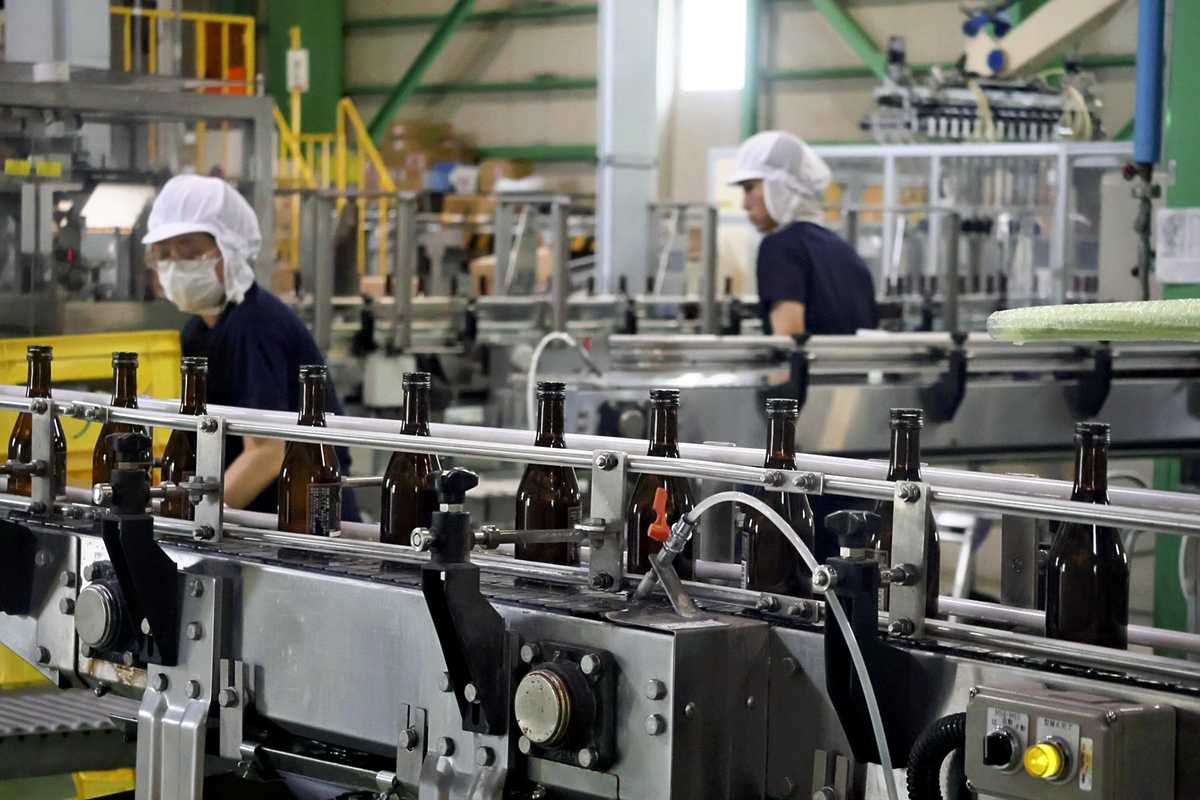
Employees check the labeling of bottled sake on Friday at the main facility of brewer Ichinokura in Osaki, Miyagi Prefecture.
6:00 JST, August 3, 2025
Uncertainty has yet to be dispelled over details of an agreed-upon automobile tariff to be imposed on Japan by the United States.
An executive order issued Thursday by the White House to impose a 15% tariff on Japan will place a heavy burden on Japanese companies. But the order did not specify an actual date for when the duty on automobiles will be reduced from the current 27.5% to 15%. The Japanese government has boasted of that reduction as the key result of its recent tariff negotiations with the United States.
“It is so disappointing, as we were hoping that [the auto tariff] would be reduced at the same time as the reduction of the ‘reciprocal tariff,’” an executive of a leading automaker said after learning that the executive order issued by U.S. President Donald Trump made no mention of an automobile tariff.
Since April, a 27.5% tariff has been levied on automobiles. The recent Japan-U.S. agreement is supposed to reduce the tariff to 15%, but when it will be implemented is uncertain.
The car tariff squeezes manufacturers’ bottom lines. “It is becoming a burden day by day,” said a senior automaker official. “We hope the updated tariff rate will be applied as soon as possible.”
Economic revitalization minister Ryosei Akazawa said Friday, “We will urge [the United States] to take steps to fulfill the agreement as soon as possible.”
However, the reciprocal tariff and the car tariff are based on different laws. The United Kingdom waited more than a month to see a lower tariff levied on its cars after reaching an agreement with the United States.
Many products affected
Meanwhile, the reciprocal tariff on most Japanese exports will be set at 15% from Thursday.
“While the hurdle has been lowered [from the initially announced rate], the impact of the tariff remains unclear,” said Hitoshi Suzuki, president of sake brewery Ichinokura Co. in Osaki, Miyagi Prefecture.
Riding a Japanese cuisine boom, Ichinokura has built up its exports to the United States, and the tariff hike comes as a significant blow. Sake was subject to nearly zero tariffs at 3 cents per liter, but that will now rise to 15%.
Tariffs on fishery products will also increase. A seafood processing company in Mombetsu, Hokkaido, has doubled its scallop exports to the United States since China imposed an import ban on Japanese seafood products in 2023.
“If we pass on the tariff increase through our prices, customers in the United States may hesitate to buy,” the president of the company said.
According to the Japanese government, products with original tariff rates of 15% or higher will continue to be subject to the same tariff rates. This was a special measure agreed upon between the European Union and the United States, and Japan had also agreed to the same mechanism.
However, this was not explicitly stated in Thursday’s executive order. Even Akazawa, who led the negotiations, told reporters Friday, “We need to examine the details” of the agreements.
No joint document made
The lack of a joint agreement document has also made the deal unclear.
U.S. Treasury Secretary Scott Bessent said in an interview with Fox News on July 23, “We’ll evaluate [Japan’s performance] every quarter and if the president’s unhappy then we’ll boomerang it back to the 25% tariff rate, both on cars and the rest of their products.”
Itochu Corp. Executive Vice President Tsuyoshi Hachimura said Friday at a press conference: “The agreement has not been put into writing, and there is even talk of evaluating [Japan’s performance], so nothing has been decided yet. At this stage, it is better not to be too positive.”
The government also intends to take domestic measures.
“We will make every effort to mitigate the impact on industry and employment, such as providing financial support,” Prime Minister Shigeru Ishiba said when he heard opinions from the automobile industry in Tokyo on Thursday.
Saisuke Sakai of Mizuho Research & Technologies, Ltd. pointed out uncertainty for companies, saying that the impact on small and medium-sized enterprises would be particularly significant.
“It is necessary for the public and private sectors to work together not only to provide financial support to companies but also to help them shift away from dependence on exports to the United States and develop products with high added value,” Sakai said.




Most Read
Most read in the last 24 hours
-
Promote Support, Respect to Help Prevent Harassment of Athletes
-
Yamato Museum Reopens in Hiroshima Pref. Following Extensive Reno...
-
Japanese Govt to Set Up Panel on Widening Access to Sports Broadc...
-
Toyota Unveils New Development Hub in Woven City Repurposed from ...
-
Elegant Weeping Cherry Blossoms on Display at Water Purification ...
-

New Budget Framework for Investments: Work to Achieve Both Growth...
-
Man Admits to Abandoning Wife's Body in Zoo Incinerator in Hokkai...
-
Fukui: Dinosaur Faculty Building Unveiled in Japanese University'...
Most read in the last 7 days
-
Earthquake Hits Japan's Tohoku Region; 3-meter Tsunami Warning Is...
-
Trump Extends the Ceasefire with Iran but Keeps the Blockade
-
China, South Korea Object to Japanese PM Takaichi's Ritual Offeri...
-

India's Arms Indigenization Quest for Self-Reliance / New Delhi S...
-
Japan to Ban Use of Portable Chargers on Airplanes from April 24,...
-
¥1,000 Coins to Be Issued to Mark Anniversary of Beginning of Jap...
-

Most Serious Cyberattacks against the UK Now from Russia, Iran an...
-

Trump Opposes United–American Merger, Signals Support for Spirit
Most read in the last 30 days
-
Earthquake Hits Japan's Tohoku Region; 3-meter Tsunami Warning Is...
-
Police Find Child's Shoe During Search for Missing Boy in Nantan,...
-
Body Found in Nantan, Kyoto Prefecture, During Search for 11-Year...
-
Cherry Blossoms, Rapeseed Flowers Perform Colorful ‘Duet’ in Niig...
-
Trump Extends the Ceasefire with Iran but Keeps the Blockade
-
China, South Korea Object to Japanese PM Takaichi's Ritual Offeri...
-

Olympic Gold Medal-Winning Figure Skaters Riku-Ryu Announce Retir...
-
Japanese Prime Minister Takaichi Speaks to Pakistani Prime Minist...
Top Articles in Business
-
Foreign Tourists Set New Record in March; 30% Drop in Visitors from Middle East
-
Japan’s ANA to Introduce Fuel Surcharges to Domestic Flights from Fy27, Driven by Rising Fuel Costs, Declining Profits
-
Middle Powers Should Create Alternative to WTO, Says Research Group
-
Toyota Motor to Begin Full-Scale Hydrogen Production in May; Mass Production and Sales of Equipment Planned to Start in 2029
-
Airborne Cellular Stations to Be Tested in Ishikawa, Miyagi; Aim to Ensure Communication During Disasters
JN ACCESS RANKING
-
Earthquake Hits Japan’s Tohoku Region; 3-meter Tsunami Warning Issued (Update 1)
-
Police Find Child’s Shoe During Search for Missing Boy in Nantan, Kyoto Prefecture
-
Body Found in Nantan, Kyoto Prefecture, During Search for 11-Year-Old Boy in Area (Update 1)
-
Cherry Blossoms, Rapeseed Flowers Perform Colorful ‘Duet’ in Niigata
-
Trump Extends the Ceasefire with Iran but Keeps the Blockade
Most read in the last 24 hours
-
Promote Support, Respect to Help Prevent Harassment of Athletes
-
Yamato Museum Reopens in Hiroshima Pref. Following Extensive Reno...
-
Japanese Govt to Set Up Panel on Widening Access to Sports Broadc...
-
Toyota Unveils New Development Hub in Woven City Repurposed from ...
-
Elegant Weeping Cherry Blossoms on Display at Water Purification ...
Most read in the last 7 days
-
Earthquake Hits Japan's Tohoku Region; 3-meter Tsunami Warning Is...
-
Trump Extends the Ceasefire with Iran but Keeps the Blockade
-
China, South Korea Object to Japanese PM Takaichi's Ritual Offeri...
-
India's Arms Indigenization Quest for Self-Reliance / New Delhi S...
-
Japan to Ban Use of Portable Chargers on Airplanes from April 24,...
Most read in the last 30 days
-
Earthquake Hits Japan's Tohoku Region; 3-meter Tsunami Warning Is...
-
Police Find Child's Shoe During Search for Missing Boy in Nantan,...
-
Body Found in Nantan, Kyoto Prefecture, During Search for 11-Year...
-
Cherry Blossoms, Rapeseed Flowers Perform Colorful ‘Duet’ in Niig...
-
Trump Extends the Ceasefire with Iran but Keeps the Blockade