
Emperor, Empress Console Internees’ Souls in Mongolia; About 1,700 Japanese Died There After World War II
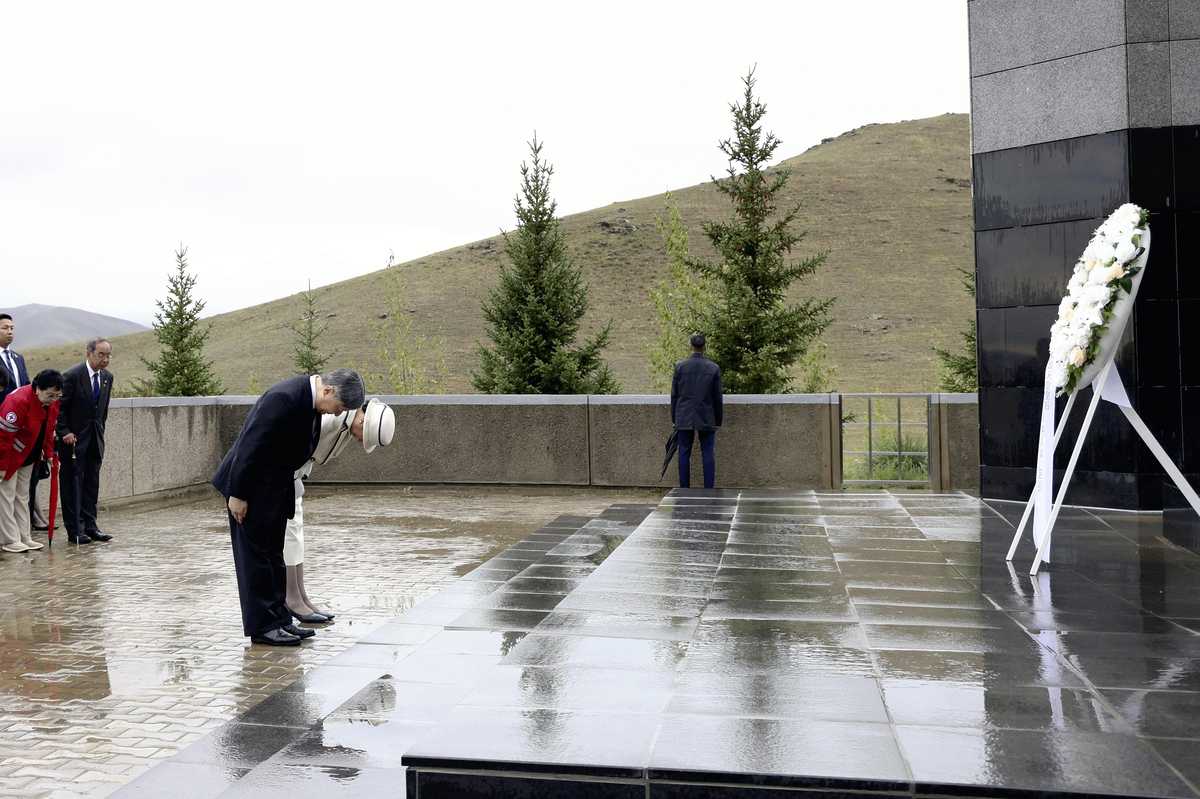
The Emperor and Empress bow at a cenotaph for Japanese who died during postwar internment in the suburbs of Ulaanbaatar on Tuesday.
16:14 JST, July 9, 2025
ULAANBAATAR — The Emperor and Empress offered flowers Tuesday at a cenotaph in the suburbs of Ulaanbaatar for the Japanese nationals who died in Mongolia during postwar internment.
This is the first time for a reigning Japanese emperor or empress to offer comfort to Japanese souls at a place of internment in Mongolia or the former Soviet Union.
The Emperor and Empress placed a white wreath at the cenotaph and bowed deeply for about a minute in the pouring rain. When the rain stopped, they closed their umbrellas and bowed silently for another 10 seconds. Afterwards, they met with families of internees who had visited from Japan.
After the war, about 14,000 Japanese were interned in Mongolia and forced to engage in the construction of the capital and other labor. About 1,700 died of infectious diseases and other causes. This is the second time for the Emperor to comfort the souls in Mongolia — he also did so in 2007, when he was crown prince. This is the first time for the Empress to do so.
On Tuesday evening, they attended a banquet hosted by the Mongolian president and his wife at a hotel in the city.
In his speech, the Emperor said that he “will never forget” the support from Mongolia after the Great East Japan Earthquake and other major disasters, and that the foundation for the development of friendship and cooperation between Japan and Mongolia was “the exchanges between past citizens of the two countries.”
He then said, “I hope that the younger generation will carry on the steps taken by their predecessors, and that the seeds of cooperation will blossom into many flowers.”
At the dinner, the Emperor played two songs on the viola, including “Hamabe no Uta” (Song of the beach), with a local orchestra.






Most Read
Popular articles in the past 24 hours
-

Voters Using AI to Choose Candidates in Japan's Upcoming General ...
-
Japan's Snow-Clad Beauty: Camellia Flowers Seen in Winter Bloom a...
-
Monkey Strikes Junior High School Girl from Behind in Japan's Yam...
-
Genichiro Inokuma's Mural in Ueno Station That Gave Hope in Postw...
-
Senior Japanese Citizens Return to University to Gain Knowledge, ...
-

Foreign and Security Policy: Political Parties Must Discuss How T...
-
Heavy Snow Linked to 30 Deaths across Japan since Late Jan.; JMA ...
-

Tokyo Police Arrest Head of Resignation Assistance Firm
Popular articles in the past week
-

Japan Institute to Use Domestic Commercial Optical Lattice Clock ...
-
Australian Woman Dies After Mishap on Ski Lift in Nagano Prefectu...
-
Foreign Snowboarder in Serious Condition After Hanging in Midair ...
-

Chinese Embassy in Japan Reiterates Call for Chinese People to Re...
-
Narita Airport, Startup in Japan Demonstrate Machine to Compress ...
-

Toyota Motor Group Firm to Sell Clean Energy Greenhouses for Stra...
-
Sakie Yokota, Last Surviving Parent of a North Korea Abductee, Ur...
-

Beer Yeast Helps Save Labor, Water Use in Growing Rice; Govt Hope...
Popular articles in the past month
-
Univ. in Japan, Tokyo-Based Startup to Develop Satellite for Disa...
-
JAL, ANA Cancel Flights During 3-day Holiday Weekend due to Blizz...
-
China Confirmed to Be Operating Drilling Vessel Near Japan-China ...
-

China Eyes Rare Earth Foothold in Malaysia to Maintain Dominance,...
-
M6.2 Earthquake Hits Japan's Tottori, Shimane Prefectures; No Tsu...
-
Japan Institute to Use Domestic Commercial Optical Lattice Clock ...
-

Japan, Qatar Ministers Agree on Need for Stable Energy Supplies; ...
-

Japan, Italy to Boost LNG Cooperation; Aimed at Diversifying Japa...
Top Articles in Society
-
JAL, ANA Cancel Flights During 3-day Holiday Weekend due to Blizzard
-
Record-Breaking Snow Cripples Public Transport in Hokkaido; 7,000 People Stay Overnight at New Chitose Airport
-
Australian Woman Dies After Mishap on Ski Lift in Nagano Prefecture
-
Foreign Snowboarder in Serious Condition After Hanging in Midair from Chairlift in Nagano Prefecture
-
Train Services in Tokyo Resume Following Power Outage That Suspended Yamanote, Keihin-Tohoku Lines (Update 4)
JN ACCESS RANKING
-
Univ. in Japan, Tokyo-Based Startup to Develop Satellite for Disaster Prevention Measures, Bears
-
JAL, ANA Cancel Flights During 3-day Holiday Weekend due to Blizzard
-
China Confirmed to Be Operating Drilling Vessel Near Japan-China Median Line
-
China Eyes Rare Earth Foothold in Malaysia to Maintain Dominance, Counter Japan, U.S.
-
Japan Institute to Use Domestic Commercial Optical Lattice Clock to Set Japan Standard Time