
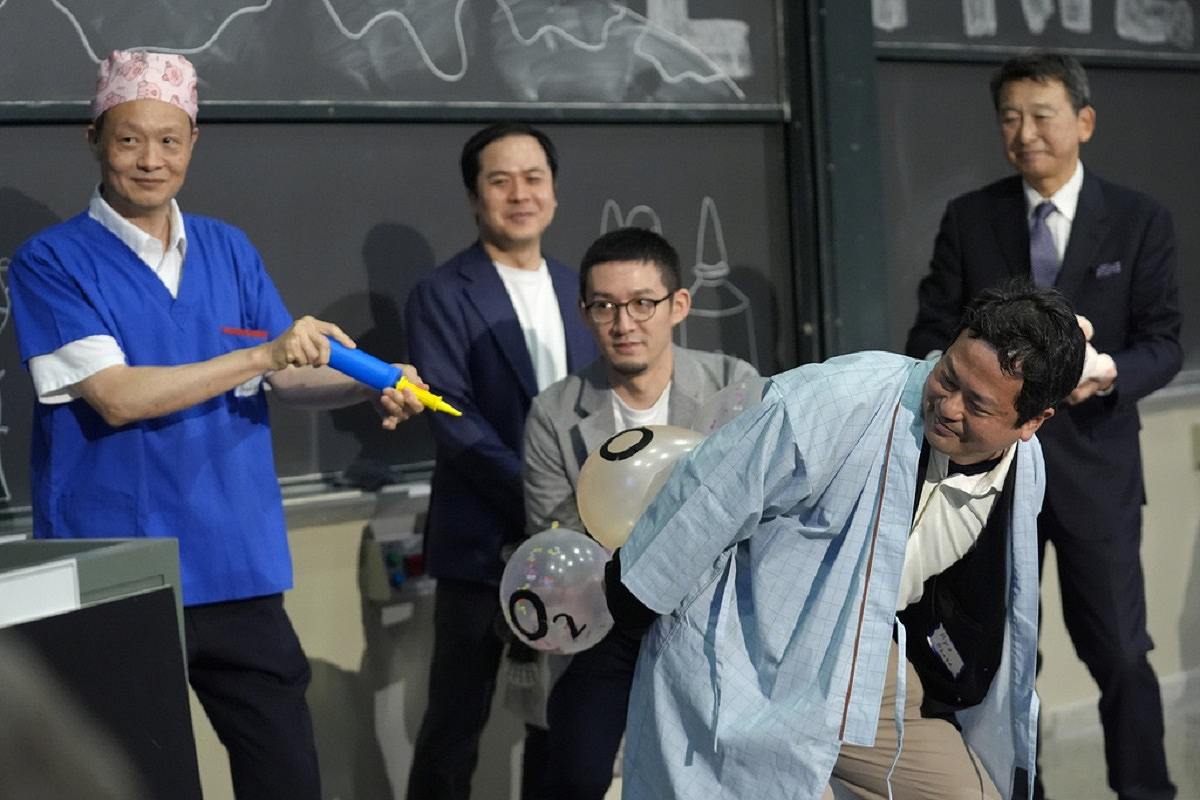
A team of researchers perform a demonstration during a performance showing that many mammals are capable of breathing through their anus while accepting the 2024 Ig Nobel prize in physiology at the Ig Nobel Prize ceremony at Massachusetts Institute of Technology, in Cambridge, Mass., Sept. 12, 2024.
14:03 JST, September 13, 2024
Cambridge, Massachusetts (Jiji Press) — A team of Japanese and U.S. researchers won this year’s Ig Nobel Prize in Physiology on Thursday for their discovery that mammals can breathe using their intestines through the anus.
It is the 18th straight year that Japanese researchers have received an Ig Nobel Prize. The award ceremony was held at the Massachusetts Institute of Technology in a Boston suburb. The annual Ig Nobel Prize, a spoof of the Nobel Prize, was launched in 1991 to honor “achievements so surprising that they make people laugh, then think.”
The team’s research is expected to help alleviate the symptoms of patients suffering from respiratory failure due to diseases such as COVID-19.
Tokyo Medical and Dental University professor Takanori Takebe, 37, and other researchers who began their study on the lungs from the perspective of regenerative medicine, an area in which where they specialize, focused on how loaches breathe. Loaches breathe through gills normally and absorb oxygen through their intestines in a low-oxygen environment.
The team conducted experiments on mice and pigs, in light of the possibility of applying the intestinal breathing method to humans with deteriorating lung function. Liquid containing large amounts of oxygen or oxygen gas was injected into the animals through their anuses, resulting in an increase in blood oxygen and an improvement in survival rates.
The researchers announced the method in 2021, naming it enteral ventilation. They are currently conducting a trial of a medical device that delivers oxygen into the bodies of human patients via the anus, aiming to commercialize it in Japan in 2028 and in the United States in 2030.
Artificial respirators and extracorporeal membrane oxygenation (ECMO) machines are used for patients with respiratory failure. But the physical burden on patients is heavy, and handling the machines is difficult.
Takebe told Jiji Press that enteral ventilation can also be used for extremely premature babies. “The technology has still not been widely accepted, but I hope people will learn about it with interest” following the winning of the Ig Nobel Prize for the research, he said.
Takebe and co-researchers including Ryo Okabe, a 45-year-old Japanese doctor, and Toyofumi Yoshikawa, 52, a professor at Nagoya University in central Japan, appeared at the award ceremony wearing caps shaped like a loach, and explained how they conducted their research.
The Ig Nobel Prize award ceremony took place in person for the first time in five years. The past four ceremonies were held online due to the COVID-19 pandemic.






Most Read
Popular articles in the past 24 hours
-

Voters Using AI to Choose Candidates in Japan's Upcoming General ...
-

Japan's Snow-Clad Beauty: Camellia Flowers Seen in Winter Bloom a...
-

Monkey Strikes Junior High School Girl from Behind in Japan's Yam...
-

Genichiro Inokuma's Mural in Ueno Station That Gave Hope in Postw...
-
Senior Japanese Citizens Return to University to Gain Knowledge, ...
-

Foreign and Security Policy: Political Parties Must Discuss How T...
-

Heavy Snow Linked to 30 Deaths across Japan since Late Jan.; JMA ...
-

Tokyo Police Arrest Head of Resignation Assistance Firm
Popular articles in the past week
-

Japan Institute to Use Domestic Commercial Optical Lattice Clock ...
-

Australian Woman Dies After Mishap on Ski Lift in Nagano Prefectu...
-

Foreign Snowboarder in Serious Condition After Hanging in Midair ...
-

Chinese Embassy in Japan Reiterates Call for Chinese People to Re...
-
Narita Airport, Startup in Japan Demonstrate Machine to Compress ...
-

Toyota Motor Group Firm to Sell Clean Energy Greenhouses for Stra...
-

Sakie Yokota, Last Surviving Parent of a North Korea Abductee, Ur...
-

Beer Yeast Helps Save Labor, Water Use in Growing Rice; Govt Hope...
Popular articles in the past month
-
Univ. in Japan, Tokyo-Based Startup to Develop Satellite for Disa...
-

JAL, ANA Cancel Flights During 3-day Holiday Weekend due to Blizz...
-

China Confirmed to Be Operating Drilling Vessel Near Japan-China ...
-

China Eyes Rare Earth Foothold in Malaysia to Maintain Dominance,...
-
M6.2 Earthquake Hits Japan's Tottori, Shimane Prefectures; No Tsu...
-
Japan Institute to Use Domestic Commercial Optical Lattice Clock ...
-

Japan, Qatar Ministers Agree on Need for Stable Energy Supplies; ...
-

Japan, Italy to Boost LNG Cooperation; Aimed at Diversifying Japa...
Top Articles in Society
-
JAL, ANA Cancel Flights During 3-day Holiday Weekend due to Blizzard
-
Record-Breaking Snow Cripples Public Transport in Hokkaido; 7,000 People Stay Overnight at New Chitose Airport
-
Australian Woman Dies After Mishap on Ski Lift in Nagano Prefecture
-
Foreign Snowboarder in Serious Condition After Hanging in Midair from Chairlift in Nagano Prefecture
-

Train Services in Tokyo Resume Following Power Outage That Suspended Yamanote, Keihin-Tohoku Lines (Update 4)
JN ACCESS RANKING
-
Univ. in Japan, Tokyo-Based Startup to Develop Satellite for Disaster Prevention Measures, Bears
-
JAL, ANA Cancel Flights During 3-day Holiday Weekend due to Blizzard
-
China Confirmed to Be Operating Drilling Vessel Near Japan-China Median Line
-
China Eyes Rare Earth Foothold in Malaysia to Maintain Dominance, Counter Japan, U.S.
-
Japan Institute to Use Domestic Commercial Optical Lattice Clock to Set Japan Standard Time