
Japan 2050: Changing Lifestyles / Beyond the Limit: Tokyo Researchers Develop Tech to Break Bodily, Perceptual Barriers
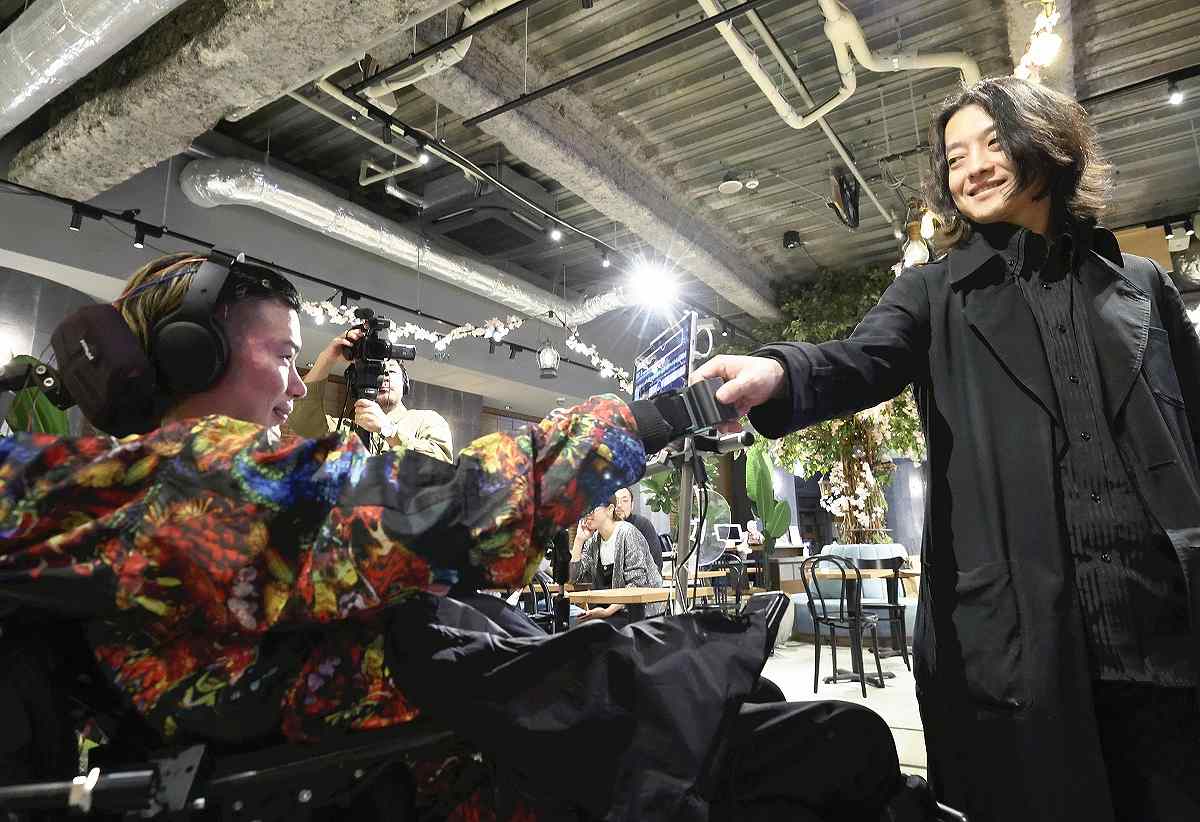
ALS patient Masatane Muto, left, shakes hands with Ory Yoshifuji by moving a robotic arm with his brain waves in Tokyo.
6:00 JST, July 1, 2024
This is the second installment in a series that explores what Japan will look like in 2050, how we as a nation will meet the challenges and what kind of society we want to have.
***
“Let’s shake hands.” In mid-April, a test was conducted in Tokyo to move a robotic arm using brain waves. Masatane Muto, a patient with amyotrophic lateral sclerosis (ALS), was the test’s subject. After announcing the handshake, he closed his eyes.
As he focused his attention for about 30 seconds, 10 devices attached to his head and ears captured his brain wave activity. Then, a robotic arm attached at his shoulder moved slowly and shook the hand of Ory Yoshifuji, 36, a robotics researcher.
“That’s good,” someone said. “Perfect!” said another. Muto responded to their cheers with a smile. “It moved on my command, my active arm,” he said.
Muto developed ALS 11 years ago. His muscles atrophied all over his body and became unable to speak after having a tracheotomy. “Technology not only supplements my physical functions, but also expands them and broadens the scope of my activities,” he says.
To speak, he types in what he wants to say via a system that tracks his eye movements and his words come out in a computerized voice. He makes music digitally and participates in overseas events online with his avatar.
In autumn last year, his daughter was born via in vitro fertilization. Muto, says the success of the robotic arm experiment gives him a lot of hope: “Even if my disease advances, I can still reach out and touch my wife and daughter. My hope for the future has grown stronger.”
“It should eventually be possible for people to go outside by operating an electric wheelchair with their brain waves” Yoshifuji said.
“Human augmentation,” the technology to expand physical and perceptual capabilities using robotics, as well as information and communication technology, has been drawing attention as a way to help people lead lives the way they want to.
Through human augmentation, researchers are attempting to use robotics and information and communications technology to expand physical and perceptual capabilities. The concept is drawing attention as a way to help people lead decent lives.
The Moonshot Research and Development Program, which was launched by the Cabinet Office in 2020, calls for a society free from “limitations of the body, brain, space and time” as one of 10 goals to be realized by 2050.
In a future with advanced human augmentation, it could be the norm for a bedridden individual to remotely control a robot, and for an individual and their digital avatar to simultaneously work at different locations.
“Everyone will have another body and be able to lead a fulfilling life in their own way,” said Prof. Kouta Minamisawa of Keio University, who is involved in the development of technology to remotely share the sense of touch.
The Vision Pro headset, released by Apple Inc. in the United States in February, may also become a tool that helps individuals expand their range of activity and their roles and that helps solves the problems that come with a shrinking population.
The device is what is known as a spatial computer and is operated by eye and hand movements. When worn, the user’s current space and the virtual world merge, making it possible to easily perform multiple tasks simultaneously, such as participating in a meeting online while cooking in real life. It is also possible to enjoy simulated space travel by superimposing a view of the moon’s surface on a room. The Vision Pro went on sale in Japan in late June.
“It’ll be possible to concentrate on what you really want to do by omitting many things and activities,” said Nobuhiko Watanabe, a professor at the Graduate School of Project Design and the chief operating officer at Styly, Inc, a Tokyo-based IT firm. “The hours in a day and your life, which you only live once, will become incomparably denser compared to today.”
Technology is on a steady march toward the future. But many issues will have to be resolved before new technologies can be put to use, including ethical issues and the establishment of relevant laws.
“Tech innovations could make up for labor shortages that come with a shrinking population,” said Atsuya Fujimoto of Mitsubishi Research Institute, Inc. “What is most important is how individuals will act and what they are trying to achieve. It’s their ability to envision the future they want.”





Popular Articles
Popular articles in the past 24 hours
-

Inclusive Society / South Korea, Taiwan Strive for Coexistence Wi...
-
Japanese Parties Step Up Preparations for Lower House Election
-

China Eyes Rare Earth Foothold in Malaysia to Maintain Dominance,...
-
Japan’s Takaichi Says She Will Dissolve Lower House, Setting up S...
-
Japan’s Takaichi to Hold Press Conference Likely to Announce Inte...
-
Milano Cortina 2026: Japanese Athletes Vow at Ceremony to Compete...
-
Centrist Reform Alliance Party To Pledge for Zero Tax on Food; Me...
-

Europe’s EV Policy: Idealism Wavers in Face of Reality
Popular articles in the past week
-

Japan, Qatar Ministers Agree on Need for Stable Energy Supplies; ...
-
Japan, Italy to Boost LNG Cooperation; Aimed at Diversifying Japa...
-
Train Services in Tokyo Resume Following Power Outage That Suspen...
-
Radiation Detected from International Mail Package from Vietnam
-

Milano Cortina 2026: Japanese Bobsleigh Athletes Lose Chance to C...
-

Japan's National Baseball Team Adds 11 Members to Participate in ...
-
Japanese Government Plans New License System Specific to VTOL Dro...
-

Prestigious Japanese Literature Prize Names Toriyama, Hatakeyama ...
Popular articles in the past month
-

Japan Govt Adopts Measures to Curb Mega Solar Power Plant Project...
-
Core Inflation in Tokyo Slows in December but Stays above BOJ Tar...
-

Major Japan Firms’ Average Winter Bonus Tops ¥1 Mil.
-
Bank of Japan Considered U.S. Tariffs, Coming Shunto Wage Hike Ta...
-

Tokyo Zoo Wolf Believed to Have Used Vegetation Growing on Wall t...
-
JAL, ANA Cancel Flights During 3-day Holiday Weekend due to Blizz...
-

‘Fiercest, Most Damaging Invasive Weed’ Spreading in Rivers, Lake...
-
Univ. in Japan, Tokyo-Based Startup to Develop Satellite for Disa...
"Society" POPULAR ARTICLE
-
Tokyo Zoo Wolf Believed to Have Used Vegetation Growing on Wall to Climb, Escape; Animal Living Happily after Recapture
-
JAL, ANA Cancel Flights During 3-day Holiday Weekend due to Blizzard
-

Snow Expected in Tokyo, Neighboring Prefectures from Jan. 2 Afternoon to Jan. 3; 5-Centimeter Snow Fall Expected in Hakone, Tama, and Chichibu Areas
-
Tokyo, Yokohama Observe First Snowfall of Season; 1 Day Earlier than Average Year
-
M6.2 Earthquake Hits Japan’s Tottori, Shimane Prefectures; No Tsunami Threat (Update 4)
JN ACCESS RANKING
-
Japan Govt Adopts Measures to Curb Mega Solar Power Plant Projects Amid Environmental Concerns
-
Core Inflation in Tokyo Slows in December but Stays above BOJ Target
-
Major Japan Firms’ Average Winter Bonus Tops ¥1 Mil.
-
Tokyo Zoo Wolf Believed to Have Used Vegetation Growing on Wall to Climb, Escape; Animal Living Happily after Recapture
-
JAL, ANA Cancel Flights During 3-day Holiday Weekend due to Blizzard