
13 Years Since the Great East Japan Earthquake / Japan’s Fisheries Look for New Sales Channels as China Continues Ban on Imports
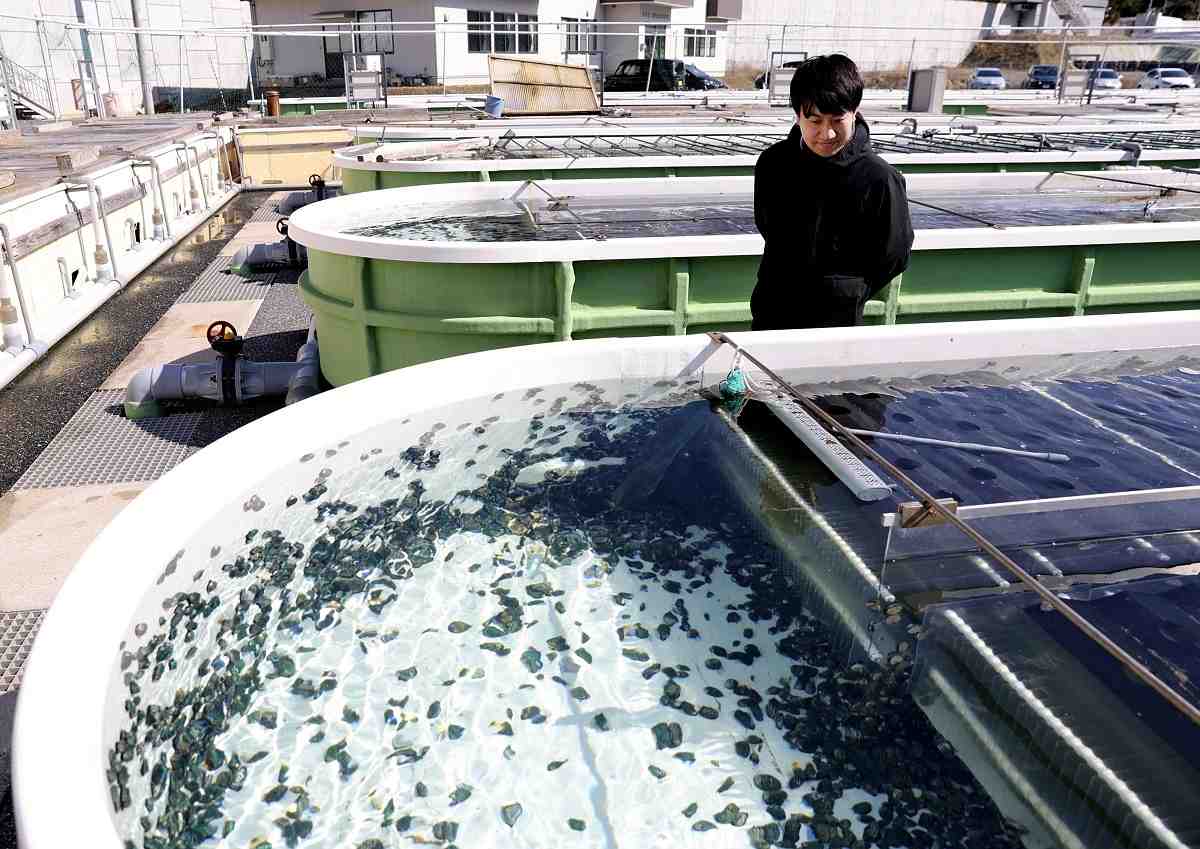
Shota Furukawa, a sales manager for Genshoei Kitanihon Fishery Co., checks the growth of abalone in Ofunato, Iwate Prefecture.
2:00 JST, March 10, 2024
This is the fifth and final installment of a series that explores the current reality in areas affected by the 2011 Great East Japan Earthquake.
***
“It’s really frustrating. Our seafood is undoubtedly safe,” said Kenya Chiba, the 33-year-old president of Yamanaka, a marine product processing company in Ishinomaki, Miyagi Prefecture, which deals in scallops and oysters.
Around the time when Tokyo Electric Power Company Holdings, Inc.’s Fukushima No. 1 nuclear power plant started the discharge of treated water into the sea in August 2023, Yamanaka was notified by its Hong Kong business partner that all transactions with the company would be discontinued.
The decision appears to have been influenced by the Chinese government’s policy of suspending imports of Japanese marine products after the discharge started. Yamanaka now aims to expand exports to Thailand and elsewhere, but Chiba said, “We are prepared for the impact to last for more than 10 years.”
Japan’s exports of marine products totaled ¥390.1 billion last year, up only 0.7% from a year earlier, a marked slowdown from the 28.5% year-on-year growth posted in 2022. Exports to mainland China fell sharply from last September, although exports to such countries as the United States rose. The impact on prices of marine products, exported to China in large quantities, has been spreading.
According to the Iwate prefectural federation of fisheries cooperative associations, the average unit price of abalone (per 10 kilograms) caught in the prefecture between November and December was ¥88,547, down 35.3% from the corresponding period a year earlier.
Yoshihiro Yamazaki, 76, head of the Omoe fisheries cooperative association in Miyako in the prefecture, said, “Abalone is a source of income for our fishermen in winter. Our livelihoods have been impacted.”
Many fisheries are rushing to develop alternative sales channels to China.
Genshoei Kitanihon Fishery Co., an Ofunato-based company engaged in land-based cultivation of abalone, had exported mainly to Hong Kong but has begun to expand sales in Southeast Asia, including Singapore.
The company, whose selling point is its high-quality abalone cultivated in clean, filtered seawater and fed with homemade food which humans can also eat, has begun shipping samples to local wholesalers in Southeast Asia.
Shota Furukawa, 28, a sales manager for the company, said, “If we can communicate the process of our aquaculture to them, they will understand the safety of our products. We hope to expand our sales to Europe and North America someday.”
The International Atomic Energy Agency (IAEA) has evaluated the treated water release into the sea as consistent with international safety standards.
In tests of water quality from samples collected off the coast of Fukushima, there have been no cases where the concentration of radioactive materials exceeded the standard. The government has been requesting China withdraw its import ban, as it is not based on scientific evidence. But there have so far been no signs of China complying with the request.
Meanwhile, the amount TEPCO is estimated to owe following the release of treated water has ballooned to about ¥37 billion in compensation for rumor-causing damage and, as of Tuesday, it had paid out about ¥4.4 billion over about 40 cases.
Exports of marine products from Fukushima Prefecture, which is home to the plant, have been affected for a long time before the discharge of the treated water started. The amount caught by the three fisheries cooperative associations in the coastal area combined has returned to only about one-quarter of the level posted before the 2011 quake.
There were fears that harmful rumors at home would hold back the fishing industry, which is still in the recovery process.
But thanks partly to the effect of campaigns by major distributors to increase consumption of marine products, there has so far been no major impact on market prices.
Akira Egawa, 77, head of the Iwaki fisheries cooperative association, said, “Joban-mono [fish caught off Fukushima] is selling well and we are grateful for the understanding of consumers across the country.”
However, in the process of releasing the treated water, there have been a series of incidents.
Workers were splashed with water containing radioactive materials in October, and water containing radioactive materials leaked out of a facility in February.
If such mistakes by TEPCO continue to happen, the efforts to promote the fisheries industry in Fukushima may stutter.
Egawa said, “We are angry that TEPCO has repeatedly been making mistakes. I hope that everyone from the top management to the frontline workers has the same sense of tension as we do.”


Related Tags






Most Read
Popular articles in the past 24 hours
-
Rising Kabuki Star Works to Ensure Deaf Audience's Enjoyment of P...
-

Lady Bess: Iroha Okuda, Mayuko Kominami Discuss Performing Elizab...
-

Japan Considering Taking Part in U.S. ‘Golden Dome’ Defense Syste...
-
Japan's TEPCO Releases Footage from Fukushima N-Plant Reactor
-

46 Evacuated from UAE, Oman on Japanese Govt-chartered Flight
-

Oil Reserve Releases: G7 Members Unite against Growing Threat
-
Japan's Sanyo Shinkansen Suspended Again; Between Okayama, Aioi S...
-
Driver Dies in Collision with Express Train at Crossing in Mito; ...
Popular articles in the past week
-

Japan Figure Skating Legend Yuzuru Hanyu Is Proud Disaster Surviv...
-

Nippon Life Insurance's U.S. Arm Sues OpenAI Over Legal Assistanc...
-
Govt to Utilize ODA for Ensuring Economic Security; Securing Ener...
-
15 Measles Patients Confirmed in Tokyo in Past 6 Days; 1 May Have...
-
Massive Sewer Pipe Found Jutting Out of Highway in Osaka
-
Japan Govt to Tighten Requirements to Receive Permanent Residency...
-
Beckoning Cats Get Makeover to Fit Modern Lifestyles with Sleek D...
-
Japan Govt Survey Finds Just 10% of Workers Want Working Hours to...
Popular articles in the past month
-

Producer Behind Pop Group XG Arrested for Cocaine Possession
-

Japan PM Takaichi’s Cabinet Resigns en Masse
-

Man Infected with Measles Reportedly Dined at Restaurant in Tokyo...
-

Videos Plagiarized, Reposted with False Subtitles Claiming ‘Ryuky...
-
Japan Figure Skating Legend Yuzuru Hanyu Is Proud Disaster Surviv...
-

iPS Treatments Pass Key Milestone, but Broader Applications Far f...
-

Sanae Takaichi Elected Prime Minister of Japan; Keeps All Cabinet...
-

Nepal Bus Crash Kills 19 People, Injures 25 Including One Japanes...
Top Articles in Society
-
Producer Behind Pop Group XG Arrested for Cocaine Possession
-
Man Infected with Measles Reportedly Dined at Restaurant in Tokyo Station
-

Bus Carrying 40 Passengers Catches Fire on Chuo Expressway; All Evacuate Safely
-

Ibaraki Pref.’s 1st Foreign Bus Driver Hired in Tsukuba
-

Tokyo Skytree’s Elevator Stops, Trapping 20 People; All Rescued (Update 1)
JN ACCESS RANKING
-
Producer Behind Pop Group XG Arrested for Cocaine Possession
-
Japan PM Takaichi’s Cabinet Resigns en Masse
-
Man Infected with Measles Reportedly Dined at Restaurant in Tokyo Station
-
Videos Plagiarized, Reposted with False Subtitles Claiming ‘Ryukyu Belongs to China’; Anti-China False Information Also Posted in Japan
-
Japan Figure Skating Legend Yuzuru Hanyu Is Proud Disaster Survivor and Gold Medalist, Vows to Continue Support Efforts