
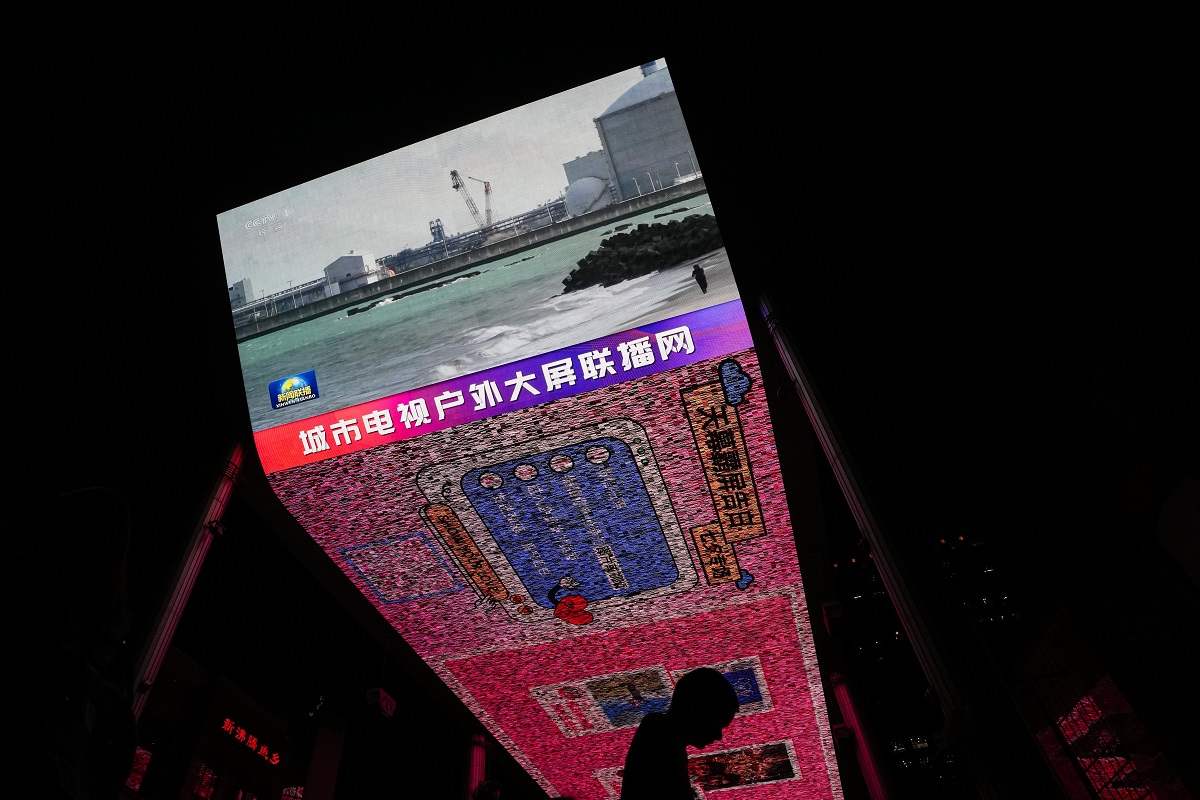
A man walks by a large screen at a shopping mall showing CCTV broadcasting news of Fukushima No. 1 nuclear power plant began releasing its first batch of treated radioactive water into the Pacific Ocean, in Beijing on Thursday
15:45 JST, August 26, 2023
MOSCOW/TOKYO (Reuters) — Russia hopes to increase its marine product exports to China in the wake of China’s ban on Japanese seafood imports after the release of treated water from the wrecked Fukushima nuclear power plant into the sea.
Russia is one of the biggest marine product suppliers to China, with 894 Russian companies allowed to export seafood, Rosselkhoznadzor, the Russian food safety watchdog, said in July.
In a statement late on Friday, Rosselkhoznadzor said it was seeking to increase the number of exporters.
“The Chinese market in general is promising for Russian fish products. We hope to increase the number of certified Russian companies and ships, the volume of products and its range,” the Rosselkhoznadzor statement said.
To aid that effort, Rosselkhoznadzor plans to continue dialog with China on seafood safety issues and finish negotiations with China on regulations for Russian marine products supply to the country, the statement said.
China has already banned some food imports from Japan but Thursday’s total ban was prompted by concerns about the “risk of radioactive contamination” after it started releasing the treated water.
China was the destination for over a half of Russian aquatic products exports between January and August, the statement said without providing figures, dominated by pollock, herring, flounder, sardine, cod and crab.
Russia exported 2.3 million metric tons of marine products last year worth about $6.1 billion, around a half of its overall catch, with China, South Korea and Japan being biggest importers, according to Russia’s fisheries agency.
Japan said criticism from Russia and China was unsupported by scientific evidence and pollution levels in the water will be below those considered safe for drinking under World Health Organization standards.
Still, Rosselkhoznadzor said it has tightened the screening of Japan seafood imports though the volumes are insignificant.
The regulator also said the direction of currents in the Russian Far East, where about 70% of Russia’s seafood is caught, “would prevent contamination” of marine products caught by Russian ships.
It has also tightened the radiological control of seafood caught in Russian waters which are relatively close to Fukushima and would test selected samples for radiation levels, Interfax reported on Thursday, citing Rosselkhoznadzor’s Pacific office.









Most Read
Popular articles in the past 24 hours
-
Tokyo Measles Patient Traveled to Fukuoka Aboard JAL Planes; Susp...
-

Govt to Set Working-Level Meeting Group for Refundable Tax Credit...
-

Party Representatives’ Questions in Diet: Takaichi Says Consumpti...
-

Milano Cortina 2026: News in Pictures / Feats of Japanese Athlete...
-

Pokémon Celebrates 30 Years with Japanese Pro Baseball Collab
-

Death Penalty Sought for Murder of U.S. Man, Family in Saitama Pr...
-

Japan Eyes Introducing Prescreening System for Foreign Travelers,...
-

Microsoft Japan Raided by Antitrust Watchdog for Allegedly Blocki...
Popular articles in the past week
-

Producer Behind Pop Group XG Arrested for Cocaine Possession
-

iPS Treatments Pass Key Milestone, but Broader Applications Far f...
-

Tokyo Skytree's Elevator Stops, Trapping 20 People; All Rescued (...
-

Milano Cortina 2026: Japanese Gold Medalist Figure Skater Miura S...
-

Nepal Bus Crash Kills 19 People, Injures 25 Including One Japanes...
-

Japan’s Major Real Estate Firms Expanding Overseas Businesses to ...
-

Baby Monkey Punch Captures Hearts at Chiba Pref. Zoo, on Social M...
-

Milano Cortina 2026: Japanese Figure Skater Kaori Sakamoto’...
Popular articles in the past month
-
Producer Behind Pop Group XG Arrested for Cocaine Possession
-

Japan PM Takaichi’s Cabinet Resigns en Masse
-

Japan Institute to Use Domestic Commercial Optical Lattice Clock ...
-

Man Infected with Measles Reportedly Dined at Restaurant in Tokyo...
-

Israeli Ambassador to Japan Speaks about Japan’s Role in the Reco...
-

Videos Plagiarized, Reposted with False Subtitles Claiming ‘Ryuky...
-

Man Infected with Measles May Have Come in Contact with Many Peop...
-

Prudential Life Insurance Plans to Fully Compensate for Damages C...
Top Articles in News Services
-

Survey Shows False Election Info Perceived as True
-
Hong Kong Ex-Publisher Jimmy Lai’s Sentence Raises International Outcry as China Defends It
-
Japan’s Nikkei Stock Average Touches 58,000 as Yen, Jgbs Rally on Election Fallout (UPDATE 1)
-
Japan’s Nikkei Stock Average Falls as US-Iran Tensions Unsettle Investors (UPDATE 1)
-

Trump Names Former Federal Reserve Governor Warsh as the Next Fed Chair, Replacing Powell
JN ACCESS RANKING
-
Producer Behind Pop Group XG Arrested for Cocaine Possession
-
Japan PM Takaichi’s Cabinet Resigns en Masse
-
Man Infected with Measles Reportedly Dined at Restaurant in Tokyo Station
-
Israeli Ambassador to Japan Speaks about Japan’s Role in the Reconstruction of Gaza
-
Videos Plagiarized, Reposted with False Subtitles Claiming ‘Ryukyu Belongs to China’; Anti-China False Information Also Posted in Japan