
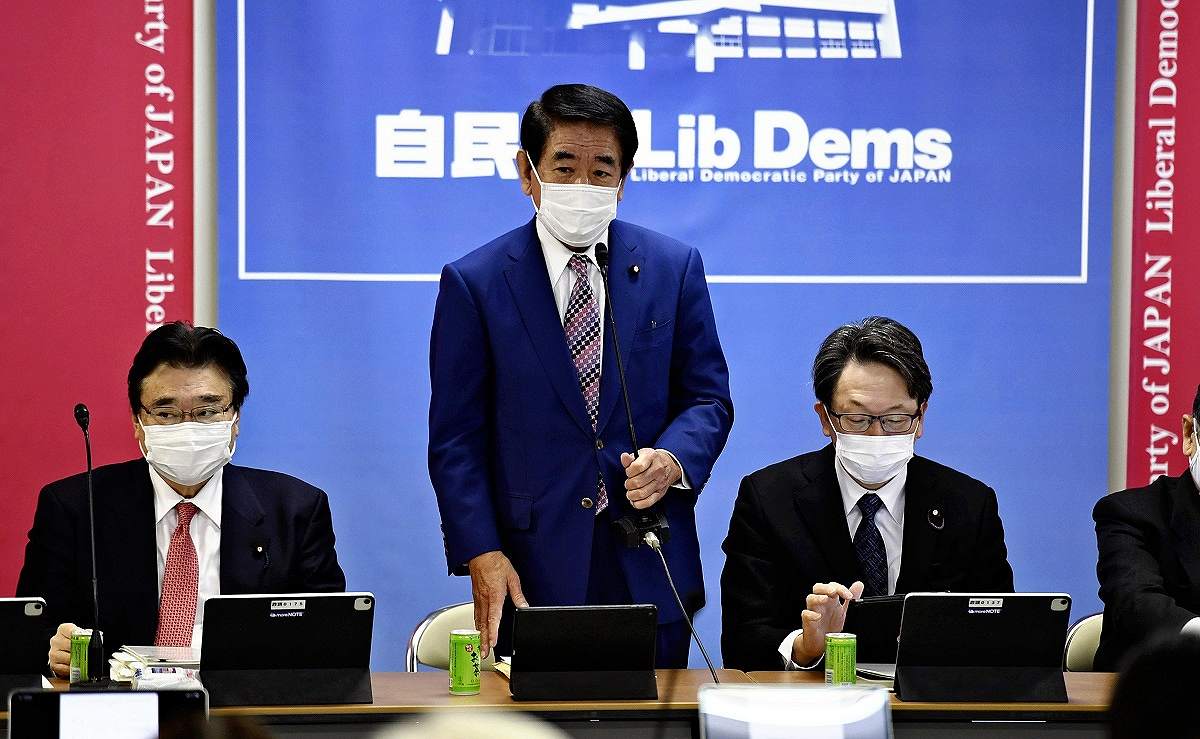
LDP Policy Research Council Chairperson Hakubun Shimomura, center, addresses a joint meeting of the party’s coronavirus task force and other groups at LDP headquarters in Tokyo on Monday.
13:04 JST, January 19, 2021
Prefectural governors will be able to order businesses to close in areas where a state of emergency has been declared, and impose a fine of up to ¥500,000 on those that do not comply, according to a draft amendment to the special measures law to cope with new strains of influenza that has been approved by the Liberal Democratic Party.
The draft amendment was approved Monday at a joint meeting of the LDP’s coronavirus task force and other groups held at its headquarters. The meeting also approved a draft amendment to the Infectious Diseases Law that would impose penalties on infected people who refuse to be hospitalized.
Although some members of the ruling and opposition parties were cautious about introducing penalties, the LDP is giving priority to increasing the effectiveness of measures against the virus. The government hopes to submit both amendments to the Diet by the end of the week, have them enacted in early February, and have them take effect in the same month.
The amendment to the special measures law allows governors to implement new measures to prevent the spread of infection even before a state of emergency is declared. Under these measures, governors can request or order businesses to shorten their business hours and impose a fine of up to ¥300,000 if they do not comply.
The draft amendment clearly states that the government and local governments will “effectively take measures to support” businesses that comply with such requests and orders. It also includes financial support from the central government for local authorities.
The proposed amendment to the Infectious Diseases Law establishes penalties for infected people who refuse to comply with their governor’s recommendation for hospitalization, stating that the penalty shall be a maximum of one year in prison or a fine of up to ¥1 million.
Also, a fine of up to ¥500,000 will be imposed for refusing an investigation by a public health center. Another provision allows the health, labor and welfare minister and governors to recommend that doctors and other officials secure hospital beds.
Komeito largely approved the draft amendments at another joint meeting on Monday. However, there were some comments regarding the introduction of penalties, such as “we should take a cautious approach” and “we should clearly specify the cases where penalties will be applied.”
The Constitutional Democratic Party of Japan accepts the introduction of penalties in the proposed amendment to the special measures law, but plans to demand “adequate compensation” for stores that cooperate in shortening business hours.
Tetsuro Fukuyama, the CDPJ secretary general, told reporters in the Diet on Monday: “Even though [we] loudly call for the introduction of penalties, the public may not cooperate readily. The government’s stance should be to ask for cooperation while providing sufficient compensation.”






Most Read
Most read in the last 24 hours
-

Tokyo Vice Governor: SusHi Tech Tokyo Garners Tangible Business O...
-
Govt to Support Universities in 17 Strategic Fields to Boost Huma...
-
Japan to Host Leaders from Major Cities from Around the World for...
-

Iran's Top Diplomat Briefly Returns to Pakistan but Trump Says th...
-

Sabastian Sawe of Kenya Becomes First Person to Run a Sub-2-hour ...
-
M6.1 Earthquake Hits Hokkaido, Japan; No Tsunami Expected
-

DC Gala Shooting Suspect Aired Grievances against Trump in Writin...
-
Students’ ‘ITAMAE’ Project Boosts Interest in Starting Small Busi...
Most read in the last 7 days
-
China, South Korea Object to Japanese PM Takaichi's Ritual Offeri...
-

Trump Extends the Ceasefire with Iran but Keeps the Blockade
-

India's Arms Indigenization Quest for Self-Reliance / New Delhi S...
-
¥1,000 Coins to Be Issued to Mark Anniversary of Beginning of Jap...
-

Most Serious Cyberattacks against the UK Now from Russia, Iran an...
-

Trump Opposes United–American Merger, Signals Support for Spirit
-
System Malfunction in Haneda Airport Causes 83 Flight Cancelation...
-

Florida Launches Criminal Probe into OpenAI and ChatGPT over Dead...
Most read in the last 30 days
-
Earthquake Hits Japan's Tohoku Region; 3-meter Tsunami Warning Is...
-
Police Find Child's Shoe During Search for Missing Boy in Nantan,...
-
Body Found in Nantan, Kyoto Prefecture, During Search for 11-Year...
-
China, South Korea Object to Japanese PM Takaichi's Ritual Offeri...
-
Cherry Blossoms, Rapeseed Flowers Perform Colorful ‘Duet’ in Niig...
-
Trump Extends the Ceasefire with Iran but Keeps the Blockade
-

Olympic Gold Medal-Winning Figure Skaters Riku-Ryu Announce Retir...
-
Japanese Prime Minister Takaichi Speaks to Pakistani Prime Minist...
Top Articles in Society
-
Earthquake Hits Japan’s Tohoku Region; 3-meter Tsunami Warning Issued (Update 1)
-
Police Find Child’s Shoe During Search for Missing Boy in Nantan, Kyoto Prefecture
-
Body Found in Nantan, Kyoto Prefecture, During Search for 11-Year-Old Boy in Area (Update 1)
-
Cherry Blossoms, Rapeseed Flowers Perform Colorful ‘Duet’ in Niigata
-
Japan to Ban Use of Portable Chargers on Airplanes from April 24, Number of Regular Chargers To Be Limited to 2
JN ACCESS RANKING
-
Earthquake Hits Japan’s Tohoku Region; 3-meter Tsunami Warning Issued (Update 1)
-
Police Find Child’s Shoe During Search for Missing Boy in Nantan, Kyoto Prefecture
-
Body Found in Nantan, Kyoto Prefecture, During Search for 11-Year-Old Boy in Area (Update 1)
-
China, South Korea Object to Japanese PM Takaichi’s Ritual Offering to Yasukuni Shrine
-
Cherry Blossoms, Rapeseed Flowers Perform Colorful ‘Duet’ in Niigata
Most read in the last 24 hours
-
Tokyo Vice Governor: SusHi Tech Tokyo Garners Tangible Business O...
-
Govt to Support Universities in 17 Strategic Fields to Boost Huma...
-
Japan to Host Leaders from Major Cities from Around the World for...
-
Iran's Top Diplomat Briefly Returns to Pakistan but Trump Says th...
-
Sabastian Sawe of Kenya Becomes First Person to Run a Sub-2-hour ...
Most read in the last 7 days
-
China, South Korea Object to Japanese PM Takaichi's Ritual Offeri...
-
Trump Extends the Ceasefire with Iran but Keeps the Blockade
-
India's Arms Indigenization Quest for Self-Reliance / New Delhi S...
-
¥1,000 Coins to Be Issued to Mark Anniversary of Beginning of Jap...
-
Most Serious Cyberattacks against the UK Now from Russia, Iran an...
Most read in the last 30 days
-
Earthquake Hits Japan's Tohoku Region; 3-meter Tsunami Warning Is...
-
Police Find Child's Shoe During Search for Missing Boy in Nantan,...
-
Body Found in Nantan, Kyoto Prefecture, During Search for 11-Year...
-
China, South Korea Object to Japanese PM Takaichi's Ritual Offeri...
-
Cherry Blossoms, Rapeseed Flowers Perform Colorful ‘Duet’ in Niig...