
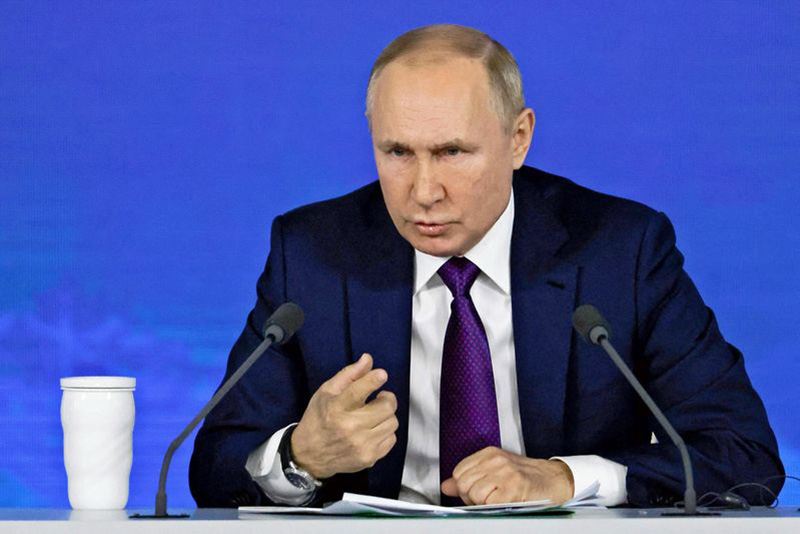
Russian President Vladimir Putin speaks during a press conference in Moscow on Dec. 23.
15:33 JST, December 27, 2021
MOSCOW — The Soviet Union, which in the decades following World War II was a global superpower alongside the United States, ended on Dec. 25, 1991.
Just 30 years later, Russian President Vladimir Putin and his administration are making risky bets to try to restore the Kremlin’s influence on nations formerly in the Soviet bloc, with Russia’s military power in the background.
Putin reiterated his position, during an annual year-end press conference in Moscow on Dec. 23, that he would not accept Ukraine joining the North Atlantic Treaty Organization, emphasizing that Russia needed security guarantees.
Putin complained that the United States and NATO have not considered Russia an equal partner since the collapse of the Soviet Union.
“We remember … how you promised us in the 1990s that [NATO] would not move an inch to the east. You cheated us shamelessly: There have been five waves of NATO expansion,” Putin said.
Russia is in the midst of a major military buildup near its border with Ukraine. The United States and countries in Europe have warned that if Russia invades, they will impose harsh economic sanctions.
Putin justified putting military pressure on Ukraine at the press conference, saying Ukrainian government forces are preparing for military action against the pro-Russian armed groups that effectively control eastern Ukraine.
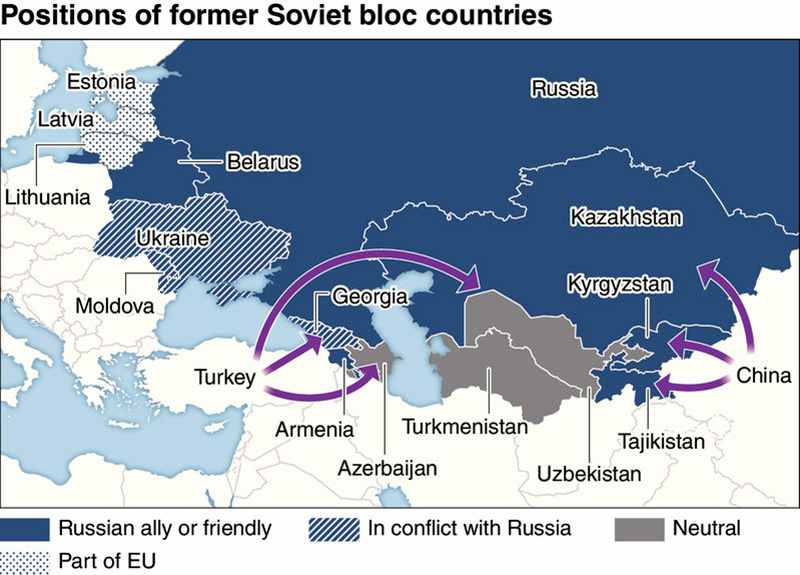
Russia annexed in 2014 the Crimean Peninsula in southern Ukraine, which is important to Russia with respect to its ethnic origins, and Russia believes it has the right to stop Ukraine from joining NATO.
Putin has also started calling NATO’s moves to bolster military support to Ukraine “a red line.”
A week earlier, on Dec. 17, the Putin administration demanded in a draft treaty it wants with the United States and NATO guarantees of Russia’s security. The demands included not allowing any more former Soviet bloc nations join NATO, nor should NATO conduct any military activities in these nations.
Being a nuclear power on par with the United States, Moscow said Washington should not deploy nuclear weapons outside its own borders and demanded it remove its nuclear weapons from Europe.
Non-NATO member Russia making statements on NATO policy is closely aligned to Putin’s perception of history. He has described the collapse of the Soviet Union as a “tragedy.”
Putin became president in 2000 and is seen as having brought stability to Russia with a strong hand during a period of disorder following the collapse of the Soviet Union.
He has already been in power for more than 20 years, and a constitutional amendment last year makes it possible for him to remain in the presidency for up to 36 years.
American experts on Russia believe Putin sees putting Ukraine under permanent Russian influence as his “mission.”
Struggle for influence
Behind Putin’s eagerness to secure influence over former Soviet bloc countries is deep concern about the growing presence of China, which along with the United States and some European nations is overwhelmingly more economically powerful than Russia.
The Union of Soviet Socialist Republics, the world’s first socialist nation, was established in 1922 after the Russian Revolution of 1917.
With a population of about 286 million people in a 1989 census and the world’s largest land area, the USSR struggled for hegemony with the United States during the Cold War after World War II.
When the USSR collapsed in 1991, the union split into 15 nations. Russia’s current gross domestic product is eleventh in the world, just behind South Korea.
Of the 15 countries that came out of the USSR, three Baltic states — Estonia, Latvia and Lithuania — chose not to participate in the Commonwealth of Independent States, which was established as a kind of successor to the Soviet Union, and instead joined the European Union and NATO in 2004.
Russia wants to prevent its neighbors from “going over to Europe” and has supported separatist movements in Ukraine, Georgia and Moldova, which have many ethnic Russian residents.
A Russian-led military alliance called the Collective Security Treaty Organization counts among its members Belarus, which has drawn closer to Russia since a presidential election last summer, as well as Armenia, Kazakhstan, Kyrgyzstan and Tajikistan.
China, which is often aligned with Russia against the United States and Europe, is increasing its influence in Central Asia through economic partnerships.
Turkey has also extended its presence in culturally similar areas like Azerbaijan and Central Asia, creating a complex struggle for influence.




Most Read
Popular articles in the past 24 hours
-
Japanese High School Student Aims to Share Kaiten History Through...
-
PM Takaichi Spells out Plans to Advance Bold Policy Shifts in Spe...
-
Chronic Issues Erode Thailand’s Economy as Political Confusion Pe...
-

Japanese Version of Shohei Ohtani's Picture Book Published
-
Tottori: 95-Year-Old Japanese Descendent from Philippines Visits ...
-
Japan to Monitor Trump Administration's Response to U.S. Supreme ...
-

Milano Cortina 2026: Speed Skater Takagi Finishes 6th in the 1,50...
-
Osaka: 40 Ninjas Display Shuriken Throwing Skills at Japan Champi...
Popular articles in the past week
-

Japan PM Takaichi’s Cabinet Resigns en Masse
-

Man Infected with Measles Reportedly Dined at Restaurant in Tokyo...
-

Sanae Takaichi Elected Prime Minister of Japan; Keeps All Cabinet...
-

Japan's Govt to Submit Road Map for Growth Strategy in March, PM ...
-

Bus Carrying 40 Passengers Catches Fire on Chuo Expressway; All E...
-

Milano Cortina 2026: Figure Skaters Riku Miura, Ryuichi Kihara Pa...
-

Japan, U.S. Name 3 Inaugural Investment Projects; Reached Agreeme...
-
U.S. Firm to Build Training Hub in Fukushima N-plant for Debris R...
Popular articles in the past month
-
Japan PM Takaichi’s Cabinet Resigns en Masse
-

Japan Institute to Use Domestic Commercial Optical Lattice Clock ...
-

Israeli Ambassador to Japan Speaks about Japan’s Role in the Reco...
-
Man Infected with Measles Reportedly Dined at Restaurant in Tokyo...
-

Videos Plagiarized, Reposted with False Subtitles Claiming ‘Ryuky...
-

Man Infected with Measles May Have Come in Contact with Many Peop...
-

Prudential Life Insurance Plans to Fully Compensate for Damages C...
-

Woman with Measles Visited Hospital in Tokyo Multiple Times Befor...
Top Articles in World
-
Israeli Ambassador to Japan Speaks about Japan’s Role in the Reconstruction of Gaza
-
Videos Plagiarized, Reposted with False Subtitles Claiming ‘Ryukyu Belongs to China’; Anti-China False Information Also Posted in Japan
-
North Korea Possibly Launches Ballistic Missile
-
Chinese Embassy in Japan Reiterates Call for Chinese People to Refrain from Traveling to Japan; Call Comes in Wake of ¥400 Mil. Robbery
-
Russia: Visa Required for Visiting Graves in Northern Territories, Lifting of Sanctions Also Necessary
JN ACCESS RANKING
-
Japan PM Takaichi’s Cabinet Resigns en Masse
-
Japan Institute to Use Domestic Commercial Optical Lattice Clock to Set Japan Standard Time
-
Israeli Ambassador to Japan Speaks about Japan’s Role in the Reconstruction of Gaza
-
Man Infected with Measles Reportedly Dined at Restaurant in Tokyo Station
-
Videos Plagiarized, Reposted with False Subtitles Claiming ‘Ryukyu Belongs to China’; Anti-China False Information Also Posted in Japan