
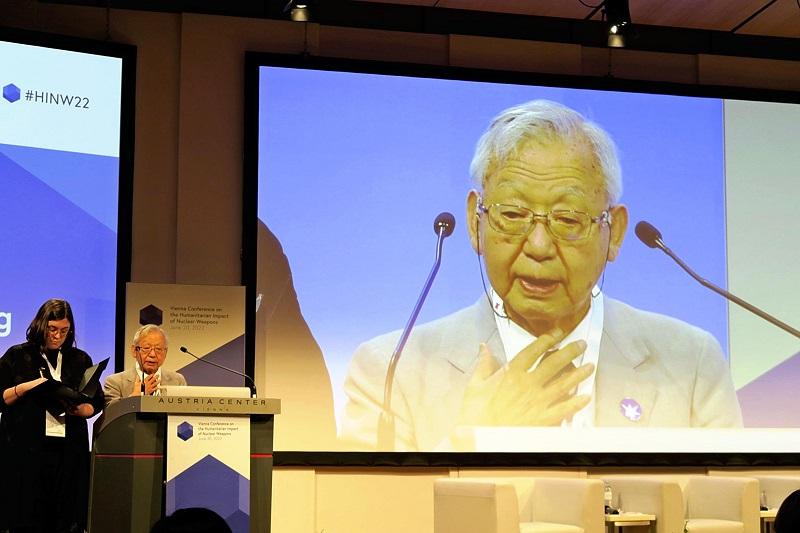
Atomic bomb survivor Sueichi Kido delivers a speech in Vienna on Monday.
14:25 JST, June 21, 2022
VIENNA — Atomic bombs are “absolute evil” and inhumane, an 82-year-old Japanese survivor of the 1945 U.S. atomic bombing of Nagasaki said Monday in a speech delivered at an international conference hosted by the Austrian government in Vienna.
“The atomic bomb is a weapon of absolute evil that does not even allow us to live as human beings,” said Sueichi Kido, secretary general of Nihon Hidankyo, the Japan Confederation of A- and H-Bomb Sufferers Organizations.
Kido was part of a Japanese government delegation taking part in the 2022 Vienna Conference on the Humanitarian Impact of Nuclear Weapons, held amid growing concerns that Russia might use nuclear weapons in its invasion of Ukraine.
The conference was scheduled ahead of the first meeting of parties to the U.N. Treaty on the Prohibition of Nuclear Weapons, which is also being held in Vienna from Tuesday through Thursday. Japan and the nuclear powers including the United States are not parties to the treaty.
Reflecting on his own experience, Kido emphasized the horror of the nuclear weapon that devastated and claimed the lives of so many people.
Kido was 5 on Aug. 9, 1945, when the United States dropped its second atomic bomb, this time on Nagasaki. The first was dropped on Hiroshima on Aug. 6. Kido was in front of his house in Nagasaki, about 2 kilometers from the hypocenter. Heat rays burned half his face. There were many charred bodies in devastated fields while survivors walked in a daze in search of water.
Shortly after, Kido suffered from high fever and pain in his gums, which he learned later had been acute symptoms of radiation exposure. After he entered a university outside Nagasaki Prefecture, he did not tell others that he was a hibakusha atomic bomb survivor due to fears of discrimination and prejudice.
His turning point arrived in 1990 when he took part in a meeting of hibakusha held in Gifu Prefecture, where he now lives. More than 100 people participated in the meeting and complained about physical and mental disorders caused by radiation exposure. There, Kido decided to squarely face the issue of atomic bombs as a member of the last generation to remember the bombing.
Many atomic bomb survivors at the time, including the late Senji Yamaguchi, revealed the parts of their bodies burned by heat and called for the elimination of nuclear weapons around the world. Their hope was that nobody would go through the hell they had suffered. Their efforts bore fruit when the Treaty on the Prohibition of Nuclear Weapons entered into force in January 2021.
This February, however, Russia invaded Ukraine and threatened the use of nuclear weapons. Along with resentment, Kido felt a fear of the possibility that the horrors of Aug. 9, 1945, would be repeated.
Kido has reached an advanced age and suffers from ill health, but he delivered his speech in Japanese on Monday for the sake of his fellow hibakusha.
“The treaty embodies the aspirations of hibakusha,” Kido said, adding that he hoped for the meeting’s success.
With the situation of Ukraine in mind, Kido concluded his speech by saying: “Hibakusha do not call for the use of force to counter force. Dialogue is the most important thing.”






Most Read
Popular articles in the past 24 hours
-

Lady Bess: Iroha Okuda, Mayuko Kominami Discuss Performing Elizab...
-

Japan Considering Taking Part in U.S. ‘Golden Dome’ Defense Syste...
-

Japan's TEPCO Releases Footage from Fukushima N-Plant Reactor
-

Oil Reserve Releases: G7 Members Unite against Growing Threat
-

46 Evacuated from UAE, Oman on Japanese Govt-chartered Flight
-

Japan's Sanyo Shinkansen Suspended Again; Between Okayama, Aioi S...
-
Driver Dies in Collision with Express Train at Crossing in Mito; ...
-

Paw Patrol: Larry Marks 15 Years at 10 Downing Street
Popular articles in the past week
-
Japan Figure Skating Legend Yuzuru Hanyu Is Proud Disaster Surviv...
-

Nippon Life Insurance's U.S. Arm Sues OpenAI Over Legal Assistanc...
-
Govt to Utilize ODA for Ensuring Economic Security; Securing Ener...
-
15 Measles Patients Confirmed in Tokyo in Past 6 Days; 1 May Have...
-
Massive Sewer Pipe Found Jutting Out of Highway in Osaka
-
Japan Govt to Tighten Requirements to Receive Permanent Residency...
-

Beckoning Cats Get Makeover to Fit Modern Lifestyles with Sleek D...
-
Japan's 2nd Round of U.S. Investments May Be Worth Over $100 Bill...
Popular articles in the past month
-

Producer Behind Pop Group XG Arrested for Cocaine Possession
-

Japan PM Takaichi’s Cabinet Resigns en Masse
-

Man Infected with Measles Reportedly Dined at Restaurant in Tokyo...
-

Videos Plagiarized, Reposted with False Subtitles Claiming ‘Ryuky...
-
Japan Figure Skating Legend Yuzuru Hanyu Is Proud Disaster Surviv...
-

iPS Treatments Pass Key Milestone, but Broader Applications Far f...
-

Sanae Takaichi Elected Prime Minister of Japan; Keeps All Cabinet...
-

Nepal Bus Crash Kills 19 People, Injures 25 Including One Japanes...
Top Articles in World
-
Videos Plagiarized, Reposted with False Subtitles Claiming ‘Ryukyu Belongs to China’; Anti-China False Information Also Posted in Japan
-
Nepal Bus Crash Kills 19 People, Injures 25 Including One Japanese National
-

South Korea Tightens Rules on Foreigners Buying Homes in Seoul Metro Area
-
Govt to Utilize ODA for Ensuring Economic Security; Securing Energy, Critical Minerals Sought
-

Ukrainian Ambassador Closely Watching Japan’s Revision of Defense Export Rules, Hopes for Future Arms Support
JN ACCESS RANKING
-
Producer Behind Pop Group XG Arrested for Cocaine Possession
-
Japan PM Takaichi’s Cabinet Resigns en Masse
-
Man Infected with Measles Reportedly Dined at Restaurant in Tokyo Station
-
Videos Plagiarized, Reposted with False Subtitles Claiming ‘Ryukyu Belongs to China’; Anti-China False Information Also Posted in Japan
-
Japan Figure Skating Legend Yuzuru Hanyu Is Proud Disaster Survivor and Gold Medalist, Vows to Continue Support Efforts