
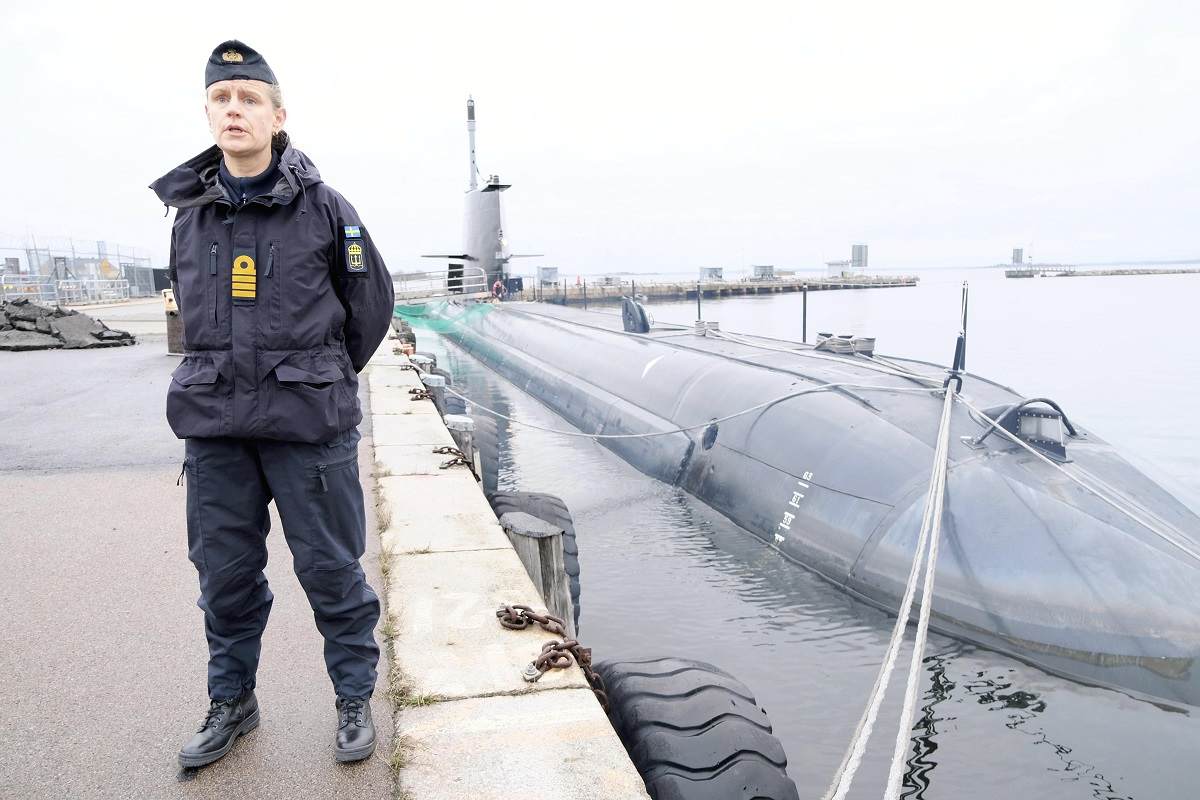
Swedish Navy Flotilla Commander Paula Wallenburg stands beside a Gotland-class submarine at the military port in Karlskrona, southern Sweden, on Dec. 12.
2:00 JST, January 30, 2024
KARLSKRONA, Sweden — With Sweden’s entry into the North Atlantic Treaty Organization nearing, a jet-black submarine, which will be on the front line of efforts to deter Russia, is quietly ready for departure from the naval base in Karlskrona, southern Sweden.
On a recent day, I visited the Gotland-class submarine, stationed beside the quay in the Baltic Sea. I descended the ladder from the deck and proceeded to the rear of the underwater craft through a narrow passage. Near the aft end of the 60-meter-long submarine was a mass of steel on both sides of the passage.
The logo of Swedish heavy industry giant Saab was engraved on the surface of the masses. They are part of the air-independent propulsion (AIP) system developed by Saab’s shipbuilding division, and are the heart of the submarine. The quiet engine system makes it difficult for AIP submarines to be detected by enemy vessels. It also allows the submarines to stay underwater for a long period of time.
An officer who guided me through the submarine said it can stay underwater for at least three weeks without resurfacing. The air around the system was slightly warm, and there was a thick, machine oil smell.
In 2005, the submarine participated in military exercises with U.S. forces and managed to score “attacks” on the USS Ronald Reagan, showcasing that the submarine was in a position to sink the U.S. aircraft carrier. If it had been real warfare, the submarine would have taken out an important enemy ship.
I told Swedish Navy Flotilla Commander Paula Wallenburg, “I heard you ‘sank’ Ronald Reagan.” She nodded and said, “Yes, many times.”
The Swedish Navy has three AIP-type submarines and will add two new ones in four years. This underwater force, known as squadron 1, is seen as the most important force Sweden will bring to NATO.
A map shown at the squadron’s headquarters in the port had numerous lines drawn along the Russian coast. NATO countries have restricted the passage of Russian goods since February last year when Russia’s aggression against Ukraine began, which has led to a sharp increase in maritime traffic.
I found that the Swedish Navy was within close enough distance to make one feel the heightened tensions on their skin.








Most Read
Popular articles in the past 24 hours
-

Voters Using AI to Choose Candidates in Japan's Upcoming General ...
-

Japan's Snow-Clad Beauty: Camellia Flowers Seen in Winter Bloom a...
-
Monkey Strikes Junior High School Girl from Behind in Japan's Yam...
-

Genichiro Inokuma's Mural in Ueno Station That Gave Hope in Postw...
-

Senior Japanese Citizens Return to University to Gain Knowledge, ...
-

Foreign and Security Policy: Political Parties Must Discuss How T...
-
Heavy Snow Linked to 30 Deaths across Japan since Late Jan.; JMA ...
-

Tokyo Police Arrest Head of Resignation Assistance Firm
Popular articles in the past week
-

Japan Institute to Use Domestic Commercial Optical Lattice Clock ...
-
Australian Woman Dies After Mishap on Ski Lift in Nagano Prefectu...
-

Foreign Snowboarder in Serious Condition After Hanging in Midair ...
-

Chinese Embassy in Japan Reiterates Call for Chinese People to Re...
-

Narita Airport, Startup in Japan Demonstrate Machine to Compress ...
-

Toyota Motor Group Firm to Sell Clean Energy Greenhouses for Stra...
-

Sakie Yokota, Last Surviving Parent of a North Korea Abductee, Ur...
-

Beer Yeast Helps Save Labor, Water Use in Growing Rice; Govt Hope...
Popular articles in the past month
-
Univ. in Japan, Tokyo-Based Startup to Develop Satellite for Disa...
-

JAL, ANA Cancel Flights During 3-day Holiday Weekend due to Blizz...
-

China Confirmed to Be Operating Drilling Vessel Near Japan-China ...
-

China Eyes Rare Earth Foothold in Malaysia to Maintain Dominance,...
-
M6.2 Earthquake Hits Japan's Tottori, Shimane Prefectures; No Tsu...
-
Japan Institute to Use Domestic Commercial Optical Lattice Clock ...
-
Japan, Qatar Ministers Agree on Need for Stable Energy Supplies; ...
-

Japan, Italy to Boost LNG Cooperation; Aimed at Diversifying Japa...
Top Articles in World
-
China Confirmed to Be Operating Drilling Vessel Near Japan-China Median Line
-
China Eyes Rare Earth Foothold in Malaysia to Maintain Dominance, Counter Japan, U.S.
-
Japan, Qatar Ministers Agree on Need for Stable Energy Supplies; Motegi, Qatari Prime Minister Al-Thani Affirm Commitment to Cooperation
-

North Korea Possibly Launches Ballistic Missile
-

10 Universities in Japan, South Korea, Mongolia to Establish Academic Community to Promote ICC Activities, Rule of Law
JN ACCESS RANKING
-
Univ. in Japan, Tokyo-Based Startup to Develop Satellite for Disaster Prevention Measures, Bears
-
JAL, ANA Cancel Flights During 3-day Holiday Weekend due to Blizzard
-
China Confirmed to Be Operating Drilling Vessel Near Japan-China Median Line
-
China Eyes Rare Earth Foothold in Malaysia to Maintain Dominance, Counter Japan, U.S.
-
Japan Institute to Use Domestic Commercial Optical Lattice Clock to Set Japan Standard Time