
Social Media and Elections: Outdated System / Surrogate Candidates Threaten Fairness of Japan’s Elections, Causing Local Govts to Lose Patience
17:44 JST, May 6, 2025
This is the fourth installment in a series that examines the challenges faced by the nation’s election system, which has been criticized as outdated.
***
“As a candidate, I will seek to be elected.”
This is the sort of oath that candidates running for the Tottori-Shimane constituency in the House of Councillors election this summer must now submit, after a decision by the joint election commission for Tottori and Shimane prefectures.
Though the oath seems to state the obvious, officials decided on the measure to prevent so-called double-horsepower campaigning, according to the commission’s director general.
In double-horsepower campaigning, candidates run in elections not to win, but to help another candidate secure victory.
The Public Offices Election Law limits the number of election campaign cars and flyers per candidate. Double-horsepower campaigning effectively doubles the amount of resources for a candidate, threatening the fairness of elections.
Swaying the Hyogo election
Double-horsepower campaigning was a prominent part of the Hyogo gubernatorial election in November, which was won by Gov. Motohiko Saito. The election was held after a whistleblower accused the governor of using his position to commit misconduct, such as harassment of others in the workplace, also called power harassment. The Hyogo prefectural assembly passed a no-confidence motion against Saito, who subsequently lost his position.
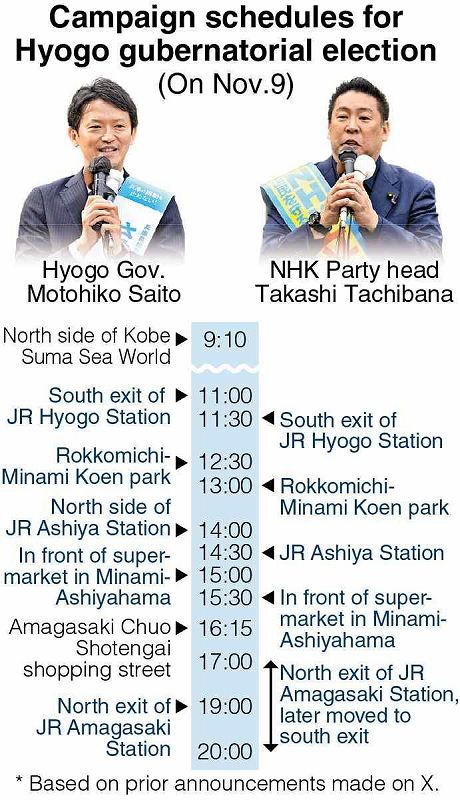
In the gubernatorial election that followed, Takashi Tachibana, leader of the NHK Party political group, became a candidate. “I will offer legally valid support for Mr. Saito,” he said.
After Saito would deliver a speech, Tachibana would show up and tell those still left in the audience that Saito had never requested gifts or engaged in power harassment, and that TV stations were attempting to brainwash people.
A third-party panel, which investigated the allegations against Saito, reported in March that it had found 10 cases of power harassment by the governor. Although the panel did not find any illegality in the alleged acceptance of gifts, it asserted that it was generally true that he had brought back many local products he received during his work trips.
In the latter half of the election campaign, from Nov. 8 to 16, Saito’s team posted advance notices on X about street canvassing at 40 locations. On eight of these days, Tachibana scheduled his election campaigning to take place at 16 locations that seemed to track Saito’s schedule. He was in Tokyo for one day to see Prime Minister Shigeru Ishiba, who was meeting with parliamentary groups in the Diet building.
“I wanted to know what was true about the allegations against Mr. Saito, and Mr. Tachibana gave me the answers,” said a woman in her 60s who supports the Hyogo governor.
On a given day during the campaign period, posts on X referring to Saito and Tachibana outnumbered by about 80% to 820% those referencing former Amagasaki City Mayor Kazumi Inamura, who was running against Saito, according to analysis by University of Tokyo Prof. Fujio Toriumi. On seven of the 17 days in the campaign period, posts touching on Tachibana alone exceeded those referring to Inamura.
“Tachibana is an influencer who has a large number of followers,” said a person who was close with the Inamura team. “I believe he significantly impacted the election results.”
Dubious legality
When Tachibana announced his candidacy for the Chiba gubernatorial election in March, he did not seek support for himself. Instead, he indicated he would back Gov. Toshihito Kumagai. But he withdrew because Kumagai said his support would be “unwelcome.”
During the election campaign, Tachibana gave roadside speeches outside Chiba Prefecture, such as in Hyogo and Osaka prefectures, and continued to relate his own theories about the problems in Hyogo Prefecture, which were unrelated to the gubernatorial election.
The Internal Affairs and Communications Ministry has noted that surrogate candidacies may be against the Public Offices Election Law, since it limits the number of election campaign cars and flyers per candidate. However, the law has no specific clause banning the practice, and it does not account for candidates not seeking to win themselves.
“Double-horsepower campaigning obviously harms the fairness of elections and poses serious problems,” said Prof. Airo Hino of Waseda University. “If elections continue to be conducted inappropriately, it will increase distrust in the electoral system. Effective countermeasures should be taken at the earliest possible stage.”
Slow to act
“We must move quickly to determine how election campaigns should be run, and do so in a way that will satisfy everyone,” Ishiba said in February as he answered a question at the Diet. At a meeting of the election campaigns council on April 1, ruling and opposition parties agreed to give top priority to discussing how to handle double-horsepower campaigning.
However, changes are not expected to be made in time for the upper house election this summer. As for the written oaths introduced in Tottori and Shimane prefectures, they are not legally binding.
“Individual constituencies shouldn’t have to do this,” said Shimane Gov. Tatsuya Maruyama at a news conference on April 22. “We’re forced to clean up the mess caused by the failure at the national level to establish an election system.”








Most Read
Popular articles in the past 24 hours
-

Japan Defense Agency to Develop AI Intelligence Analysis System f...
-

Moai Statue Shows Lasting Bond Between Miyagi Pref. Town, Easter ...
-

Milano Cortina 2026: Japan’s Oguri Wins Para Snowboard Silver at ...
-
Japan's Defense Ministry: North Korea Appears to Have Fired Balli...
-

Aichi Fisheries Cooperatives Use Smart Tech to Farm Triploid Oyst...
-
Teachers Support Students’ Inquiry Learning behind the Scenes
-

National Intelligence Council: Proposed Body Must Be Utilized To ...
-
Japan's Lower House Passes Budget Proposal; Could Be Delayed in U...
Popular articles in the past week
-

Japan Figure Skating Legend Yuzuru Hanyu Is Proud Disaster Surviv...
-

Govt to Utilize ODA for Ensuring Economic Security; Securing Ener...
-
15 Measles Patients Confirmed in Tokyo in Past 6 Days; 1 May Have...
-

Massive Sewer Pipe Found Jutting Out of Highway in Osaka
-

Japan Govt to Tighten Requirements to Receive Permanent Residency...
-
JR Tokai Breaks Ground on Yamanashi Maglev Station; Will Be Part ...
-

Beckoning Cats Get Makeover to Fit Modern Lifestyles with Sleek D...
-

Power Outage Forces About 980 Passengers in Yokohama to Walk to T...
Popular articles in the past month
-

Producer Behind Pop Group XG Arrested for Cocaine Possession
-

Japan PM Takaichi’s Cabinet Resigns en Masse
-

Man Infected with Measles Reportedly Dined at Restaurant in Tokyo...
-

Videos Plagiarized, Reposted with False Subtitles Claiming ‘Ryuky...
-
Japan Figure Skating Legend Yuzuru Hanyu Is Proud Disaster Surviv...
-

iPS Treatments Pass Key Milestone, but Broader Applications Far f...
-

Sanae Takaichi Elected Prime Minister of Japan; Keeps All Cabinet...
-

Nepal Bus Crash Kills 19 People, Injures 25 Including One Japanes...
Top Articles in Society
-
Producer Behind Pop Group XG Arrested for Cocaine Possession
-
Man Infected with Measles Reportedly Dined at Restaurant in Tokyo Station
-
15 Measles Patients Confirmed in Tokyo in Past 6 Days; 1 May Have Come into Contact with Many in Shibuya
-

Bus Carrying 40 Passengers Catches Fire on Chuo Expressway; All Evacuate Safely
-

Ibaraki Pref.’s 1st Foreign Bus Driver Hired in Tsukuba
JN ACCESS RANKING
-
Producer Behind Pop Group XG Arrested for Cocaine Possession
-
Japan PM Takaichi’s Cabinet Resigns en Masse
-
Man Infected with Measles Reportedly Dined at Restaurant in Tokyo Station
-
Videos Plagiarized, Reposted with False Subtitles Claiming ‘Ryukyu Belongs to China’; Anti-China False Information Also Posted in Japan
-
Japan Figure Skating Legend Yuzuru Hanyu Is Proud Disaster Survivor and Gold Medalist, Vows to Continue Support Efforts