
Examining Generative AI: Impact on Society / Generative AI Displays Misinformation at City Official Website; Towns Limit AI Services as Mistakes Creep in
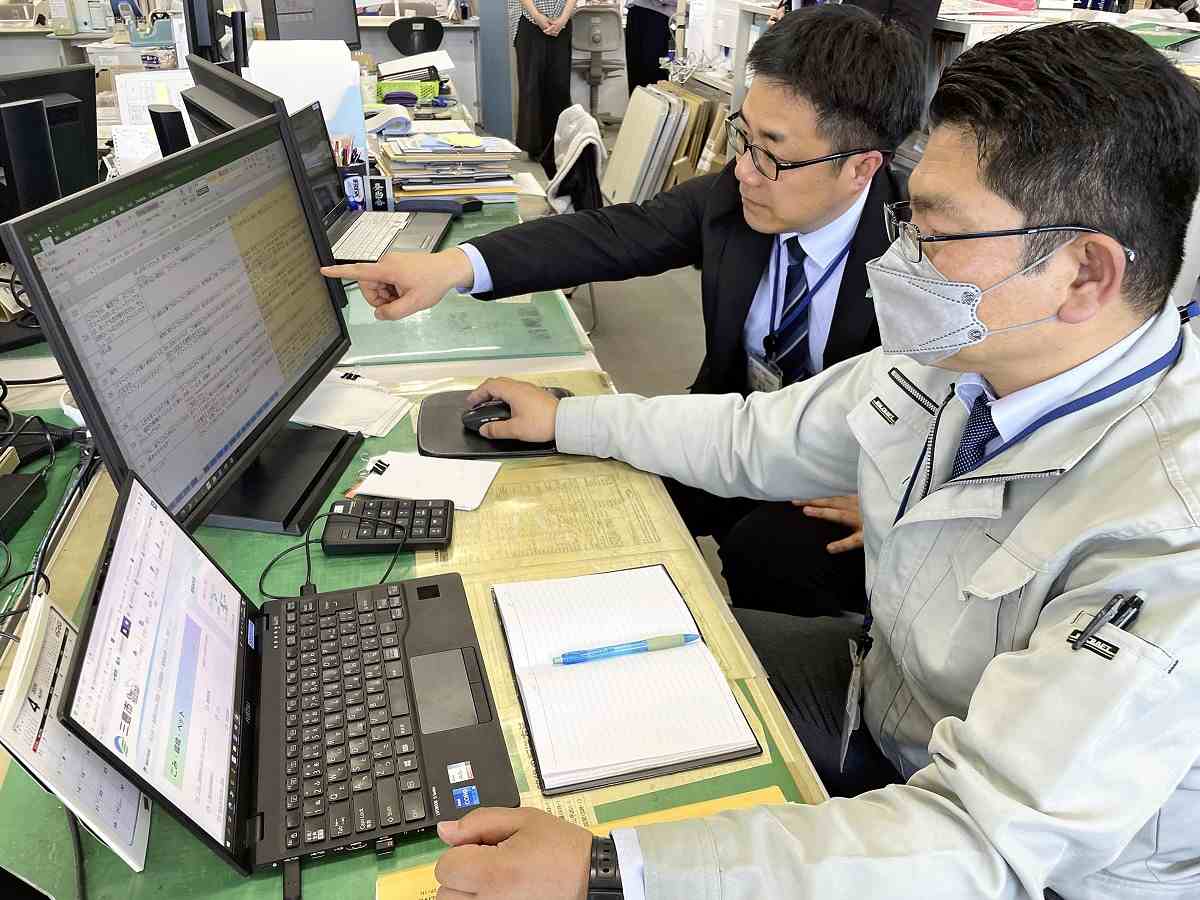
Takeshi Arawaki, left, and Eiji Okazaki, both employees of Mitoyo, Kagawa Prefecture, look back at the data of incorrect answers created by generative AI in Mitoyo, Kagawa Prefecture, on April 16.
6:00 JST, May 15, 2024
The use of generative AI has been rapidly expanding in various areas of society. While people place high expectations on generative AI to improve convenience, confusion caused by the negative impact of generative AI is spreading in people’s daily lives. This is the second installment of a series which explores issues and potential countermeasures in the fields of education, government, business, medicine and sport.
***
Last November, Eiji Okazaki, 51, a local government official, sighs as he looks at the computer screen in his city office in Mitoyo, Kagawa Prefecture, a city on the Seto Inland Sea home to thriving manufacturing and agricultural industries.
He is the assistant manager of the city’s environmental sanitation division.
His eyes are fixed on text generated by ChatGPT, an interactive artificial intelligence service that the city government is running as an experiment to demonstrate the service’s capabilities.
In an answer to a question about how to dispose of garbage, the chatbot made a mistake.
Asked about where to dispose of air conditioners and televisions, ChatGPT responded, “Contact the environmental sanitation division of the Kanonji city office.”
The answer should have been to contact the Mitoyo city government or to take the items to a recycling company in neighboring Kanonji. ChatGPT, however, mentioned a nonexistent Kanonji city government department.
He also found that ChatGPT falsely labeled plastic natto packets as “flammable waste.” When asked how to dispose of a cell phone battery, the instructions included a method that could have caused the battery to catch fire. These instructions only deepened Okazaki’s concerns.
In June last year, Mitoyo city government began experimenting with an inquiry system for garbage disposal in cooperation with the University of Tokyo laboratory specializing in generative AI.
The city, which has a population of more than 60,000, has recently seen an increase in residents who speak foreign languages, including technical intern trainees.
The inquiry system is expected to answer citizens’ questions about garbage disposal 24 hours a day in different languages. Hopes were high for the system to reduce the workload.
However, “wrong answers” became a major stumbling block. The city set a goal of 99% or higher accuracy. After training the AI on more than 4,000 questions, the rate of correct answers improved from the initial 63% to 94%, but that was as far as it could improve.
“It is difficult to further increase the percentage of correct answers with the current technology,” said a person at the laboratory in charge of the system.
In December of last year, the city decided not to fully implement the system because it feared the system would increase its employees’ workload, as incorrect information could lead to noncompliance with waste disposal regulations or an increase in inquiries.
“It’s the role of the administration to deliver accurate information. We decided it was too early to implement the system for citizens,” said Takeshi Arawaki, 49, who was then head of the city’s digital promotion office and is now director of the regional strategy section.
The city is now considering using AI for other tasks in cooperation with the University of Tokyo laboratory.
Generative AI is expected to improve work efficiency due to its ability to produce human-like sentences. However, one of the risks of using AI is that it sometimes gives incorrect answers.
Tobetsu, Hokkaido, a town with a population of about 15,200, installed ChatGPT on all 200 of its employees’ computers in October last year.
Improving work efficiency is a pressing concern for the town, as many local government staff hold multiple jobs.
The town has used ChatGPT to generate ideas and create meeting materials, and the amount of work required to summarize meetings minutes has been cut in half.
While aiming to introduce the system in services for its citizens, the town learned that Mitoyo had “given up” on ChatGPT.
“Making good use of generative AI is a way for the town to survive. I was shocked to learn that we wouldn’t be able to introduce the system for resident services if the percentage of correct answers isn’t high enough,” said Hirohisa Usui, 41, chief manager of the town’s digital promotion division. “We have to set our sights even higher.”
The town said it has been promoting the use of AI since spring by appointing “missionaries” who are familiar with digital technology at each department, but services for citizens have yet to materialize.
Akihira Yoshimoto, director of the Association for Promotion of Public Local Information and Communication, believes that “local governments are expected to face further staff shortages and heavier workloads due to the declining population, falling birthrate and aging society. The expectation for AI is more apparent in rural areas.”
Meanwhile, problems such as misinformation persist.
“Since some mistakes can be fatal with today’s technology, generative AI needs to be used in a limited way to assist the staff,” he said.






Most Read
Popular articles in the past 24 hours
-

McDonald's Japan Raises Prices; Big Mac to Cost ¥500, Double Chee...
-

Nepal Bus Crash Kills 19 People, Injures 25 Including One Japanes...
-

Japan’s Nikkei Stock Average Rises as AI-Related Stocks Shine; Co...
-

Aggression against Ukraine: Malignant Precedent Must Not Be Set t...
-

Joruri Bunraku Narrative Performed in Honor of Donald Keene by La...
-

Kanto's 1st Spring Wind Blows as Tokyo Sees Unseasonably High Tem...
-

How Keri Russell's Suede Coach Boots Ended up in My Closet
-

Early-Blooming Kawazu Cherry Blossoms Create Sea of Pink at Park ...
Popular articles in the past week
-

Producer Behind Pop Group XG Arrested for Cocaine Possession
-

Japan PM Takaichi’s Cabinet Resigns en Masse
-

Sanae Takaichi Elected Prime Minister of Japan; Keeps All Cabinet...
-

Japan's Govt to Submit Road Map for Growth Strategy in March, PM ...
-

Bus Carrying 40 Passengers Catches Fire on Chuo Expressway; All E...
-

Japan, U.S. Name 3 Inaugural Investment Projects; Reached Agreeme...
-

Riku-Ryu Pair Wins Gold Medal: Their Strong Bond Leads to Major C...
-

iPS Treatments Pass Key Milestone, but Broader Applications Far f...
Popular articles in the past month
-
Producer Behind Pop Group XG Arrested for Cocaine Possession
-
Japan PM Takaichi’s Cabinet Resigns en Masse
-

Japan Institute to Use Domestic Commercial Optical Lattice Clock ...
-

Man Infected with Measles Reportedly Dined at Restaurant in Tokyo...
-

Israeli Ambassador to Japan Speaks about Japan’s Role in the Reco...
-

Videos Plagiarized, Reposted with False Subtitles Claiming ‘Ryuky...
-

Man Infected with Measles May Have Come in Contact with Many Peop...
-

Prudential Life Insurance Plans to Fully Compensate for Damages C...
Top Articles in Society
-
Producer Behind Pop Group XG Arrested for Cocaine Possession
-
Man Infected with Measles Reportedly Dined at Restaurant in Tokyo Station
-
Man Infected with Measles May Have Come in Contact with Many People in Tokyo, Went to Store, Restaurant Around When Symptoms Emerged
-

Woman with Measles Visited Hospital in Tokyo Multiple Times Before Being Diagnosed with Disease
-

Australian Woman Dies After Mishap on Ski Lift in Nagano Prefecture
JN ACCESS RANKING
-
Producer Behind Pop Group XG Arrested for Cocaine Possession
-
Japan PM Takaichi’s Cabinet Resigns en Masse
-
Man Infected with Measles Reportedly Dined at Restaurant in Tokyo Station
-
Israeli Ambassador to Japan Speaks about Japan’s Role in the Reconstruction of Gaza
-
Videos Plagiarized, Reposted with False Subtitles Claiming ‘Ryukyu Belongs to China’; Anti-China False Information Also Posted in Japan