
13 Years Since the Great East Japan Earthquake / Decommissioning of Fukushima Nuclear Plant in 40 Years Seems Doubtful; Three Mile Island Cleanup to Take Nearly 60 Years
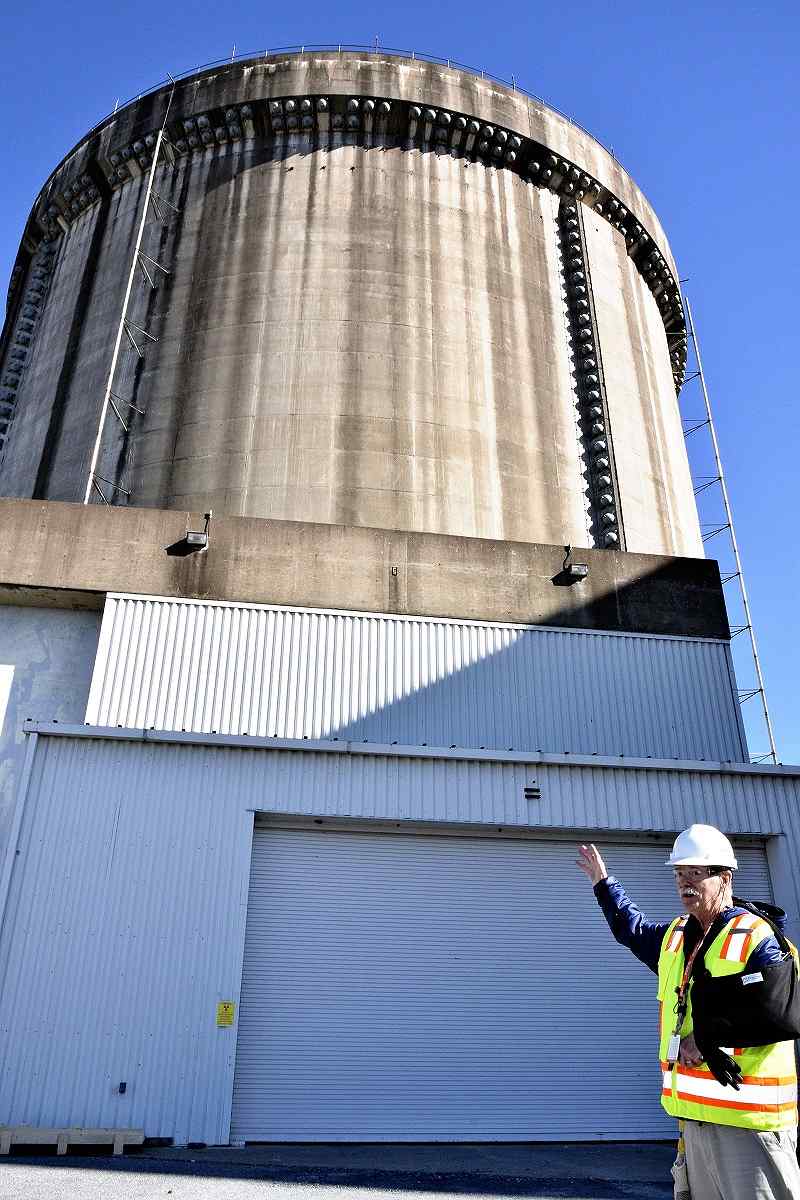
The No. 2 reactor building at the Three Mile Island nuclear station in Pennsylvania, where an accident occurred in March 1979, is seen in February this year.
21:00 JST, March 8, 2024
This is the fourth installment of a series that explores the current reality in areas affected by the 2011 Great East Japan Earthquake.
***
Huge cooling towers stand on an island in the Susquehanna River, which runs through the eastern U.S. state of Pennsylvania. The towers are part of the Three Mile Island nuclear station, which in 1979 became the site of the world’s first meltdown in a commercial nuclear reactor.
By 1990, 11 years after the accident, about 99% of the debris – including nuclear fuel that melted due to heat in the station’s No. 2 reactor – had been recovered and is now stored at a national laboratory in Idaho. The remaining 1% is highly radioactive and sits on the bottom of the reactor’s pressure vessel.
The job will only get harder from here, according to Frank Eppler of EnergySolutions, a U.S. company handling the decommissioning of the nuclear plant. Even if robots and other technologies are used to retrieve the debris, and the plan to demolish all the buildings and return the site to vacant land proceeds as scheduled, decommissioning is expected to be completed in 2037 — 58 years after the accident.
The progress made at Three Mile Island is very different from that at the Fukushima No. 1 nuclear power plant, which was operated by Tokyo Electric Power Company Holdings, Inc. Thirteen years after the accident triggered by the Great East Japan Earthquake on March 11, 2011, the debris inside the reactors there remains untouched.
Meltdowns occurred at three of the plant’s reactors, and debris broke through the pressure vessels and spread to the outer containment vessels. This debris, which includes pieces of the reactor structures, is estimated to total about 880 tons. Cleaning it up will be significantly more difficult than the operation in progress at Three Mile Island.
The government and TEPCO have indicated that decommissioning the Fukushima nuclear plant will be completed by 2051, which would be 40 years after the accident. However, experts are skeptical of this target. “I think achieving that will be difficult,” one expert said.
Developing the technologies needed to recover the debris also has been challenging. Initially, TEPCO planned to conduct a test to remove a few grams of debris from a reactor in 2021. However, completion of a 22-meter-long robotic arm has been delayed, and in January 2024 the removal plan was pushed back for a third time. TEPCO now aims to conduct this operation by around October using a fishing rod-type device that has a proven track record.
“This is a job that has never been done anywhere in the world,” explained Akira Ono, president of TEPCO’s Fukushima Daiichi Decontamination & Decommissioning Engineering Co. “We are making safety our top priority.”
In February, TEPCO made its first attempt to closely examine the inside of the No. 1 reactor by using a drone to take video. However, the plan was abandoned after a robot that was to transmit data stalled. No date for resuming the drone operation has been set, and problems continue to plague the robot.
Now that the difficulty of decommissioning the Fukushima plant is becoming more evident, calls from locals for a clearer explanation are growing louder. Since 2022, Waseda University Prof. Shunji Matsuoka, an expert on environmental economics and policy assessment, has regularly held discussions with local residents and others to talk about the nuclear plant’s decommissioning process and reconstruction of the region. How and where debris collected from the plant will be stored is still undecided. Given this, residents attending the meetings reportedly often complain that there is no clear vision for the region after the plant is decommissioned, and that TEPCO has not provided enough information.
In the years following the Three Mile Island accident, the U.S. Nuclear Regulatory Commission held 78 meetings with the public in the vicinity of the nuclear station. EnergySolutions also has held nine such meetings since 2021. Gaining the understanding of local residents is essential for decommissioning the nuclear station, according to Eppler.
Matsuoka shares this sentiment. “Decommissioning the Fukushima No. 1 nuclear power plant will take a long time. Accordingly, a flexible approach will be required, such as by adjusting the schedule at times,” Matsuoka said. “The government and TEPCO must continue steady efforts to hold dialogue with the region and society in general on this issue.”


Related Tags





Most Read
Popular articles in the past 24 hours
-

Moai Statue Shows Lasting Bond Between Miyagi Pref. Town, Easter ...
-

Milano Cortina 2026: Japan’s Oguri Wins Para Snowboard Silver at ...
-
Japan's Defense Ministry: North Korea Appears to Have Fired Balli...
-

National Intelligence Council: Proposed Body Must Be Utilized To ...
-
Aichi Fisheries Cooperatives Use Smart Tech to Farm Triploid Oyst...
-
Teachers Support Students’ Inquiry Learning behind the Scenes
-

Japan's Lower House Passes Budget Proposal; Could Be Delayed in U...
-

CARTOON OF THE DAY (March 14)
Popular articles in the past week
-

Japan Figure Skating Legend Yuzuru Hanyu Is Proud Disaster Surviv...
-
Govt to Utilize ODA for Ensuring Economic Security; Securing Ener...
-
15 Measles Patients Confirmed in Tokyo in Past 6 Days; 1 May Have...
-
Massive Sewer Pipe Found Jutting Out of Highway in Osaka
-

Japan Govt to Tighten Requirements to Receive Permanent Residency...
-
JR Tokai Breaks Ground on Yamanashi Maglev Station; Will Be Part ...
-
Power Outage Forces About 980 Passengers in Yokohama to Walk to T...
-

Beckoning Cats Get Makeover to Fit Modern Lifestyles with Sleek D...
Popular articles in the past month
-

Producer Behind Pop Group XG Arrested for Cocaine Possession
-

Japan PM Takaichi’s Cabinet Resigns en Masse
-

Man Infected with Measles Reportedly Dined at Restaurant in Tokyo...
-

Videos Plagiarized, Reposted with False Subtitles Claiming ‘Ryuky...
-
Japan Figure Skating Legend Yuzuru Hanyu Is Proud Disaster Surviv...
-

iPS Treatments Pass Key Milestone, but Broader Applications Far f...
-

Sanae Takaichi Elected Prime Minister of Japan; Keeps All Cabinet...
-

Nepal Bus Crash Kills 19 People, Injures 25 Including One Japanes...
Top Articles in Society
-
Producer Behind Pop Group XG Arrested for Cocaine Possession
-
Man Infected with Measles Reportedly Dined at Restaurant in Tokyo Station
-
15 Measles Patients Confirmed in Tokyo in Past 6 Days; 1 May Have Come into Contact with Many in Shibuya
-

Bus Carrying 40 Passengers Catches Fire on Chuo Expressway; All Evacuate Safely
-

Ibaraki Pref.’s 1st Foreign Bus Driver Hired in Tsukuba
JN ACCESS RANKING
-
Producer Behind Pop Group XG Arrested for Cocaine Possession
-
Japan PM Takaichi’s Cabinet Resigns en Masse
-
Man Infected with Measles Reportedly Dined at Restaurant in Tokyo Station
-
Videos Plagiarized, Reposted with False Subtitles Claiming ‘Ryukyu Belongs to China’; Anti-China False Information Also Posted in Japan
-
Japan Figure Skating Legend Yuzuru Hanyu Is Proud Disaster Survivor and Gold Medalist, Vows to Continue Support Efforts