
German Journalist Traces Footsteps of Great-Grandfather Who Was POW in Japan During World War I
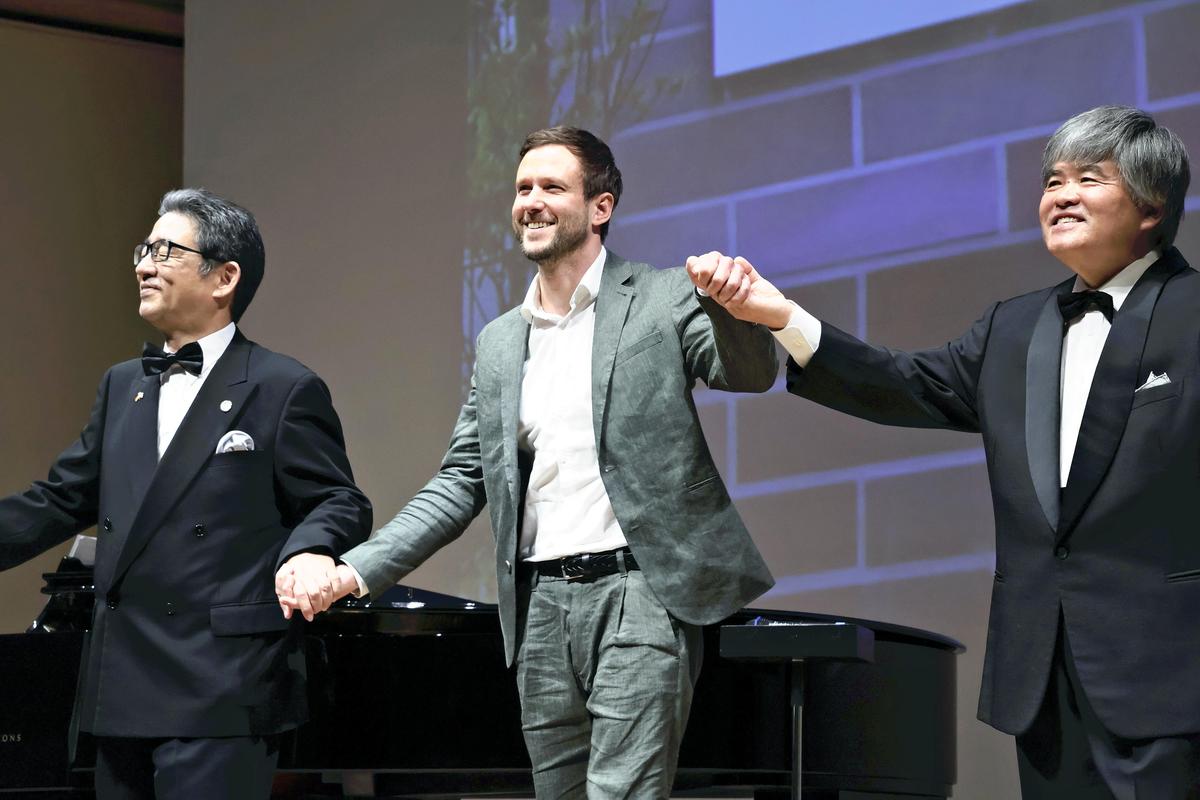
Tobias Oellig sings a song sung by his great-grandfather, Josef Oellig, at a concert in Narashino, Chiba Prefecture, in November 2025.
7:00 JST, March 15, 2026
CHIBA — A German journalist has been tracing the footsteps of his great-grandfather, who was a prisoner of war in Japan during World War I.
Tobias Oellig came to Japan late last year to visit Narashino, Chiba Prefecture, where the Narashino Prisoner-of-war Camp — a facility for German POWs who were enemies of Japan at the time — was located. Oellig’s great-grandfather, Josef Oellig, was held at the facility for a few years.
The driving force behind his visit to the city was his desire to find out how his great-grandfather spent his days in the camp and how he felt during his time as a POW. Oellig also hopes to share how people interacted during that period of time.
“My dear ones!” began a postcard Josef sent from Narashino to Germany in 1915. “My health is still excellent; I hope the same for you. When will we see each other again? … With warmest regards to you all, Your Josef.”
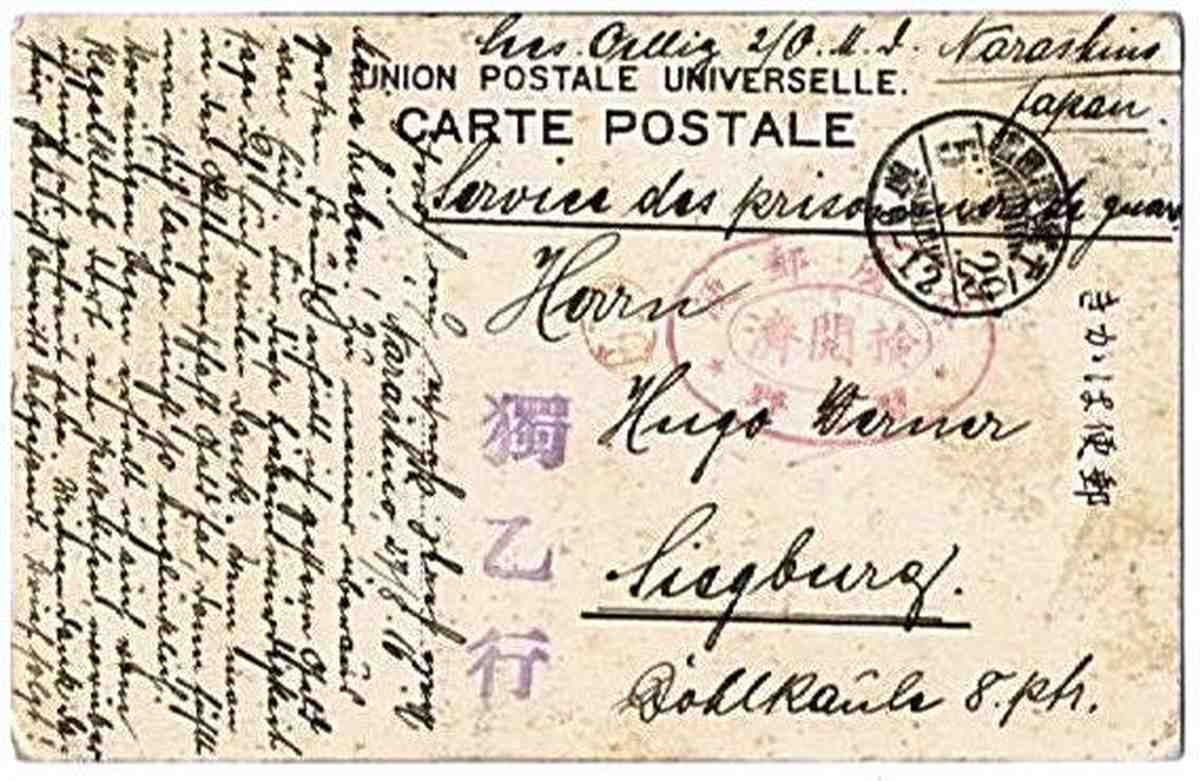
A postcard sent to Germany by Josef from the Narashino Prisoner-of-war Camp in Narashino, Chiba Prefecture
Concerned for his family and friends back home, Josef longed to hear from them.
Josef, a German solider, was captured by the then Japanese military in China’s Qingdao, which was controlled by Germany at the time. He was subsequently sent to the Narashino camp, where he spent 4½ years.
Oellig, 44, first learned about his great-grandfather’s past about a decade ago. His father told him that Josef was a solider who was captured on the battlefield in China before becoming a POW in Japan.
Oellig said that Japan felt very distant, both culturally and geographically.
“At that time, people didn’t travel that far. I found it interesting that at that age, he must have been in his 20s … someone took so long journey,” Oellig said. “That was very unusual.”
Josef died at the age of 90 in 1982.
Oellig became intrigued by his great-grandfather, who had passed away before he was old enough to remember. Oellig delved into books and materials to learn about German POWs and contacted university researchers, trying to trace Josef’s footsteps.
Two years after beginning his research, Oellig learned about the existence of the postcards Josef sent from Narashino to family and friends.
On one postcard, Josef wrote: “You must forgive me for writing so little. I only have one letter and one card available each month.” On another, he wrote: “To my great joy, I received money from you yesterday. For this kindness, I thank you very much. When you have money in captivity, you don’t feel nearly as unhappy!”
The postcards described his daily life in the POW camp, his gratitude for the money and supplies sent to him and the loneliness of being away from home in a foreign land.
Oellig said the postcards made it painfully clear how his great-grandfather must have felt.
“I could see his handwriting, see the stamps, everything on the postcard … That was really magical to receive these postcards,” said Oellig.
He became even more motivated to research his great-grandfather after reading the postcards.
Visits to Narashino
Oellig visited Narashino twice last year. He also visited the site of the former POW camp, which is now a park and a cemetery for German soldiers who never made it home.
His first visit was in September, the same month Josef was transferred to the camp.
“He experienced this heat, rain, and [saw] the same bird, saw the same tree, similar trees, and I was just trying to get a feel for what it was like to be there for five years,” Oellig said.
While researching historical materials in Japan and speaking with experts, Oellig learned that Josef was a member of a choir within the camp.
Last November, Oellig was invited to a concert featuring songs about Narashino’s history. He sang the same songs that Josef sang in those days.
Visiting the city allowed him to conduct literary research, but it was also an emotional experience for him.
“I can feel his presence and get a feel for the nature, the climate, the people … find out how he would have spent his time,” Oellig said.
Even after more than a century, dedicated local residents continue to pass down the history and memories of the POWs.
Oellig said he was “touched by all those Japanese people still holding the memory of this time,” adding, “They put so much effort in keeping this memory alive.”
“I [want to get] more details on how the life in Narashino for him was,” he said, especially about how Josef spent his daily life in the camp and what he thought about.
After the end of WWI, Josef returned home and served again in WWII.
Oellig plans to write an article about his great-grandfather in the future.
“At that time, Germany and Japan were enemies, but they really had some cultural exchange and some curiosity from each other, learning from each other and were treating each other well,” said Oellig. “It’s more a story of cultures inspiring each other than a story of war.”
***
POW camps served as places for cultural activities, interactions with residents
With the formation Anglo-Japanese Alliance, Japan fought with the Allies in World War I.
Camps were established in several places in the country for about 4,700 German prisoners of war.
POWs interacted with local residents, and cultural activities frequently took place in the camps. At the Bando Prisoner-of-war Camp in Tokushima Prefecture, POWs performed Beethoven’s Symphony No. 9 for the first time in Japan.
About 1,000 Germans were at the Narashino Prisoner-of-war Camp at its peak. They formed an orchestra, played soccer and tennis, and also went on field trips. Sausage-making techniques are said to have been introduced to Japan by POWs at the Narashino camp.
“Japan at that time strongly desired to be recognized as one of the top countries, so it abided by international law and treated POWs with respect,” said Masayuki Hoshi, 66, who researches the history of the Narashino camp.
Hoshi said: “Some Germans remained in Japan and continued their activities, contributing to the friendship between the two countries. I want to pass on such history to the next generation.”


Related Tags

Most Read
Popular articles in the past 24 hours
-

National Intelligence Council: Proposed Body Must Be Utilized To ...
-
Japan's Defense Ministry: North Korea Appears to Have Fired Balli...
-
Aichi Fisheries Cooperatives Use Smart Tech to Farm Triploid Oyst...
-

CARTOON OF THE DAY (March 14)
-
Japan's Lower House Passes Budget Proposal; Could Be Delayed in U...
-

Fukuoka: American Beavers at Japan's Zoo Create Sculptures; Visit...
-
Hyogo: Family in Japan Produces Traditional Charcoal to Help Pres...
-

Election Fraud in Tokyo’s Ota Ward: Use Incident As Catalyst for ...
Popular articles in the past week
-

Japan Figure Skating Legend Yuzuru Hanyu Is Proud Disaster Surviv...
-
Govt to Utilize ODA for Ensuring Economic Security; Securing Ener...
-
15 Measles Patients Confirmed in Tokyo in Past 6 Days; 1 May Have...
-

Massive Sewer Pipe Found Jutting Out of Highway in Osaka
-

Japan Govt to Tighten Requirements to Receive Permanent Residency...
-
JR Tokai Breaks Ground on Yamanashi Maglev Station; Will Be Part ...
-
Power Outage Forces About 980 Passengers in Yokohama to Walk to T...
-
Beckoning Cats Get Makeover to Fit Modern Lifestyles with Sleek D...
Popular articles in the past month
-

Producer Behind Pop Group XG Arrested for Cocaine Possession
-

Japan PM Takaichi’s Cabinet Resigns en Masse
-

Man Infected with Measles Reportedly Dined at Restaurant in Tokyo...
-
Japan Figure Skating Legend Yuzuru Hanyu Is Proud Disaster Surviv...
-

iPS Treatments Pass Key Milestone, but Broader Applications Far f...
-

Sanae Takaichi Elected Prime Minister of Japan; Keeps All Cabinet...
-

South Korea Tightens Rules on Foreigners Buying Homes in Seoul Me...
-

Nepal Bus Crash Kills 19 People, Injures 25 Including One Japanes...
Top Articles in Society
-
Producer Behind Pop Group XG Arrested for Cocaine Possession
-
Man Infected with Measles Reportedly Dined at Restaurant in Tokyo Station
-
15 Measles Patients Confirmed in Tokyo in Past 6 Days; 1 May Have Come into Contact with Many in Shibuya
-

Bus Carrying 40 Passengers Catches Fire on Chuo Expressway; All Evacuate Safely
-

Ibaraki Pref.’s 1st Foreign Bus Driver Hired in Tsukuba
JN ACCESS RANKING
-
Producer Behind Pop Group XG Arrested for Cocaine Possession
-
Japan PM Takaichi’s Cabinet Resigns en Masse
-
Man Infected with Measles Reportedly Dined at Restaurant in Tokyo Station
-
Japan Figure Skating Legend Yuzuru Hanyu Is Proud Disaster Survivor and Gold Medalist, Vows to Continue Support Efforts
-
iPS Treatments Pass Key Milestone, but Broader Applications Far from Guaranteed