
Decline of Working-Age Population Continues in 42 Coastal Municipalities across Mainly Iwate, Miyagi, Fukushima Prefs. in Japan

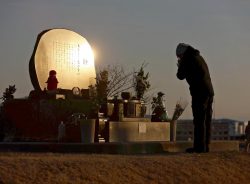
People visit a cenotaph for the 2011 Great East Japan Earthquake in Ishinomaki, Miyagi Prefecture, on Wednesday morning.
16:45 JST, March 11, 2026
Wednesday marked 15 years since the Great East Japan Earthquake. In 42 municipalities, mainly along the coasts of Iwate, Miyagi and Fukushima prefectures, the working-age population — those ages 15 to 64 — has declined. The rate of decline compared to pre-disaster levels has reached 17%, nearly double the national average.

While infrastructure has been rebuilt through reconstruction projects costing ¥42 trillion, residents have not returned, making regional sustainability a challenge.
The government’s reconstruction efforts from April will focus on Fukushima Prefecture, where the accident at Tokyo Electric Power Company Holdings, Inc.’s Fukushima No.1 nuclear power plant occurred, but the paths for decommissioning the plant and final disposal of soil removed from the contaminated areas remain unclear.
You may also like to read
Fukushima Towns Only Back to 20% of Population Before Nuclear Disaster Kesennuma, Miyagi Pref., Locals Raise Carp Streamers as Symbol of Courage; City Hopes to Demonstrate Recovery on 15th Anniversary of TsunamiAccording to basic resident registers for January to February and other data, the total population across 42 municipalities, including areas near the nuclear plant, was about 2.3 million. This represents a decrease of roughly 264,100 people, or 11%, from pre-disaster levels.
The working-age population declined in all municipalities except Natori, Miyagi Prefecture, while the population age 65 and over increased by nearly 20% across all 42 municipalities. Primarily in Fukushima Prefecture, where difficult-to-return zones still exist, 26,281 people still remain evacuated.
The special demand created by the reconstruction efforts has ended, and industries like construction suffer from declining orders. The fishing industry, a key local industry, has not returned to pre-disaster levels. According to Tokyo Shoko Research, Ltd., disaster-related bankruptcies in the three prefectures exceed 430 cases.
Amid the ongoing population decline, maintaining infrastructure has become a heavy burden for municipalities. An official of Kesennuma city government in Miyagi Prefecture, which has about 2,000 public housing units for disaster victims, said, “We may need to consider consolidation or selling them to the private sector in the future.”
The government will focus intensively on Fukushima’s recovery during the five-year period from April. However, progress remains slow on retrieving the estimated 880 tons of nuclear fuel debris generated by the nuclear accident.
In addition, no final disposal plan has been established for the approximately 14 million cubic meters of soil removed from the contaminated areas currently being stored.


Related Tags




Most Read
Popular articles in the past 24 hours
-

TEPCO's Rebuilding Still Far from Complete; Effects of 2011 Fukus...
-

G7 Agrees to Support Global Energy Supply Amid Soaring Oil Prices...
-

78% Interested in Reconstruction from 2011 Disaster; Concern High...
-

Fears of a Long Mideast War Drive Crude Oil Prices Skyward
-

2 Mt. Fuji Hikers Identified as Police Warn People Not to Climb i...
-

Japan’s Nikkei Stock Average Rise Lifted by AI Stocks, Easing Con...
-

Italy Shocks U.S. in World Baseball Classic Pool Game
-

Samurai Japan Routs Perky Czech Republic Team After Shuto, Muraka...
Popular articles in the past week
-

Ibaraki Pref.'s 1st Foreign Bus Driver Hired in Tsukuba
-
Govt to Utilize ODA for Ensuring Economic Security; Securing Ener...
-

Amid Strait of Hormuz Blockade, Shipping Companies Scramble to Ge...
-

Nippon Life Insurance's U.S. Arm Sues OpenAI Over Legal Assistanc...
-
Japan Govt Survey Finds Just 10% of Workers Want Working Hours to...
-

Japan's 2nd Round of U.S. Investments May Be Worth Over $100 Bill...
-

Imperial Family Watches World Baseball Classic Game Against Austr...
-

Beckoning Cats Get Makeover to Fit Modern Lifestyles with Sleek D...
Popular articles in the past month
-

Producer Behind Pop Group XG Arrested for Cocaine Possession
-

Japan PM Takaichi’s Cabinet Resigns en Masse
-

Man Infected with Measles Reportedly Dined at Restaurant in Tokyo...
-

Videos Plagiarized, Reposted with False Subtitles Claiming ‘Ryuky...
-

iPS Treatments Pass Key Milestone, but Broader Applications Far f...
-

Sanae Takaichi Elected Prime Minister of Japan; Keeps All Cabinet...
-

Nepal Bus Crash Kills 19 People, Injures 25 Including One Japanes...
-

South Korea Tightens Rules on Foreigners Buying Homes in Seoul Me...
Top Articles in Society
-
Producer Behind Pop Group XG Arrested for Cocaine Possession
-
Man Infected with Measles Reportedly Dined at Restaurant in Tokyo Station
-

Bus Carrying 40 Passengers Catches Fire on Chuo Expressway; All Evacuate Safely
-

Tokyo Skytree’s Elevator Stops, Trapping 20 People; All Rescued (Update 1)
-
Ibaraki Pref.’s 1st Foreign Bus Driver Hired in Tsukuba
JN ACCESS RANKING
-
Producer Behind Pop Group XG Arrested for Cocaine Possession
-
Japan PM Takaichi’s Cabinet Resigns en Masse
-
Man Infected with Measles Reportedly Dined at Restaurant in Tokyo Station
-
Videos Plagiarized, Reposted with False Subtitles Claiming ‘Ryukyu Belongs to China’; Anti-China False Information Also Posted in Japan
-
iPS Treatments Pass Key Milestone, but Broader Applications Far from Guaranteed