
Record Snowfall in Japan Causes Serious Agricultural Damage in Tohoku Region, Could Be Worse Than in Typical Years
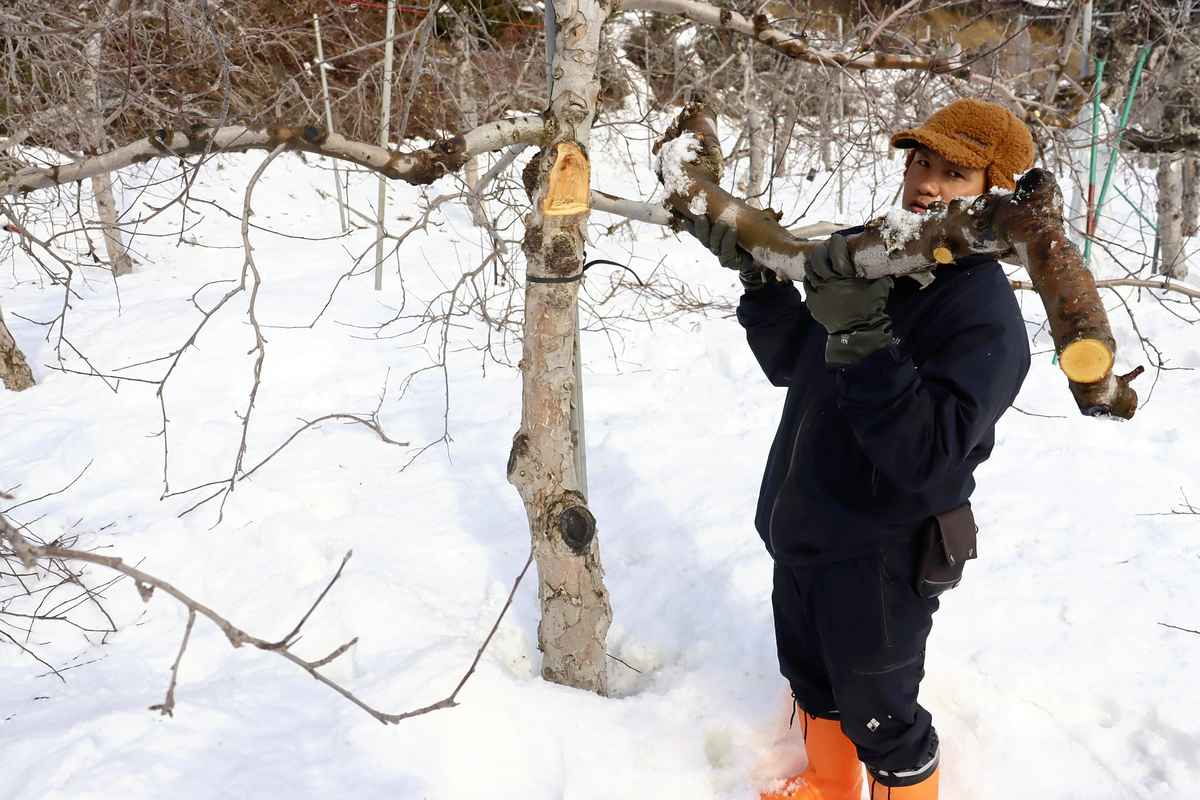
A farmer holds a branch that broke off an apple tree due to snow in Hirosaki, Aomori Prefecture, on Feb. 16. “This is useless,” he said.
2:00 JST, March 3, 2026
HIROSAKI, Aomori Pref./AKITA — This winter’s record snowfall that has hit the Tohoku region and Niigata Prefecture has caused serious agricultural damage such as breaking branches on fruit trees and causing vinyl greenhouses to collapse.
Because many farm roads remain buried in snow, confirming the extent of the damage done so far will take a long time, and it could be worse than in typical years.
“I can only sigh because more branches have been broken than last year,” a farmer said in mid-February while carefully digging up branches buried in the snow in an apple orchard in Hirosaki, Aomori Prefecture. In January, the city saw a record snowfall of 148 centimeters.
Last winter, broken branches on apple trees alone caused more than ¥20 billion in damage in the prefecture. The yield from his 5-hectare farm dropped by nearly 10 tonnes, down over 10% from typical years. Branches have been broken over a wide area this year, and he said, “I’m afraid this year’s yield will be lower than last year’s.”
In Kita-Akita, Akita Prefecture, where 160 centimeters of snow fell in the downtown area in January, about 70 structures such as vinyl greenhouses and coops for “Hinai Jidori” chickens suffered damage from heavy snowfall.
A vegetable farmer said 10 of his greenhouses, nearly half of the total, have been damaged. His spinach and kogomi ostrich fern plants have been left buried in the snow without being harvested, and his tractor is snowbound. He estimates the damage to be about ¥40 million.
“I’ve never seen snow like this before, and the surge in material prices makes it difficult to rebuild my greenhouses.” he said.
Niigata Prefecture, which has also seen heavy snowfall in some areas, has confirmed damage to about 190 agricultural facilities in nine municipalities in the prefecture as of Feb. 26.
In Hirosaki, the city usually begins to remove snow on farm roads in February, but it moved up the timing to the end of January. This winter, however, the city has not been able to handle the snow removal operations alone, so it secured a supplementary budget of ¥17.6 million to outsource some of the work to a construction company.
The Aomori municipal government moved up the start of snow removal on 84 kilometers of farm roads in the city to early January. However, operations on farm roads have been progressing slowly because of the need to remove snow on other roads used for daily life. Under such circumstances, the municipal government has not been able to assess the extent of agricultural damage.
“It has been snowing for a long period of time this season, and the damage from the snowfall may be greater than the previous year,” said an official of the Japan Agricultural Cooperative (JA) Aomori.
In Aomori Prefecture, experts instruct farmers on how to mitigate damage. According to Takahisa Kudo, 53, an engineer with the Aomori Apple Association, it is important to remove snow on trees in order to prevent branches and trunks from being broken by the weight of snow.
He has held seminars and study meetings this winter in various parts of the prefecture. He points out that, as snow repeatedly falls and melts, it becomes compressed, causing branches to break more easily.
“I hope snow will be removed from farm roads in the order of priority, while snow-melting agents should be used as quickly as possible,” he said.
Tomoyoshi Hirota, a professor of agricultural meteorology at Kyushu University, said, “Global warming has caused sea surface temperatures to rise, which creates an environment that allows heavy snowfall to occur easily.” Since it is difficult to predict when and where heavy snowfall will occur, he said, “It is necessary to reinforce greenhouses and take other damage mitigation measures while at the same time, the government should take measures to compensate farmers for damage.”



Most Read
Popular articles in the past 24 hours
-

Japanese Shipping Giants Halt Strait of Hormuz Transit as Iran Co...
-

U.S. Launches Attacks on Iran: Avoid Escalation of Conflict by An...
-
Sawtooth Roof Factory Stands as Monument to Ashikaga Textile Hist...
-
Parents of Japanese Teen Shot in U.S. Strive for Gun Control
-
Rental Lab Space in Tokyo Area More Than Doubles Since 2010, Offe...
-

Disinformation Spreads About Team Mirai, Ballot Readers; Online P...
-
Asahi Breweries to Stage Comeback with New Product in April; Comp...
-

Bank of Japan Deputy Governor Says Rate Hikes Likely to Continue
Popular articles in the past week
-

Nepal Bus Crash Kills 19 People, Injures 25 Including One Japanes...
-

Milano Cortina 2026: Japanese Gold Medalist Figure Skater Miura S...
-
Tokyo Spends Big on Children, Wins Over Parents
-

McDonald's Japan Raises Prices; Big Mac to Cost ¥500, Double Chee...
-

‘Dry Bonsai’ Gives New Life to Withered Trees, Allows Free Artist...
-

Japan’s Miura, Kihara Announce Withdrawal from Figure Skating Wor...
-

Exhibition Featuring Yoshiharu Tsuge’s Manga World Underway in Ch...
-

Yokohama to Test Out Renewable-Powered Offshore Floating Data Cen...
Popular articles in the past month
-

Producer Behind Pop Group XG Arrested for Cocaine Possession
-

Japan PM Takaichi’s Cabinet Resigns en Masse
-

Man Infected with Measles Reportedly Dined at Restaurant in Tokyo...
-

Israeli Ambassador to Japan Speaks about Japan’s Role in the Reco...
-

Videos Plagiarized, Reposted with False Subtitles Claiming ‘Ryuky...
-

Man Infected with Measles May Have Come in Contact with Many Peop...
-

Prudential Life Insurance Plans to Fully Compensate for Damages C...
-

Woman with Measles Visited Hospital in Tokyo Multiple Times Befor...
Top Articles in Society
-
Producer Behind Pop Group XG Arrested for Cocaine Possession
-
Man Infected with Measles Reportedly Dined at Restaurant in Tokyo Station
-
Man Infected with Measles May Have Come in Contact with Many People in Tokyo, Went to Store, Restaurant Around When Symptoms Emerged
-
Woman with Measles Visited Hospital in Tokyo Multiple Times Before Being Diagnosed with Disease
-

Bus Carrying 40 Passengers Catches Fire on Chuo Expressway; All Evacuate Safely
JN ACCESS RANKING
-
Producer Behind Pop Group XG Arrested for Cocaine Possession
-
Japan PM Takaichi’s Cabinet Resigns en Masse
-
Man Infected with Measles Reportedly Dined at Restaurant in Tokyo Station
-
Israeli Ambassador to Japan Speaks about Japan’s Role in the Reconstruction of Gaza
-
Videos Plagiarized, Reposted with False Subtitles Claiming ‘Ryukyu Belongs to China’; Anti-China False Information Also Posted in Japan